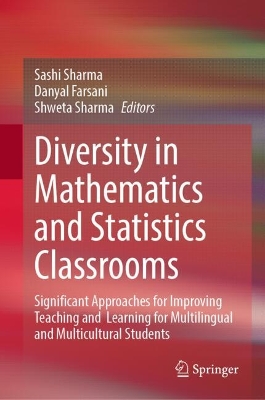
This book adopts a language- and culture -as-resource approach and broadens our understanding of diversity which may be observed, heard, and felt in today's mathematics and statistics classrooms. It draws on significant approaches to improving teaching and learning in mathematics and statistics education in multilingual and multicultural settings. It also presents and discusses critical research work from a range of geographical contexts from five continents. Research from Asia-Pacific contexts as well as from a few countries which are often underrepresented in the mathematics education research field is particularly highlighted in this book. This book summarizes the state of research in mathematics and statistics education providing empirical research, and showcases different theoretical and methodological perspectives, to inform implications for policy and practice in mathematics and statistics classrooms.
Reimagining diversity in mathematics and statistics classrooms.- The
need and possibilities for indigenising mathematics curricula for initial
teacher education for maori medium schools.- Connecting funds of knowledge
values and language to develop culturally sustaining mathematics pedagogy.-
Parochial probability perspectives.- Teaching secondary school mathematics
using examples benefits and challenges from a case study of teachers and
students in solomon islands.- Therapeutic decolonial research program in
mathematics education.- Examining mathematics education in multicultural
india from the perspective of policy directives.- Formation of pakistan as a
nation and education within the landscape of diversity of languages
considerations for equity and quality mathematics education.- What expertise
do teachers need to exploit the epistemic potential of multiple languages for
mathematics learning.- Fostering mathematical meaning making connecting out
of school mathematical knowledge and multilingual pedagogy.- A study on
teaching learning of mathematics in trilingual contexts.- Semiotic resources
in the linguistically diverse mathematics classroom.- Exploring mathematical
nonverbal interaction of l2 spanish speakers through spy cameras.- Teachers
and childrens speech genres in a new zealand multilingual primary mathematics
classroom.- Supporting the teaching and learning of statistics in
multilingual classrooms a collaborative study.- From the voices of five
immigrant students.- Envisioning diversity for weaving culture and language
in mathematics and statistics classrooms.- Implications for Policy and
Practice the debate on language of instruction.
Dr. Sashi Sharma is an associate professor at the Division of Education, University of Waikato, New Zealand. She is a mathematics educator who is employing a language-as-resource approach to increase the learning opportunities for all learners by focusing on mathematics/statistics and language development. As someone from a Pacific nation who has conducted research in the region, multilingualism is of personal importance as well as of strategic relevance. She has published extensively in the area of mathematics and statistics education. Her research interests span statistical literacy and lexical ambiguity in statistics.
Dr. Danyal Farsani is an associate professor of mathematics education and is interested in language particularly in the verbal, vocal, and visual forms of language. He has experienced teaching (and learning) mathematics in three different continents in five different countries (Iran, United Kingdom, Chile, Brazil, and Norway). Danyal has published various papers in educational, educational psychology, and educational technology journals concerning teaching and learning mathematics in multilingual and multicultural contexts.
Dr. Shweta Sharma is a lecturer and teacher educator at the University of Canterbury, New Zealand. She is interested in the role of language in mathematical meaning-making. Her thinking is largely influenced by Bakhtins Dialogic theory, which takes language use as social action. As a multilingual person and a primary teacher, she has experienced how language is not merely a tool for transferring knowledge, but rather an action of displaying and negotiating understandings. She is an emerging researcher with an active publication record.