Muutke küpsiste eelistusi

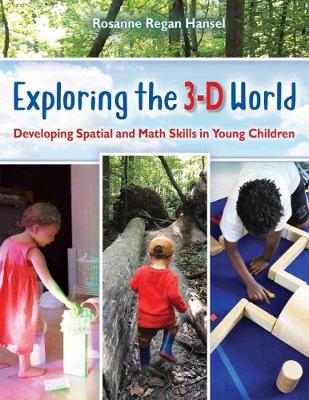
Exploring the 3-D World: Developing Spatial and Math Skills for Young Children [Pehme köide]

  • Formaat: Paperback / softback, 184 pages, kaal: 565 g
  • Ilmumisaeg: 10-Jun-2021
  • Kirjastus: Redleaf Press
  • ISBN-10: 1605546925
  • ISBN-13: 9781605546926
  • Pehme köide
  • Hind: 36,69 €*
  • * hind on lõplik, st. muud allahindlused enam ei rakendu
  • Tavahind: 43,17 €
  • Säästad 15%
  • Raamatu kohalejõudmiseks kirjastusest kulub orienteeruvalt 3-4 nädalat
  • Kogus:
  • Lisa ostukorvi
  • Tasuta tarne
  • Tellimisaeg 2-4 nädalat
  • Lisa soovinimekirja
  • Formaat: Paperback / softback, 184 pages, kaal: 565 g
  • Ilmumisaeg: 10-Jun-2021
  • Kirjastus: Redleaf Press
  • ISBN-10: 1605546925
  • ISBN-13: 9781605546926
"We live in a 3-D world, but many of our learning environments today offer few opportunities for three-dimensional exploration. Spatial reasoning is also integral to everyday life, in social studies, the arts, and geography as well as new careers like computer animation. Exploring the 3-D World will help early childhood teachers feel confident in implementing more mathematical and spatial concepts into their rooms"--

We live in a three-dimensional world, but many of our learning environments offer few opportunities for three-dimensional exploration and developing the spatial reasoning that is integral to everyday life and to closing the achievement gap.

Developing these skills in children will cultivate their curiosity, persistence, and intellectual capacity beyond the narrow definitions of academic achievement. Exploring the 3-D World covers
  • current research on the effectiveness of developing spatial skills in the early years
  • the essential components of playful exploration
  • key spatial skills that are important for children to learn
  • how visual representations such as displays of data, drawing, and documentation open new pathways to learning
  • vocabulary and conversation starters to expand learning
  • activities for families to try at home with recommended children’s books that reinforce the spatial skills introduced

  • The skills are accompanied with illustrated examples of activities taken from public preschool and kindergarten classrooms, private preschools and child care centers, and home settings.

    Help develop young children's spatial reasoning and math skills through play.
    Foreword ix
    Acknowledgments xi
    Introduction 1(6)
    Part One What We Know about Teaching Spatial Skills
    1 Definition and Rationale for Teaching Spatial Skills in the Early Years
    7(6)
    2 Strategies for Teaching Math and Spatial Skills
    13(16)
    Part Two Playful Explorations
    3 Essential Components of a Playful Exploration
    29(16)
    4 Geometric Shapes and Properties
    45(14)
    5 Patterns
    59(10)
    6 Transforming, Composing, and Decomposing
    69(16)
    7 Visualization and Visual-Spatial Working Memory
    85(10)
    8 Perspective Taking and Dimension Shifting
    95(8)
    9 Spatial Orientation
    103(14)
    10 Visual Representation
    117(20)
    References 137(8)
    Index 145
    Rosanne Regan Hansel has been both a teacher and administrator for a variety of early childhood programs. She was also the Early Childhood Specialist for the Math Science Partnership at Rutgers University and currently serves as the Education Program Development Specialist for the Department of Education. Ms. Hansel received her MS Ed in Early Childhood Leadership from Bank Street College of Education. She is the author of the award-winning book Creative Block Play.