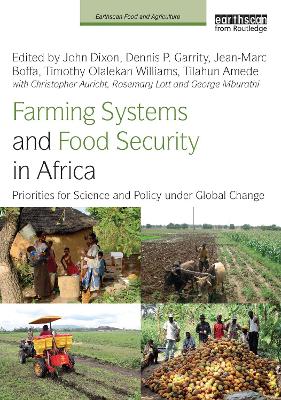
This book systematically and comprehensively describes and classifies the characteristics, trends, drivers of change and strategic priorities for each of thirteen African farming systems and their main subsystems.
Knowledge of Africa’s complex farming systems, set in their socio-economic and environmental context, is an essential ingredient to developing effective strategies for improving food and nutrition security.
This book systematically and comprehensively describes the characteristics, trends, drivers of change and strategic priorities for each of Africa’s fifteen farming systems and their main subsystems. It shows how a farming systems perspective can be used to identify pathways to household food security and poverty reduction, and how strategic interventions may need to differ from one farming system to another. In the analysis, emphasis is placed on understanding farming systems drivers of change, trends and strategic priorities for science and policy.
Illustrated with full-colour maps and photographs throughout, the volume provides a comprehensive and insightful analysis of Africa’s farming systems and pathways for the future to improve food and nutrition security. The book is an essential follow-up to the seminal work Farming Systems and Poverty by Dixon and colleagues for the Food and Agriculture Organization (FAO) of the United Nations and the World Bank, published in 2001.
Part I Introduction
1. Africa through the farming systems lens: context
and approach
2. Methods and data sources Part II Analysis of farming systems
3. Maize mixed farming system: an engine for rural growth and poverty
reduction
4. The agropastoral farming system: Achieving adaptation and
harnessing opportunities under duress
5. The highland perennial farming
system: Sustainable intensification and the limits of farm size
6. The Root
and Tuber Crop Farming System: diversity, complexity and productivity
potential
7. The cereal-root crop mixed farming system: a potential bread
basket transitioning to sustainable intensification
8. The highland mixed
farming system of Africa: diversifying livelihoods in fragile ecosystems
9.
The tree crop farming system in the humid lowlands of Africa: stagnation,
innovation and forest degradation
10. The pastoral farming system: Balancing
between tradition and transition
11. The fish-based farming system:
maintaining ecosystem health and flexible livelihood portfolios
12. The
forest-based farming system: highly diverse, annual and perennial systems
under threat
13. Large-scale irrigated farming system: The potential and
challenges to improve food security, livelihoods and ecosystem management
14.
The arid pastoral and oasis farming system: key centres for the development
of trans-Saharan economies
15. Perennial mixed and island farming systems:
exploiting synergies for maximum system productivity
16. Urban and peri-urban
farming systems: feeding cities and enhancing resilience Part III Synthesis
and conclusions
17. Farming and food systems potentials
18. Ways forward:
strategies for effective science, investments and policies for African
farming and food systems
19. Conclusions: implementation of the farming
systems approach for African food security
John Dixon is Principal Adviser Research & Program Manager, Cropping Systems and Economics, Australian Centre for International Agricultural Research (ACIAR), Canberra, Australia.
Dennis Garrity is Senior Fellow at the World Agroforestry Centre (ICRAF), based in Nairobi, Kenya, UNCCD Drylands Ambassador, and Chair of the EverGreen Agriculture Partnership.
Jean-Marc Boffa is Director of Terra Sana Projects and Associate Fellow of the World Agroforestry Centre (ICRAF), Nairobi, Kenya.
Timothy Olalekan Williams is Regional Director for Africa at the International Water Management Institute (IWMI), based in Accra, Ghana.
Tilahun Amede is Principal Scientist and Systems Agronomist at the International Crops Research Institute for Semi-Arid Tropics (ICRISAT), Nairobi, Kenya.
Christopher Auricht is Managing Director of Auricht Projects, a niche international consulting firm based in Adelaide, Australia.
Rosemary Lott is Director of Vegetation Connections Pty Ltd, and an Assistant Director, Australian Government Department of Agriculture, Canberra, Australia.
George Mburathi is a former FAO Deputy Regional Representative for Africa, Nairobi, Kenya.