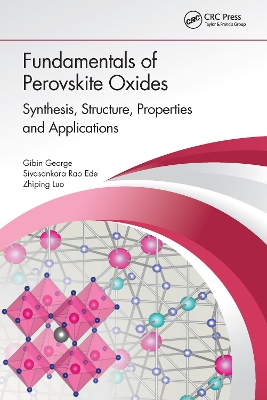
This textbook entitled Fundamentals of Perovskite Oxides: Synthesis, Structure, Properties and Applications summarizes the structure, synthesis routes, and potential applications of perovskite oxide materials. Since these perovskite-type ceramic materials offer opportunities in a wide range of fields of science and engineering, the chapters are broadly organized into four sections of perovskite-type oxide materials and technology.
- Covers recent developments in perovskite oxides
- Serves as a quick reference of perovskite oxides information
- Describes novel synthesis routes for nanostructured perovskites
- Discusses comprehensive details for various crystal structures, synthesis methods, properties, and applications
- Applies to academic education, scientific research, and industrial R&D for materials research in real-world applications like bioengineering, catalysis, energy conversion, energy storage, environmental engineering, and data storage and sensing
This book serves as a handy and practical guideline suitable for students, engineers, and researchers working with advanced ceramic materials.
This book summaries the structure, synthesis route, and potential applications of perovskite oxide materials. Since these perovskite-type ceramic materials offer wide opportunities in all fields of science and engineering, the chapters are broadly organized into four sections of perovskite-type oxide materials and technology.
1. Introduction to Perovskite
2. Synthesis of Perovskite Oxides
3. Crystal Structure of Simple Perovskites
4. Structural Variants of Perovskite Oxides
5. Magnetic Properties of Perovskite Oxides
6. Electronic Properties of Perovskite Oxides
7. Diffusion, Thermal, and Optical Properties of Perovskites
8. Applications of Perovskite Oxides
Appendix A1: Examples of Single Perovskites with the Structural Lattice
Parameters
Index
Dr. Gibin George is a Postdoctoral Fellow in the Department of Chemistry and Physics at Fayetteville State University, North Carolina. He was as an Assistant Professor in the Department of Mechanical Engineering at Jyothi Engineering College, Thrissur, India, before joining Fayetteville State University. Gibin completed his Ph.D. in 2015 from National Institute of Technology Karnataka, India. His research interest is in electrospinning, oxide nanomaterials for energy storage and production, and photoluminescence.
Dr. Sivasankara Rao Ede is a Postdoctoral Fellow in the Department of Chemistry and Physics at Fayetteville State University, North Carolina. S. R. Ede received his Ph.D. in 2018 from Central Electrohemial Research Intitute, Karaikudi, India. His research mainly focused on synthesis of perovskite oxide nanomaterials for energy conversion and energy storage.
Dr. Zhiping Luo is a Professor in Material Science in the Department of Chemistry and Physics at Fayetteville State University, North Carolina. He received a Ph.D. from Chinese Aeronautical Establishment in 1994, followed with postdoc research at Okayama University of Science, Japan. From 1998-2001, he worked at Argonne National Laboratory as a Visiting Scholar, with a promotion to Assistant Scientist; and from 2001-2012, he worked at Texas A&M University as a Research Scientist. Dr. Luo joined the current position in 2012 and established his research on the nanomaterials for energy-related applications. Dr. Luo has coauthored over 250 articles in peer-reviewed journals, and two books as a single author.