Muutke küpsiste eelistusi

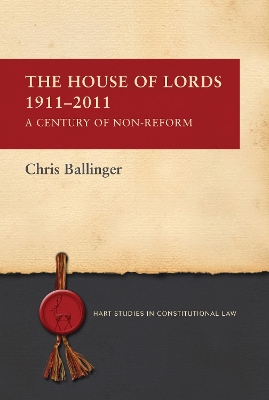
House of Lords 1911-2011: A Century of Non-Reform [Pehme köide]

  • Formaat: Paperback / softback, 264 pages, kõrgus x laius x paksus: 234x156x22 mm, kaal: 417 g
  • Sari: Hart Studies in Constitutional Law
  • Ilmumisaeg: 07-Aug-2014
  • Kirjastus: Hart Publishing
  • ISBN-10: 1849466602
  • ISBN-13: 9781849466608
Teised raamatud teemal:
  • Pehme köide
  • Hind: 31,60 €*
  • * hind on lõplik, st. muud allahindlused enam ei rakendu
  • Tavahind: 42,14 €
  • Säästad 25%
  • Raamatu kohalejõudmiseks kirjastusest kulub orienteeruvalt 3-4 nädalat
  • Kogus:
  • Lisa ostukorvi
  • Tasuta tarne
  • Tellimisaeg 2-4 nädalat
  • Lisa soovinimekirja
  • Formaat: Paperback / softback, 264 pages, kõrgus x laius x paksus: 234x156x22 mm, kaal: 417 g
  • Sari: Hart Studies in Constitutional Law
  • Ilmumisaeg: 07-Aug-2014
  • Kirjastus: Hart Publishing
  • ISBN-10: 1849466602
  • ISBN-13: 9781849466608
Teised raamatud teemal:
House of Lords reform is often characterised as unfinished business: a riddle that has been left unanswered since 1911. But rarely can an unanswered riddle have had so many answers offered, even though few have been accepted; indeed, when Viscount Cave was invited in the mid-1920s to lead a Cabinet committee on Lords reform, he complained of finding 'the ground covered by an embarrassing mass of proposals'.That embarrassing mass increased throughout the twentieth century. Much ink has been spilled on what should be done with the upper House of Parliament; much less ink has been expended on why reform has been so difficult to achieve.

This book analyses in detail the principal attempts to reform the House of Lords. Starting with the Parliament Act of 1911 the book examines the century of non-reform that followed, drawing upon substantial archival sources, many of which have been under-utilised until now. These sources challenge many of the existing understandings of the history of House of Lords reform and the reasons for success or failure of reform attempts. The book begins by arguing against the popular idea that the 1911 Act was intended by its supporters to be a temporary measure.


'No one peers included should be allowed to pronounce about the future of the House of Lords without reading Chris Ballinger's authoritative, shrewd and readable account about reform attempts over the past century. He punctures several widely-held myths and claims in the current debate.' Rt Hon Peter Riddell CBE Director, Institute for Government and former Hansard Society chair


'This is at once an impeccably researched academic study, and a thoroughly readable account loaded with lessons for today's would-be Lords reformers.' Lord (David) Lipsey

Arvustused

This excellent book examines House of Lords reform over the 100-year period following the 1911 Parliament Act..Ballinger is very good at contextualising each attempted reform in the immediate politics of the period when it was under development. -- Donald Shell * Public Law, No. 1/2014 * This work reflects an impressive depth of knowledge and research that is presented in a clear and disciplined writing style. Every chapter commences with arresting quotes that whet the appetite of the general reader as well as the specialist. A blizzard of complex data is made accessible through compression into a number of useful tables. Shrewd analysis challenges entrenched myths concerning House of Lords reform...This work offers much to attract political and legal historians. -- Thomas Mohr * Irish Jurist, 2013(2) * It would be an understatement to say that reform of the House of Lords (in its legislative capacity) is a holy grail of British politics. This book throws a vast amount of light on the reasons why so little has come of the various attempts at reform since the idea was first mooted more than a century ago. All the relevant arguments and controversies are addressed, comprehensively and competently. Anyone involved in the ongoing efforts at tackling this thorny issue could do worse than consult this book. * The Commonwealth Lawyer, Volume 22, No 2 * This is a remarkably good book: authoritative, insightful, shrewd, and eminently readable [ and] one that I cannot recommend highly enough...The quality of the book is underpinned not only by its scope but also by Chris Ballinger's in-depth, detailed analysis. It is further underpinned by the author's very apparent understanding of the totality of the topic, and especially of the nature and indeed changing nature of House of Lords reform over the years...something that is not always possible to say about those who write, let alone speak, on this topic...Quite clearly this book should be mandatory reading for anyone with any interest in the subject of the House of Lords...Certainly anyone either thinking about, or determined to embark upon, House of Lords reform in the future will be well served by having read and inwardly digested Chris Ballinger's study. -- Nicholas D.J. Baldwin * The Journal of Legislative Studies * Well researched, it is no dry academic treatise, but provides real insight into how and why all attempts at fundamental change have failed. -- Bob Hughes (Lord Hughes of Woodside) * Progress Online * The books covers each attempt at reform in remarkable detail, demonstrating the author's deep familiarity with the subject. The footnotes are a trove of information...It is to be hoped that at some point a second edition will cover these (and no doubt other) developments with the same elegance and mastery as Dr Ballinger demonstrates in this splendid book. Surely he is unrivalled in academia in his depth of knowledge of this subject. -- Nicolas Besly * The Table *

Acknowledgements vii
Tables
xiii
Introduction: Reform and Non-reform 1(14)
Reform and Non-reform
1(2)
A Century of Non-reform
3(1)
The Evolution of the House of Lords
4(7)
Twelve Instances of Reform and Non-reform
11(4)
1 Veto Limitation over Reform: The Parliament Act 1911
15(20)
The Political Situation, 1906--07
15(1)
Cabinet Discussions on Lords Reform, 1907
16(4)
Budget Rejection, 1909
20(3)
Between the 1910 Elections
23(5)
The Parliament Bill 1911
28(2)
Reform following Veto Limitation? 1911--14
30(1)
Conclusion
31(4)
2 `The Battle is Over': House of Lords Reform, 1917--45
35(16)
The Bryce Conference, 1917--18
35(4)
Cabinet Committees, 1921--22
39(4)
The Cabinet Committee, 1925--27
43(3)
Lords reform in the 1920s
46(1)
Avoiding Reform, 1928--45
46(5)
3 A Pre-emptive Strike: The Parliament Act 1949
51(24)
Labour and the House of Lords
52(2)
Moves Towards reform, 1943--47
54(2)
Nationalisation and House of Lords Reform
56(3)
The Parliament Bill 1947
59(5)
The Party Leaders' Conference 1948
64(5)
The Parliament Bill Resumed
69(2)
The Iron and Steel Bill
71(2)
Conclusion
73(2)
4 Diluting the Hereditary Principle?: The Life Peerages Act 1958
75(26)
Life Peers
77(1)
Inter-Party Discussions
77(4)
Discussions, 1953--55
81(2)
Limiting the Hereditaries: Proposals
83(2)
Wider Reform: The Cabinet Committee, 1955--56
85(2)
Short and Long Bills
87(6)
The Life Peerages Bill
93(1)
Limiting the Hereditary Peers
94(3)
Conclusion
97(4)
5 `The Wedgwood Benn Enabling Bill': The Peerage Act 1963
101(26)
A Hereditary Life Peerage
103(1)
Earlier Attempts at Renouncing Peerages
104(2)
The Persistent Commoner
106(1)
Fears over Loss of the Hereditary System
107(1)
Party Support for Benn
108(1)
The Committee of Privileges
109(1)
`Re-election'
110(3)
Seating the `Defeated' Candidate
113(1)
The Joint Select Committee
114(4)
The Peerage Bill
118(4)
Conclusion
122(5)
6 Adding to Wilson's Strife: The Inter-Party Conference and the Parliament (No 2) Bill [ 1968--69]
127(32)
Abandoning the Unilateral, Two-Stage Approach
131(2)
The Inter-Party Conference
133(4)
The Southern Rhodesia (United Nations Sanctions) Order 1968
137(3)
The White Paper and the Decision to Proceed with the Bill
140(2)
The Parliament (No 2) Bill
142(8)
Abandoning the Bill
150(3)
1970
153(1)
Conclusion
153(1)
Epilogue: House of Lords Reform, 1970--74
154(4)
After 1974
158(1)
7 Stage One of Two?: The House of Lords Act 1999
159(20)
Turning the Tide of Constitutional Reform
160(2)
John Smith's Leadership
162(1)
Tony Blair and House of Lords Reform
162(1)
Post-election 1997
163(1)
Priorities for the First Session
164(2)
The Cabinet Committee
166(3)
The Queen's Speech 1998
169(1)
The Weatherill Amendment: Origins
169(4)
The House of Lords Bill
173(1)
By-elections for Hereditary Peers
174(3)
Conclusion
177(2)
8 The Long Stage Two: The Wakeham Commission and Beyond
179(32)
The Royal Commission on the Reform of the House of Lords
179(10)
Follow-up to the Royals Commissions's Report
189(1)
2001--05: Indecision, then a Surprising Move on Reform
190(10)
Lords Reform in Labour's Third Term
200(4)
2010: General Election and Coalition Government
204(5)
Conclusion
209(2)
9 Reasons for Reform and Non-reform
211(10)
How and Why Does House of Lords Reform Reach the Cabinet's Agenda?
214(1)
How Do Proposals Change When Under Consideration?
215(1)
How and Why Do Proposals Succeed or Fail?
216(3)
Conclusion
219(2)
Further Reading 221(4)
Bibliography 225(16)
Index 241
Chris Ballinger is Academic Dean and Official Fellow of Exeter College, Oxford.