Muutke küpsiste eelistusi

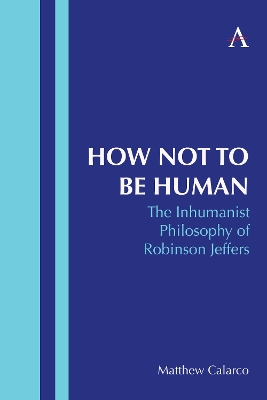
How Not to Be Human: The Inhumanist Philosophy of Robinson Jeffers [Pehme köide]

  • Formaat: Paperback / softback, 122 pages, kõrgus x laius x paksus: 229x153x8 mm, kaal: 175 g
  • Ilmumisaeg: 12-May-2026
  • Kirjastus: Anthem Press
  • ISBN-10: 1839999470
  • ISBN-13: 9781839999475
Teised raamatud teemal:
  • Pehme köide
  • Hind: 36,75 €
  • See raamat ei ole veel ilmunud. Raamatu kohalejõudmiseks kulub orienteeruvalt 3-4 nädalat peale raamatu väljaandmist.
  • Kogus:
  • Lisa ostukorvi
  • Tasuta tarne
  • Tellimisaeg 2-4 nädalat
  • Lisa soovinimekirja
  • Formaat: Paperback / softback, 122 pages, kõrgus x laius x paksus: 229x153x8 mm, kaal: 175 g
  • Ilmumisaeg: 12-May-2026
  • Kirjastus: Anthem Press
  • ISBN-10: 1839999470
  • ISBN-13: 9781839999475
Teised raamatud teemal:
Current debates in the environmental humanities, animal studies, and related fields increasingly revolve around this question: What to do with the human? Is the human a category worth preserving? Should it be replaced with the post-human? Should marginalized and minoritarian groups advocate for a universal humanism? What is the relationship between humanism and anthropocentrism? Is a genuinely non-anthropocentric mode of thinking and living possible for human beings? This book argues that the writings of twentieth-century poet Robinson Jeffers offer twenty-first-century readers a number of crucial insights concerning such questions and timely advice about how not to be human. For Jeffers, our tendency to turn inward on ourselves and to indulge in human narcissism is at the heart of the social, economic, and existential ills that plague modern societies. As a remedy, Jeffers recommends turning ourselves outwardbeyond the self and beyond the humanand learning to affirm and even love the inhuman cosmos in all of its terrible beauty. In the process, Jeffers helps us find our way back to ourselves, but this time no longer as human in the traditional sense but as plain members of the inhuman world.

Arvustused

The book is appropriately cautious in pointing out ambiguities and potential dangers, and it also offers the reader a good sample of Jeffer's poetry. Jeffers's rewriting of Greek tragedies may be of special interest here. CHOICE Lucid and reader-friendly yet imbued with philosophical gravitas, Matthew Calarco has written the perfect accompaniment to a growing twenty-first-century awareness of the poetry of Robinson Jeffers. Calarco shows that at the compassionate heart of Jefferss radical inhumanism is a bold demand, not just to understand the inhuman, but to learn to love it. Jeff Wallace, Professor Emeritus, Cardiff Metropolitan University, and author of Abstraction in Modernism and Modernity: Human and Inhuman (2023)  Matthew Calarcos How Not to Be Human is a timely conversation about what matters mostthe individuals relationship to society and humans relationship to the more-thanhuman cosmos. Calarco invigorates Robinson Jefferss work with a philosophical vitality for our times. Dr. Ron Broglio, Arizona State University Calarcos book is exciting, intriguing, and invigorating. The structuring of the book through the five major thematic linesevil/theodicy, saviors, cosmos, humans, and valuesworked really well and is a blessing and a gift to the reader. Jessica Pierce, Faculty Affiliate with the Center for Bioethics and Humanities, University of Colorado Anschutz Medical Campus

Muu info

Argues that the writings of twentieth-century poet Robinson Jeffers offer twenty-first-century readers a number of crucial insights concerning such questions as how not to be human.
Preface; Abbreviations of Works by Robinson Jeffers; Introduction:
Between Poetry and Philosophy;
1. Evil;
2. Saviors;
3. Cosmos;
4. Human;
5.
Value; Conclusion: Inhumanism; Suggestions for Further Reading; Index
Matthew Calarco is Professor of Philosophy at California State University, Fullerton.