Muutke küpsiste eelistusi

Inequality Regime of AI: Power, Allocation, and the Struggle for Justice [Kõva köide]

(Sharjah University, UAE), (University of Sharjah, UAE)
  • Formaat: Hardback, 180 pages, kõrgus x laius: 234x156 mm, 1 Tables, black and white; 6 Halftones, black and white; 6 Illustrations, black and white
  • Sari: Routledge Studies in New Media and Cyberculture
  • Ilmumisaeg: 15-Jun-2026
  • Kirjastus: Routledge
  • ISBN-10: 1041173687
  • ISBN-13: 9781041173687
Teised raamatud teemal:
  • Kõva köide
  • Hind: 159,19 €*
  • * hind on lõplik, st. muud allahindlused enam ei rakendu
  • Tavahind: 212,25 €
  • Säästad 25%
  • See raamat ei ole veel ilmunud. Raamatu kohalejõudmiseks kulub orienteeruvalt 3-4 nädalat peale raamatu väljaandmist.
  • Kogus:
  • Lisa ostukorvi
  • Tasuta tarne
  • Tellimisaeg 2-4 nädalat
  • Lisa soovinimekirja
  • Formaat: Hardback, 180 pages, kõrgus x laius: 234x156 mm, 1 Tables, black and white; 6 Halftones, black and white; 6 Illustrations, black and white
  • Sari: Routledge Studies in New Media and Cyberculture
  • Ilmumisaeg: 15-Jun-2026
  • Kirjastus: Routledge
  • ISBN-10: 1041173687
  • ISBN-13: 9781041173687
Teised raamatud teemal:

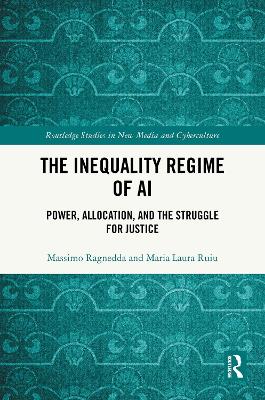
Does artificial intelligence (AI) empower humanity, or does it merely automate the stratifications of the past? In The Inequality Regime of AI, the authors offer a critical sociology of artificial power, arguing that AI represents a fundamental ontological shift in how social life is organized, valued, and governed.


Moving beyond the traditional digital divide, this book introduces the concept of the Inequality Regime of AI. The authors trace a profound transition from inequalities of participation to inequalities of prediction, where social power is concentrated in the hands of those who own and control the means of cognition. Through a global lens, the volume exposes the hidden architectures of the algorithmic age: from the predictive cage of automated governance and the digital feudalism of rentier platforms to the extractive computational metabolism that binds AI to planetary resource depletion. Drawing on Southern epistemologies and the concept of techno-colonialism, the book reveals how AI stabilizes social hierarchies while presenting them as objective, efficient, and inevitable. However, the authors do not stop at critique. They advocate for a “praxis of freedom”, proposing a shift from extractive models toward redistributive infrastructures and the algorithmic commons.


Grounded in a relational ethics of care and critical literacy, this volume is essential reading for scholars and students of sociology, media studies, political science, and the ethics of technology seeking to understand, and contest, the new architectures of global power.


This book explores the expanding digital divide in the age of artificial intelligence (AI). This volume will interest any scholars and students of media studies, sociology, political science, and the ethics of technology.

Arvustused

"In The Inequality Regime of AI, Ragnedda and Ruiu provide much-needed foundational sociological grammar for our algorithmic era. Moving the field far beyond the digital divide, they generate a fresh foundational concept: the insidious 'AI stratification spiral' through which historical inequalities are mathematically naturalized and automated. By conceptualizing AI as a regime that monopolizes the 'means of cognition,' Ragnedda and Ruiu reveal how the 'allocative turn' in social institutions functions as a new form of symbolic violence. As such their work does not merely treat AI technologies; rather it is a critical mapping of how predictive power reorganizes the social order, making it an essential text for any scholar of social stratification and global power."

-- Laura Robinson, Professor of Sociology, Santa Clara University, USA

"This is a timely intervention that frames AI not as a neutral tool marred by occasional bias, but as a structuring force in a new Inequality Regime. By shifting the focus from participation gaps to asymmetries in prediction, the book argues that power now lies with those who control the means of cognition. Concepts such as the Predictive Cage, digital feudalism, and computational metabolism offer a rigorous vocabulary for understanding how automated systems stabilize hierarchy while extracting both social and planetary resources. The authors do not stop at critique: their call for redistributive infrastructures and an algorithmic commons is concrete, ambitious, but mostly necessary. This is an important contribution that supports shaping debates across technology, politics, and society."

-- Alexander van Deursen, Professor of Digital Inequality and Director of the Centre for Digital Inclusion, University of Twente, the Netherlands

Introduction. The Social Question of Artificial Intelligence: Framing
Justice, Power, and Collective Intelligence in the Age of AI Part
1. From
Digital Divides to Inequality Regimes
1. AI as an Inequality Regime;
2. The
Roots of AI Inequality: From Digital Divides to the Allocative Turn;
3. The
Core Fractures: Data, Algorithm, and Governance Part
2. Architectures of
Allocation
4. The Algorithmic Habitus: Micro-politics of the Self;
5.
Institutionalising Inequality: Labour, Welfare, and Education;
6. Bias as
Structural, Symbolic, and Algorithmic Violence Part
3. Global Orders of
Extraction
7. AI and Environmental Inequalities: From Digital to Ecological
Regimes;
8. Techno-Colonialism: Data, Labour, and Epistemic Extractivism;
9.
Digital Feudalism and the Algorithmic Commons Part
4. Horizons of Justice
10.
Literacies of Liberation;
11. From Inequality Regime to Redistributive
Infrastructures
Massimo Ragnedda is an Associate Professor in Media and Communications at Sharjah University, UAE.

Maria Laura Ruiu is an Associate Professor in Media and Communication at the American University of Sharjah, UAE.