Muutke küpsiste eelistusi

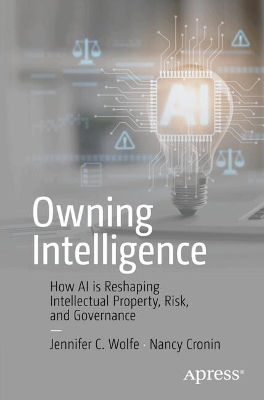
Owning Intelligence: How AI is Reshaping Intellectual Property, Risk, and Governance [Pehme köide]

  • Formaat: Paperback / softback, 111 pages, kõrgus x laius: 235x155 mm, 25 Illustrations, color; 1 Illustrations, black and white
  • Ilmumisaeg: 22-Jun-2026
  • Kirjastus: APress
  • ISBN-13: 9798868823879
Teised raamatud teemal:
  • Pehme köide
  • Hind: 33,31 €*
  • * hind on lõplik, st. muud allahindlused enam ei rakendu
  • Tavahind: 44,41 €
  • Säästad 25%
  • See raamat ei ole veel ilmunud. Raamatu kohalejõudmiseks kulub orienteeruvalt 3-4 nädalat peale raamatu väljaandmist.
  • Kogus:
  • Lisa ostukorvi
  • Tasuta tarne
  • Tellimisaeg 2-4 nädalat
  • Lisa soovinimekirja
  • Formaat: Paperback / softback, 111 pages, kõrgus x laius: 235x155 mm, 25 Illustrations, color; 1 Illustrations, black and white
  • Ilmumisaeg: 22-Jun-2026
  • Kirjastus: APress
  • ISBN-13: 9798868823879
Teised raamatud teemal:
AI is not just a tool. It's a new creator and a new risk. Artificial intelligence is transforming how companies innovate, create, and compete. But with this transformation comes a legal and strategic minefield.


Generative AI tools can produce valuable assets or create unintentional IP violations. Training data may be unknowingly scraped, reused, or leaked. And companies that fail to align their IP strategies with AI use risk litigation, brand damage, and even board liability. This book is a fresh guide for business leaders, general counsel, and board directors on how to rethink the process of where AI meets human behavior in IP and governance in the age of AI, offering a blueprint for managing data, rights, innovation, and risk.


This isnt another AI ethics book or a law treatise. Its a hands-on guide for operationalizing AI and IP governance, covering process, policy, and people with practical tools you can implement immediately. Grounded in legal precedent, business strategy, and practical frameworks, Owning Intelligence is written for leaders who want to do more than write policies, they want to implement them. It includes a playbook of governance checklists, management structure, sample company policies, and tools that organizations can adopt immediately to protect what they build and comply with evolving law.


What You Will Learn


Embed governance into workflows across legal, engineering, and product teams. Legal frameworks, authorship and ownership challenges, and strategic approaches to policy for proprietary data and AI outputs. How boards, executives, and legal teams must prepare for AI accountability, compliance, and oversight. Use AI in IP development and choosing a path that balances the benefits and the risks. The risks of scraping, fair use boundaries, and active landmark cases. Tools, techniques, and AI-assisted compliance strategies for detecting unauthorized use. AI patent trends, key companies, future directions, and the evolving role of trade secrets. 


Who This Book Is For


General Counsel tasked with drafting and  enforcing AI usage policies or protecting trade secrets; Board Directors seeking to fulfill fiduciary duty in light of emerging AI risk; CTOs, R&D and product development team leaders seeking to integrate the use of AI with IP awareness in their processes; Innovation and legal teams evaluating patent, copyright, and licensing strategies; policymakers or regulators interested in model governance frameworks.


 
Chapter 1: Why We Wrote This Book and What You'll Gain From It.
Chapter
2: Understanding Artificial Intelligence in the Context of IP.
Chapter 3:
Ownership and Authorship of AI.
Chapter 4: Oversight and Accountability.-
Chapter 5: Where should AI oversight reside within the organization?.-
Chapter 6: AI as a Tool In Managing IP.
Chapter 7: Building the AI-IP
Strategy in an Evolving Global Policy Landscape.
Chapter 8: The Silent
Disruption: How AI Is Rewriting the Rules of Work and Organizational
Behavior.
Chapter 9: Key Takeaways and the Road Ahead.
Jennifer C. Wolfe, Esq., APR, SSBB is an internationally recognized expert on intellectual property strategy, corporate governance, and emerging technologies. She is the Founder and Executive Director of Governing-Intelligence Research Group.  She was a Founder and Managing Partner of one of the largest woman-owned boutique IP law firms in the U.S. and later launched Dot Brand 360, a digital strategy consultancy which she successfully exited after a decade of advising global brands.


Jen has served as the Chair of the Independent Review of ICANNs Generic Names Supporting Organization (GNSO), advising on international internet governance policy, and has been a faculty member and Leadership Fellow for the National Association of Corporate Directors (NACD) on digital transformation and risk.


A prolific author of six IP and governance books, Forbes Business Council Contributor, and keynote speaker, Jens thought leadership spans Fortune 100 boardrooms, international policy forums, and fast-growing startups. Her focus now lies in helping boards, general counsel and executives navigate the evolving frontier of AI, organizational behavior and intellectual asset management.


Nancy Cronin, P.E., is a strategy expert, engineer, and innovation consultant who advises leading companies across a diverse set of industries. With deep expertise in intellectual asset management, IP strategy, invention portfolio development, and patent analytics, Nancy brings a unique perspective at the intersection of technical invention and legal protection.


Her work spans the full lifecycle of innovation from ideation and analytics to invention harvesting, documentation and strategic advisement, and most recently, AI integration into IP workflows. She has guided Fortune 500 companies in building defendable IP portfolios and identifying whitespace and has been recognized repeatedly for 10 years among the IAM Strategy 300: The Worlds Leading IP Strategists.


Nancys technical education from Caltech and Harvard, her background in engineering and IP strategy, and her 25-year career as a recognized IP professional allows her to bridge the divide between engineering teams and legal departments making her a sought-after advisor and facilitator for interdisciplinary innovation strategy challenges.