Muutke küpsiste eelistusi

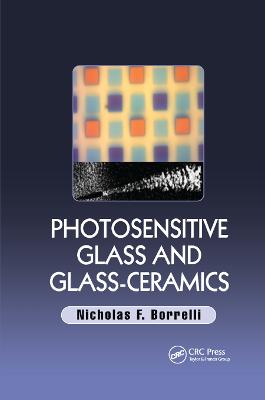
Photosensitive Glass and Glass-Ceramics [Pehme köide]

(Corning Inc., Corning, New York, USA)
  • Formaat: Paperback / softback, 248 pages, kõrgus x laius: 234x156 mm, kaal: 460 g
  • Ilmumisaeg: 12-Dec-2019
  • Kirjastus: CRC Press
  • ISBN-10: 0367875128
  • ISBN-13: 9780367875121
  • Pehme köide
  • Hind: 100,45 €*
  • * hind on lõplik, st. muud allahindlused enam ei rakendu
  • Tavahind: 133,94 €
  • Säästad 25%
  • Raamatu kohalejõudmiseks kirjastusest kulub orienteeruvalt 3-4 nädalat
  • Kogus:
  • Lisa ostukorvi
  • Tasuta tarne
  • Tellimisaeg 2-4 nädalat
  • Lisa soovinimekirja
  • Raamatukogudele
  • Formaat: Paperback / softback, 248 pages, kõrgus x laius: 234x156 mm, kaal: 460 g
  • Ilmumisaeg: 12-Dec-2019
  • Kirjastus: CRC Press
  • ISBN-10: 0367875128
  • ISBN-13: 9780367875121

This book will discuss how glass and glass ceramic interact with light, both transiently and permanently. Ways that light permanently alter the properties of glass and glass ceramic like the color, refractive index, and mechanical and chemical behaviors will be included. Each photochromatic phenomenon will be discussed in detail from the physica


This book will discuss how glass and glass ceramic interact with light, both transiently and permanently. Ways that light permanently alter the properties of glass and glass ceramic like the color, refractive index, and mechanical and chemical behaviors will be included. Each photochromatic phenomenon will be discussed in detail from the physical and chemical origin to the method fabrication and ultimately to their utilization.

Arvustused

"Photosensitive Glass and Glass-Ceramics is a great balance of the underlying physics, chemistry, optics, and glass structure, thoroughly described in an easy-to-read style by an unquestioned authority on the topic. It is a must-read for any one working in photosensitive glass and glass-ceramics."John Ballato, Clemson University, South Carolina, USA

"A remarkable book written by an authoritative, highly accomplished, and internationally renowned glass scientist. Comprehensive, informative, and exceptionally well written, it is a must read for all involved in photosensitive glass and glass-ceramic materials." L. David Pye, New York State College of Ceramics at Alfred University, USA

"clear and straightforward at several levels; it fills a void for teaching at the undergraduate and graduate level. An important contribution to the history of materials science." Carlo Pantano, The Pennsylvania State University, USA

"Written with passion, this book is a masterpiece of science and technology domain." Eugen Pavel, Storex Technologies, Wilmington, Delaware, USA

1) Introduction. Bit of history. Technical Relevance. Scope. 2) Basic
photosensitive mechanism. 2.1) Initial chemistry. 2.2) Metal ions. 2.3)
Origin of color. 3) Other phases produced photosensitively. 3.1) Basic
mechanism for photo- nucleation of other glass-ceramic phases 3.11)
Li-metasilicate (Fotoform) 3.111) Photo-machinable 3.112) Spherical lens
arrays (SMILE). 3.12) NaF (Fota-Lite) 3.121 Colored 3.13) NaF
(Polychromatic) 3.131) mechanism of controlled color 3.14) AgCl (Rainbow)
3.141) Mechanism of thermal formation 3.142) photo-induced effects) 3.15)
Li-aluminosilicate (Nepheline) 3.151) example of double nucleation phenomenon
4) Photorefractive Effects (induced refractive index) 4.1) NaF-based 4.11)
Holograms 4.12) Gradient index lenses 4.2) Photorefractive and polarizing
4.21 Photorefraction (see 3.142) 4.22) polarizing mechanism 4.3) Fs-laser
induced 4.31) waveguides 4.32) gratings 4.4) Bulk Fiber Bragg Grating
SiO2/GeO2+ H2 5) Photo-adaption 5.1) definition and description of the
various manifestations 5.11) photo-induced color 5.12 photo-induced
polarization 6) Solarization 6.1) Different Mechanisms 6.2) Extent of effect
in different glasses 6.3) Bleaching effects 7) Photochemistry in porous
Vycor 7.1) description and preparation of porous glass 7.2) photo-produced
effect with the aid of organo-metallic impregnation
Nicholas F. Borrelli presently is in a position as a corporate research fellow in the research division of Corning Incorporated located in Corning NY.