Muutke küpsiste eelistusi

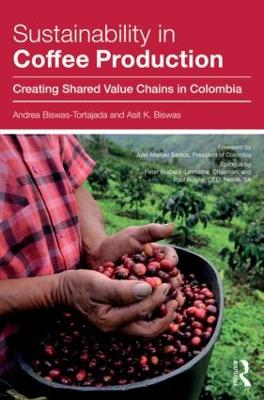
Sustainability in Coffee Production: Creating Shared Value Chains in Colombia [Kõva köide]

, (National University of Singapore)
  • Formaat: Hardback, 208 pages, kõrgus x laius: 234x156 mm, kaal: 520 g, 2 Tables, black and white; 11 Line drawings, black and white; 13 Illustrations, black and white
  • Ilmumisaeg: 16-Jun-2015
  • Kirjastus: Routledge
  • ISBN-10: 1138902071
  • ISBN-13: 9781138902077
Teised raamatud teemal:
  • Formaat: Hardback, 208 pages, kõrgus x laius: 234x156 mm, kaal: 520 g, 2 Tables, black and white; 11 Line drawings, black and white; 13 Illustrations, black and white
  • Ilmumisaeg: 16-Jun-2015
  • Kirjastus: Routledge
  • ISBN-10: 1138902071
  • ISBN-13: 9781138902077
Teised raamatud teemal:
Coffee, as a commodity and through its global value chains, is the focus of much interest to achieve fair trade and equitable outcomes for producers, processors and consumers. It has iconic cultural and economic significance for Colombia, which is one of the world's major coffee producers for the global market. This book examines sustainable coffee production in Colombia, specifically the initiatives of Nestlé to create shared value.

It describes the transformation of the coffee landscape by the development of economically, socially and environmentally viable and dedicated supply chains. Suppliers have been encouraged to shift production and quality paradigms, in order to develop long-term and sustainable strategies for higher value and premium quality products. This has been partially achieved by establishing a robust partnership with the Coffee Growers Federation and other public, private and social actors, thereby taking control of the institutional architecture and knowledge base that exists in the country. The book provides an important lesson of corporate social responsibility and the creation of shared value for the benefit of farmers, corporations and consumers.
Acronyms, abbreviations and definitions vii
Weights and measures ix
List of figures and tables
xi
Foreword: shared value from coffee xiii
Preface xv
Acknowledgments xix
1 Why Creating Shared Value?
1(9)
2 The world's beverage of choice
10(8)
Redefining the coffee sector
12(6)
3 The shared C in coffee and Colombia: complexity
18(45)
Price volatility
22(2)
Ageing factors of production
24(3)
Falling productivity
27(4)
Climate change: making the already variable even more unpredictable
31(8)
Succession: where will the new farmers come from?
39(7)
Women
46(3)
Colombia's coffee architecture
49(4)
Peace wears yellow
53(2)
The International Coffee Agreement, the quota system and the crisis that followed
55(3)
Half full cups
58(2)
The promises of a national policy for rural development
60(3)
4 Nestle in Colombia
63(30)
Sharing value locally
64(2)
Human capital
66(4)
Quality archetypes
70(3)
The coffee roads
73(3)
Reducing footprints
76(3)
Stability anchors
79(5)
Agents of change
84(3)
Sustainability is a global effort
87(6)
5 From farm to cup: the Nescafe Plan
93(10)
Partnerships
95(4)
The record in Colombia
99(4)
6 Quality, productivity and sustainability: the AAA Sustainable Quality" Program
103(25)
Commitments
106(2)
Moving towards 100 per cent sustainable coffee sourcing
108(1)
From farm to landfill? What is happening to the capsules
109(3)
Carbon off and in setting
112(1)
The sustainability continuum
113(3)
The record
116(2)
Picking friends
118(3)
Assessing sustainability
121(7)
7 Lessons learned: future challenges and opportunities
128(27)
Local partnerships that work
130(2)
Changing generational paradigms
132(2)
At the core of competitiveness: relevant technical assistance
134(9)
Capacity building
143(4)
Sharing the spotlight between farmers and consumers
147(3)
From activities to objectives and from transactions to interactions
150(3)
Puzzling implications of human capital creation
153(2)
8 Further thoughts
155(13)
Postscript 168(5)
Epilogue 173(8)
Bibliography 181(20)
Index 201
Andrea Biswas-Tortajada is a Research Fellow at the Third World Centre for Water Management in Mexico. She has also worked for the Water Supply Department in Gujarat, India and for the United Nations Development Programme in Geneva.

Asit K. Biswas is Distinguished Visiting Professor at the Lee Kuan Yew School of Public Policy, National University of Singapore. A recipient of the Stockholm Water Prize and named by Reuters as one of the top 10 water trailblazers of the world, his work has been translated into 37 languages.