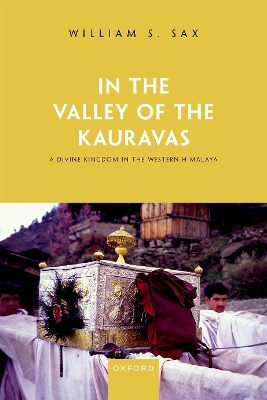
William Sax, the leading ethnographer of the Western Himalayas, has produced a work of remarkable depth, maturity, and conviction, weaving together possession, polity, agency, and local Mahabharata performance in a definitive statement on divine kingship a Himalayan area known as Rawain. Adroitly mixing ethnography and theory, Sax shows how local deities like Shalya, Duryodhana, and especially Karna, rule as kings, are woven into local oral literature and performance, mediated through oracular possession and shamanic vision, and manifested in everyday religious interaction. The result is a unique culture that is grounded in intertwining historical and mythological moments. Sax has written a tour de force that will immediately become the standard work for understanding this unique mountainous region. * Frederick M. Smith, Professor of Sanskrit & Classical Indian Religions * In this book, William Sax describes a remote valley in the Western Himalayas where headhunting and polyandry were once widespread, and where people worship Karan, the defeated hero of the epic Mahabharata, as a beneficent king. Responding critically to the 'ontological turn' in Anthropology and related disciplines, he shows how the local worlds of divine kings persist, despite the immense economic and political changes of recent decades. He argues that such multiple worlds offer an an alternative way of looking at politics, decision-making, and collective solidarity. Sax has written yet another masterpiece, confirming his position as the pre-eminent ethnographer of the region, in a book that will appeal to students of India, Hinduism, Folklore, Ritual, and Social Theory. * Mahesh Sharma, Professor of History, Punjab University * Overall, I was impressed by the volume's organization, especially the palanquin on the cover. The Index at the end, which clearly lists page numbers, greatly aids readers. This commendable work is not only well-structured but also inspiring for future researchers and will be remembered for years to come. * Abhijeet Singh Dewari, Anthropology Book Forum * A wonderfully written, superbly detailed, and analytically captivating ethnography that explores the Divine Kingdoms of the Western Himalaya, where local gods rule the people. It is particularly committed to showing how this system, and the world of which it is part, is made real for its people through a range of discursive and performative means, how it is maintained in everyday life, and how some aspects of it also change with the passage of time and circumstances. The fruit of many decades of study, the narrative blends thick descriptions of numerous events, an intimate personal voice, and helpful insights, all wrapped in comprehensive theory that makes sense of it all. This engaging book is a highly welcomed and particularly seasoned contribution to the ethnographic study of the Western Himalaya. * Ehud Halperin, Tel-Aviv University *