Muutke küpsiste eelistusi

E-raamat: In the Valley of the Kauravas: A Divine Kingdom in the Western Himalaya

(Professor of Anthropology of South Asia, Heidelberg University)
  • Formaat: EPUB+DRM
  • Ilmumisaeg: 02-Jan-2024
  • Kirjastus: Oxford University Press
  • Keel: eng
  • ISBN-13: 9780198879411
  • Formaat - EPUB+DRM
  • Hind: 92,81 €*
  • * hind on lõplik, st. muud allahindlused enam ei rakendu
  • Lisa ostukorvi
  • Lisa soovinimekirja
  • See e-raamat on mõeldud ainult isiklikuks kasutamiseks. E-raamatuid ei saa tagastada.
  • Formaat: EPUB+DRM
  • Ilmumisaeg: 02-Jan-2024
  • Kirjastus: Oxford University Press
  • Keel: eng
  • ISBN-13: 9780198879411

DRM piirangud

  • Kopeerimine (copy/paste):

    ei ole lubatud

  • Printimine:

    ei ole lubatud

  • Kasutamine:

    Digitaalõiguste kaitse (DRM)
    Kirjastus on väljastanud selle e-raamatu krüpteeritud kujul, mis tähendab, et selle lugemiseks peate installeerima spetsiaalse tarkvara. Samuti peate looma endale  Adobe ID Rohkem infot siin. E-raamatut saab lugeda 1 kasutaja ning alla laadida kuni 6'de seadmesse (kõik autoriseeritud sama Adobe ID-ga).

    Vajalik tarkvara
    Mobiilsetes seadmetes (telefon või tahvelarvuti) lugemiseks peate installeerima selle tasuta rakenduse: PocketBook Reader (iOS / Android)

    PC või Mac seadmes lugemiseks peate installima Adobe Digital Editionsi (Seeon tasuta rakendus spetsiaalselt e-raamatute lugemiseks. Seda ei tohi segamini ajada Adober Reader'iga, mis tõenäoliselt on juba teie arvutisse installeeritud )

    Seda e-raamatut ei saa lugeda Amazon Kindle's. 

The isolated valleys of Rawain in the Western Himalaya are ruled by local gods who control the weather, provide justice, and regularly travel through their territories to mark their borders and to ward off incursions by rival gods. These, identified with Karna and Duryodhana from the great Indian epic Mahabharata, are regarded as divine kings whom local persons serve as priests, ministers, patrons, soldiers, and servants. Each divine kings has an oracle, who is regularly summoned, enters into a trance, and speaks with the god's voice, appointing and dismissing officers, confiscating property, levying fines, and ratifying the decisions of councils of elders. The gods hear civil and sometimes criminal cases and, through their oracles, enforce their judgments through fines and penalties, or by compelling disputants to reach a compromise.

In the Valley of the Kauravas seeks to describe how this system functions by closely examining the myths, legends, rituals, and folklore associated with it, and above all by providing a detailed ethnographic description of its day-to-day workings. It contextualizes this system by comparing it with 'divine kingship' throughout history, in both South and Southeast Asia, and seeks to embed this historical and ethnographic analysis in a theoretical discussion of the nature, goals, and limits of anthropological knowledge of 'multiple worlds'.

The chapters of the book are organized in terms of the 'seven limbs' of the classical Indian kingdom as described by the political philosopher Kautilya: king, land and people, minister, army, treasury, ally, and enemy.

In Western Himalaya, local gods are seen to rule as kings, communicating with their subjects through their human oracles. They remain central in modern society, and In the Valley of the Kauravas explores how the power of the local gods and oracles remains by examining the myths, legends, rituals, and folklore of the region.

Arvustused

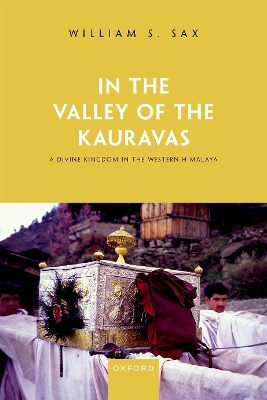
William Sax, the leading ethnographer of the Western Himalayas, has produced a work of remarkable depth, maturity, and conviction, weaving together possession, polity, agency, and local Mahabharata performance in a definitive statement on divine kingship a Himalayan area known as Rawain. Adroitly mixing ethnography and theory, Sax shows how local deities like Shalya, Duryodhana, and especially Karna, rule as kings, are woven into local oral literature and performance, mediated through oracular possession and shamanic vision, and manifested in everyday religious interaction. The result is a unique culture that is grounded in intertwining historical and mythological moments. Sax has written a tour de force that will immediately become the standard work for understanding this unique mountainous region. * Frederick M. Smith, Professor of Sanskrit & Classical Indian Religions * In this book, William Sax describes a remote valley in the Western Himalayas where headhunting and polyandry were once widespread, and where people worship Karan, the defeated hero of the epic Mahabharata, as a beneficent king. Responding critically to the 'ontological turn' in Anthropology and related disciplines, he shows how the local worlds of divine kings persist, despite the immense economic and political changes of recent decades. He argues that such multiple worlds offer an an alternative way of looking at politics, decision-making, and collective solidarity. Sax has written yet another masterpiece, confirming his position as the pre-eminent ethnographer of the region, in a book that will appeal to students of India, Hinduism, Folklore, Ritual, and Social Theory. * Mahesh Sharma, Professor of History, Punjab University * Overall, I was impressed by the volume's organization, especially the palanquin on the cover. The Index at the end, which clearly lists page numbers, greatly aids readers. This commendable work is not only well-structured but also inspiring for future researchers and will be remembered for years to come. * Abhijeet Singh Dewari, Anthropology Book Forum * A wonderfully written, superbly detailed, and analytically captivating ethnography that explores the Divine Kingdoms of the Western Himalaya, where local gods rule the people. It is particularly committed to showing how this system, and the world of which it is part, is made real for its people through a range of discursive and performative means, how it is maintained in everyday life, and how some aspects of it also change with the passage of time and circumstances. The fruit of many decades of study, the narrative blends thick descriptions of numerous events, an intimate personal voice, and helpful insights, all wrapped in comprehensive theory that makes sense of it all. This engaging book is a highly welcomed and particularly seasoned contribution to the ethnographic study of the Western Himalaya. * Ehud Halperin, Tel-Aviv University *

1. Introduction2. Divine Kingdoms in South and Southeast Asia3. The King's Three Bodies4. The Realm: Land and People5. The Ballad of Jariyan6. The Minister and the Army7. A Treaty of Honor: Folklore and Practical Reason in Western Himalayan Pastoralism8. The Ally9. The EnemyAppendices
William S. Sax was born in a small town in eastern Washington State, studied in Seattle, Wisconsin, and India, and earned his PhD in Anthropology at the University of Chicago in 1987. He has taught at Harvard University, the University of Canterbury in New Zealand (where he lived for eleven years), and Germany, where he has been Professor of Anthropology at Heidelberg University's South Asia Institute since 2000. Altogether he has spent about fifteen years in India, and produced three monographs, seven volumes of collected essays, and dozens of articles on theater, healing, ritual, mental health, spirit possession, and psychiatry in South Asia.