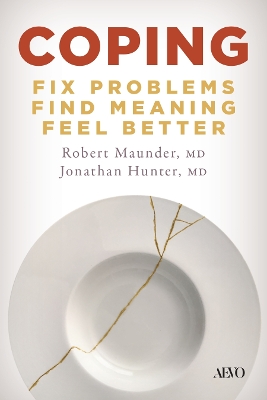
Coping offers a straightforward, evidence-based road map for managing stress with clarity and confidence. Drawing on decades of clinical experience and a thorough review of the latest research, psychiatrists and mental health researchers Robert Maunder, MD and Jonathan Hunter, MD present a practical, curated guide to effective coping strategies – along with realistic expectations for their success.
With warmth and wisdom, the authors introduce three essential steps: fix the problem if you can, feel better about what you can’t fix, and, when suffering persists, seek purpose and meaning. For each step, they provide specific, proven techniques to help you tackle problems, find comfort, and discover deeper significance in challenging times. Step-by-step instructions and decision-making tools make it easy to learn, apply, and choose the right approach for any situation. These science-backed strategies are designed for maximum flexibility and can be adapted to meet the reader where they are. Integrating twelve powerful, real-life interviews with individuals facing extraordinary stress, the book helps readers modify the tested methods to their unique challenges and personal preferences and provides a rare sense of hope.
Accessible, compassionate, and grounded in science, Coping presents a scientifically sound, practical, forgiving, and authoritative guide to caring for yourself.
Preface
Introduction
Chapter
1. Coping with Plagues
Niko: Hope is Always Present
Chapter
2. What Coping Isnt and Is
Chapter
3. Stress and Coping
Step One: Fix It If You Can
Chapter
4. Solve It Yourself
Leyla: I Realized I Had Two Choices
Chapter
5. Solve It with Others
Chapter
6. Problems That Cant Be Solved
Step Two: Feel Better About What You Cant Fix
Act
Chapter
7. Do Healthy Stuff
Heather: I Just Go into Problem-Solving Mode
Chapter
8. Relax!
Chapter
9. Indulge in Worthy Distractions
Carol: A Raincoat for the Crying
Chapter
10. Manage Painful Emotions
Chapter
11. Take It Easy on the Harmful Stuff
Connect
Chapter
12. (Not) Everybody Likes to Cha Cha Cha
Chapter
13. The Art of Connection
Istvan: I Always Found a Tribe
Chapter
14. Use the Connections That Work for You
Adopt a Helpful Attitude
Chapter
15. Be Open to New Perspectives
Niko: I Had a Purpose and Meaning of Some Sort
Chapter
16. Gratitude and Positivity
Chapter
17. Favour Acceptance over Denial
Step Three: Live Meaningfully
Endure
Chapter
18. Persist with Hope and Purpose
Dawit: I Have to Focus on the Things That I Love
Chapter
19. Find Courage
Bennie: I Just Coped by Ignoring It
Chapter
20. Make Sense of Suffering
Live by Your Values
Chapter
21. Act According to Your Values
Rashid: I Use My Voice
Chapter
22. Engage in Religion and Spirituality
Pascal: What If This Is Gods Plan?
Look Beyond Yourself
Chapter
23. Reach Outward with Awe, Altruism, and Advocacy
Dee and Louise: Making Meaning Is a Community Thing
Chapter
24. Gather Your People
Grow
Cindy: I Had to Come Out as Myself
Chapter
25. Fulfill Your Potential
Chapter
26. Create
Chapter
27. Enjoy
Katrina: You Have to Accept the Facts
Coda
Chapter
28. Three Steps versus Real Life
Acknowledgments
End Notes
Robert Maunder, MD is a psychiatrist and researcher. He is currently a professor in the department of psychiatry at the University of Toronto, and chair in health and behaviour at Sinai Health. The author of multiple books, he has written for general readers in the Globe and Mail, Toronto Star, The Walrus, The Conversation, and Psychology Today.
Jonathan Hunter, MD is a psychiatrist and psychotherapist. He is currently a professor in the department of psychiatry at the University of Toronto and holds the Pencer Chair in Applied General Psychiatry at Sinai Health. His clinical and research work includes the psychological care of cancer patients, the role of early life experience in adaptation to disease, and supporting hospital staff in times of strain.