Muutke küpsiste eelistusi

Routledge Handbook of Housing and Welfare [Pehme köide]

Edited by , Edited by
  • Formaat: Paperback / softback, 336 pages, kõrgus x laius: 246x174 mm, 44 Tables, black and white; 1 Line drawings, black and white; 18 Halftones, black and white; 19 Illustrations, black and white
  • Ilmumisaeg: 22-Jun-2026
  • Kirjastus: Routledge
  • ISBN-10: 1032080523
  • ISBN-13: 9781032080529
  • Pehme köide
  • Hind: 59,95 €*
  • * hind on lõplik, st. muud allahindlused enam ei rakendu
  • Tavahind: 79,94 €
  • Säästad 25%
  • See raamat ei ole veel ilmunud. Raamatu kohalejõudmiseks kulub orienteeruvalt 3-4 nädalat peale raamatu väljaandmist.
  • Kogus:
  • Lisa ostukorvi
  • Tasuta tarne
  • Tellimisaeg 2-4 nädalat
  • Lisa soovinimekirja
  • Formaat: Paperback / softback, 336 pages, kõrgus x laius: 246x174 mm, 44 Tables, black and white; 1 Line drawings, black and white; 18 Halftones, black and white; 19 Illustrations, black and white
  • Ilmumisaeg: 22-Jun-2026
  • Kirjastus: Routledge
  • ISBN-10: 1032080523
  • ISBN-13: 9781032080529
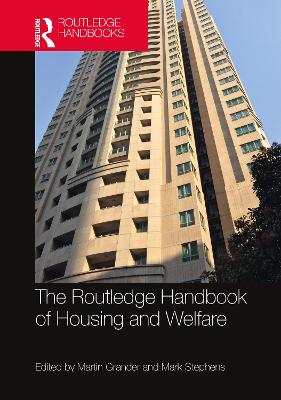
This handbook takes on one of the most pressing issues of todays society the question of housing. It is a cutting-edge edited volume about the disputed interrelationship between housing and the wider welfare state. Although housing scholars generally agree that housing should be regarded as part of such a wider welfare system, it has proven hard to pinpoint and operationalize its position within it. Moreover, the relationship became considerably more complex as a result of the period of intense globalization and the integration of national housing finance systems into world finance markets. Furthermore, welfare systems reflect economic as well as social models and these, too, have changed as countries have responded to globalization, and traditional ideological frameworks have become less distinct.

Thus, there is a need to redefine the connection between housing and welfare in light of changes in both welfare and housing systems. By investigating the current situation and historical development of housing provision and welfare distribution in different contexts worldwide, this book aims to contribute to an expanded understanding of housing and welfare.

The book brings together 25 international housing researchers covering 15 countries worldwide. With such a global approach, the book aims to provide an updated empirical picture and analysis of different housing systems and their connection to the welfare regime in different national contexts. The book moves beyond the usual focus on affordable housing provision in the context of well-developed welfare regimes and includes countries from the global south, incorporating regions where it is debatable whether there are welfare systems present at all. Thus, the book aims to provide the reader with an insight into the large differences in housing provision in international contexts with large differences regarding how the welfare state is comprised. From these insights, we reflect on whether regime approaches continue to provide a suitable theoretical framework for understanding the relationship between housing and the wider welfare state.

This handbook is essential reading for researchers, students, policymakers, and other professionals in the fields of housing studies, welfare studies, economics, urban studies, social work, social and public policy, and sociology.

Arvustused

"This handbook presents a significant intellectual contribution in the form of a solid framework for housing and welfare that carefully builds on earlier work. Moreover, it provides a wealth of empirical evidence from a wide range of countries across the globe. For these reasons, the book is a must-read for researchers, graduate students, policymakers, and specialists in fields such as housing studies, welfare policy, public policy, sociology, and urban planning." Marja Elsinga, Professor of Housing Institutions & Governance, Delft University of Technology in Marja Elsinga (25 Sep 2025): The Routledge Handbook of Housing and Welfare, Housing, Theory and Society, DOI: 10.1080/14036096.2025.2567115

Acknowledgements

List of tables and figures

Foreword

List of contributors

1. Introduction. Martin Grander and Mark Stephens

PART I. UNDERSTANDING HOUSING AND WELFARE

2. Understanding housing and welfare. Martin Grander and Mark Stephens

3. Understanding the relationship between housing and welfare. Martin Grander
and Mark Stephens

PART II. HOUSING AND WELFARE IN A GLOBAL CONTEXT

4. Housing and welfare in England. Michael Marshall, Stephen Hincks and Ryan
Powell

5. Housing and welfare in the United Sates. J. Rosie Tighe and Patrick
Grogan-Myers

6. Housing and welfare in Australia. Kath Hulse, Piret Veeroja and Zoë
Goodall

7. Housing and welfare in Sweden, Norway and the wider Nordic region. Jardar
Sørvoll, Carina Listerborn and Matilda Sandberg

8. Housing and welfare in conservative Central Europe: The cases of Germany,
Austria and Switzerland. Steffen Wetzstein

9. Housing and welfare in Italy. Daniela Leonardi

10. Housing and welfare in Catalonia, Spain. Melissa García-Lamarca

11. Housing and welfare in Russia and the former Soviet Union. Alexander
Kalyukin and Alexander Puzanov

12. Housing and welfare in East-Central Europe the case of Hungary. József
Hegedüs

13. Housing and welfare in China. Julie Tian Miao

14. Housing and welfare in the wider Latin American context: The Chilean
experience. Valentina Abufhele and Nicolás Angelcos

15. Housing and welfare in South Africa. Elelwani Mmbadi, Lochner Marais and
Job Gbadegesin

PART III. HOUSING AND WELFARE IN THE 21ST CENTURY

16. Changes in housing and welfare a global analysis. Martin Grander and
Mark Stephens

17. The embeddedness of housing in the welfare regime. Martin Grander and
Mark Stephens

18. Conclusions: Welfare regimes in the 21st century: From labelling to
explaining. Martin Grander and Mark Stephens
Martin Grander is Associate Senior Lecturer in Urban Studies at Malmö University and Director of the Interdisciplinary Research Environment Studies in Housing and Welfare.

Mark Stephens is Ian Mactaggart Chair in Land, Property and Urban Studies at the University of Glasgow. He also leads the international theme in the UK Collaborative Centre for Housing Evidence (CaCHE). Much of his contribution to this book was undertaken during his appointment as Visiting Professor in the School of Architecture, Planning and Design, The University of Sydney.