Update cookies preferences

E-book: History of Groves

Edited by (University of Sheffield, UK), Edited by (University of Sheffield, UK)
  • Format - PDF+DRM
  • Price: 58,49 €*
  • * the price is final i.e. no additional discount will apply
  • Add to basket
  • Add to Wishlist
  • This ebook is for personal use only. E-Books are non-refundable.

DRM restrictions

  • Copying (copy/paste):

    not allowed

  • Printing:

    not allowed

  • Usage:

    Digital Rights Management (DRM)
    The publisher has supplied this book in encrypted form, which means that you need to install free software in order to unlock and read it.  To read this e-book you have to create Adobe ID More info here. Ebook can be read and downloaded up to 6 devices (single user with the same Adobe ID).

    Required software
    To read this ebook on a mobile device (phone or tablet) you'll need to install this free app: PocketBook Reader (iOS / Android)

    To download and read this eBook on a PC or Mac you need Adobe Digital Editions (This is a free app specially developed for eBooks. It's not the same as Adobe Reader, which you probably already have on your computer.)

    You can't read this ebook with Amazon Kindle

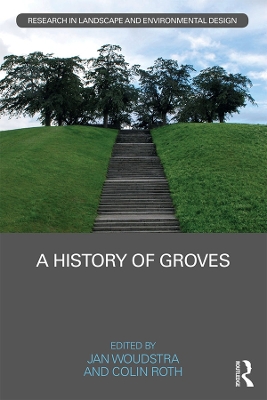
The grove, a grouping of trees, intentionally cultivated or found growing wild, has a long diverse history entwined with human settlement, rural practices and the culture and politics of cities. A grove can be a memorial, a place of learning, a site of poetic retreat and philosophy or political encampment, a public park or theatre, a place of hidden pleasures, a symbol of a vanished forest ecology, or a place of gods or other spirits. Yet groves are largely absent from our contemporary vocabulary and rarely included in today’s landscape practice, whether urban or rural. Groves are both literal and metaphorical manifestations, ways of defining spaces and ecologies in our cultural life. Since they can add meaning to urban forms and ecologies and contribute meaningfully to the significance of place, critical examination is long overdue. The editors have taken care to ensure that the text is accessible to the general reader as well as specialists.

Reviews

"Human beings have had a long, deep, cultural relationship with trees, a relationship which transcends national cultures. That said, as we have become more urban based and our landscapes more designed as a result, this relationship seems to have been somewhat underestimated, something this wonderful publication seeks to put right. The book enthusiastically traces the cultural concepts of The Grove from pre-historic times up to the present day, from the spiritual to the practical and the artistic, and provides compelling evidence of the growing relevance of The Grove to improving the quality of contemporary human experience. The contribution of a number of authors to this stimulating and creative publication is a significant milestone in the re-awakening of our interest in the cultural relationship between us and our trees."

Professor Alan Simson, School of Art, Architecture + Design, Leeds Beckett University, UK.

"Evoking everything from classical deities to druids and amorous liaisons in Augustan pleasure gardens, groves have always been special tree places. Ranging across millennia and traversing the globe from ancient Greece to China, Japan, North America and Africa, this rich and learned collection of essays by an international team of experts, offers an enchanting new slant upon our love affair with trees. The editors and authors are to be congratulated on having created such a varied, readable and stimulating volume which will surely long remain the definitive study of a hitherto surprisingly neglected subject."

Paul Elliott, College of Arts, Humanities and Education, University of Derby, UK.

Contributors ix
Acknowledgements xii
Introduction 1(12)
Jan Woudstra
1 The sacred places of the immortal ones: ancient Greek and Roman sacred groves
13(21)
Maureen Carroll
2 Seeing the wood for the trees: the long-term aesthetics of woodland in England
34(20)
Tom Williamson
3 The sacredness of groves
54(13)
David Jacques
4 The history and development of groves in English formal gardens (1600--1750)
67(19)
Jan Woudstra
5 Colourful groves: the origins of the woodland garden
86(16)
Brent Elliott
6 Groves as metaphor for the fragmented redwood forests of California
102(17)
Camilla Allen
7 Sacred groves in African contexts (Benin, Cameroon): insights from history and anthropology
119(16)
Dominique Juhe-Beaulaton
Matthieu Salpeteur
8 Groves in Chinese gardens and beyond them
135(15)
Lei Gao
9 Korean village groves
150(17)
Hae-Joon Jung
10 The shrine groves of modern Japan
167(17)
Yoshifumi Demura
11 Nature mystification and the example of the `heroes' groves in early twentieth-century Germany
184(19)
Gert Groening
12 Dan Kiley: groves, space and complexity
203(12)
Marc Treib
Index 215
Jan Woudstra is Reader in Landscape History and Theory at the Department of Landscape at the University of Sheffield. His MA thesis at the University of York explored the wilderness in seventeenth- and early eighteenth-century gardens, and he has retained an interest in the topic, evidenced in various publications including The Early Eighteenth Century Wilderness at Stainborough, New Arcadian Journal, no.57/58 (200405), pp. 6584. In 1997 he completed his PhD at the Department of Geography, University College London, with a thesis entitled Landscape for Living; Garden Theory and Design of the Modern Movement.

Colin Roth is an interdisciplinary specialist in the psychology of aesthetics. His primary research field is in Danish culture through the long nineteenth century, and his articles have appeared in the Royal Library Copenhagens journals Fund og Forskning and Carl Nielsen Studies, more recently in a sequence for food professionals in Chef magazine. He has been a regular lecturer at the Tate and the Royal Academy of Arts. His editorial work began in the 1980s with the first Journal of the Derby Porcelain International Society, since when his wide disciplinary range has enabled him to work across the fields of musicology and ballet, art history, architecture and landscape. Dr Roth is currently co-director of the Centre for Nordic Studies at the University of Sheffield.