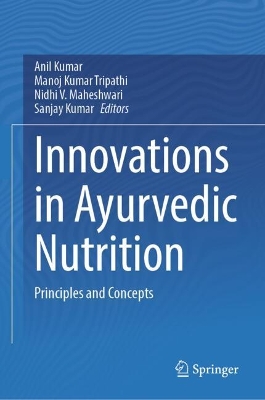
The book offers a comprehensive exploration of Nutri-Ayur innovations, blending traditional Ayurvedic wisdom with advancements in nutrition and molecular biology. It provides an in-depth overview of foundational, specialized, and emerging knowledge in the field—ranging from core principles of Ayurveda and nutrition to the development and application of Nutri-Ayur products. The first book in which provides a conceptual framework of amalgamating nutritional and ayurvedic biology for the development of Nutri-Ayur products for well-being of human mankind.
The opening chapters address major global health challenges, examining their symptoms, causes, and treatment strategies. The volume also introduces nutritional genomics, highlighting how modern genomics technologies are being used to investigate the complex interactions between genes, nutrition, and health outcomes.
Subsequent chapters delve into the critical topic of food–drug interactions, analyzing their effects on drug pharmacokinetics and pharmacodynamics, and the potential implications for nutrient bioavailability and nutritional status. The final sections of the book focus on the role and relevance of novel drug delivery systems within Ayurvedic therapeutics, emphasizing their pharmacological and clinical importance.
Altogether it serves as a valuable resource for researchers and professionals in Ayurveda, nutrition, food technology, biotechnology, process engineering, and R&D sectors.
Chapter
1. Introduction: Diet and Nutrition.
Chapter
2. Human
nutrition: The concept of a Balanced Diet.
Chapter
3. Nutrition Biology: A
New Paradigm for Human Health.
Chapter
4. Impact of Nutrigenomics on Human
Nutrition.
Chapter
5. Food- Drug Interaction.
Chapter
6. Foodomics: A
Recent Trends in Food and Omics.
Chapter
7. Nutraceuticals: Nutritionally
functional Foods.
Chapter
8. Nutri-Ayur Components: Millets, Fruit & Veg,
Spices, Pulses, Cereals, Nuts and Seeds, Herbs.
Chapter
9. Forest Product
Utilization for Development of Nutri-Ayur Components.
Chapter
10. Indian
Traditional Medicine: A Medical Inheritance.
Chapter
11. Ayurvedic Biology
for Holistic Healing.
Chapter
12. Nutrition in Ayurveda.
Chapter
13.
Ayurvedic Drugs: Pharmacological and Pharmaceutical Principles and their
Delivery Systems.
Chapter
14. Medicinal Plants and Sustainable Human
Health.
Chapter
15. Ayurnutrigenomics: Ayurveda-Inspired Nutrition from
Inception to Evidence using Omics Platform.
Chapter
16. Integrated
Approaches for Development of Herbal Medicine.
Chapter
17. Exploring the
Potential of Ayurveda in Developing Sustainable and Reliable Treatment
Options for the Future.
Dr. Anil Kumar is Director of Education at Rani Lakshmi Bai Central Agricultural University, Jhansi, Uttar Pradesh
Dr. M. K. Tripathi is Principal Scientist (Biochemistry) at the Agricultural Process and Product Development Division, ICAR-CIAE, Bhopal, Madhya Pradesh, India.
Dr. Nidhi V. Maheshwari is currently working as Assistant Professor in Somaiya Vidyavihar University, Mumbai, Maharashtra, India. S.
Dr. Sanjay Kumar serves as Chairman, Agricultural Scientists Recruitment Board (ASRB), New Delhi, India. He holds a Masters degree from G.B. Pant University of Agriculture and Technology, Pantnagar, and a Ph.D. from the Indian Agricultural Research Institute, New Delhi.

 Biežāk uzdotie jautājumi par e-grāmatām