Update cookies preferences

E-book: Matriarchy in Bronze Age Crete: A Perspective from Archaeomythology and Modern Matriarchal Studies

(Oakton Community College (Des Plaines, Illinois USA))
  • Format: 280 pages
  • Pub. Date: 30-Jun-2022
  • Publisher: Archaeopress Archaeology
  • Language: eng
  • ISBN-13: 9781803270456
Other books in subject:
  • Format - PDF+DRM
  • Price: 4,08 €*
  • * the price is final i.e. no additional discount will apply
  • Add to basket
  • Add to Wishlist
  • This ebook is for personal use only. E-Books are non-refundable.
  • Format: 280 pages
  • Pub. Date: 30-Jun-2022
  • Publisher: Archaeopress Archaeology
  • Language: eng
  • ISBN-13: 9781803270456
Other books in subject:

DRM restrictions

  • Copying (copy/paste):

    not allowed

  • Printing:

    not allowed

  • Usage:

    Digital Rights Management (DRM)
    The publisher has supplied this book in encrypted form, which means that you need to install free software in order to unlock and read it.  To read this e-book you have to create Adobe ID More info here. Ebook can be read and downloaded up to 6 devices (single user with the same Adobe ID).

    Required software
    To read this ebook on a mobile device (phone or tablet) you'll need to install this free app: PocketBook Reader (iOS / Android)

    To download and read this eBook on a PC or Mac you need Adobe Digital Editions (This is a free app specially developed for eBooks. It's not the same as Adobe Reader, which you probably already have on your computer.)

    You can't read this ebook with Amazon Kindle
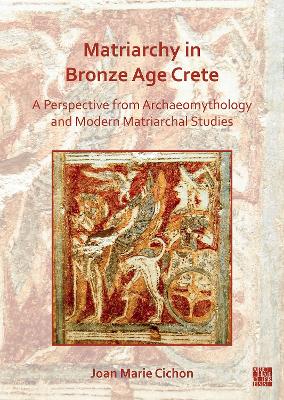
Matriarchy in Bronze Age Crete: A Perspective from Archaeomythology and Modern Matriarchal Studies offers a very different perspective of Crete than is usually found in academic writing; making a compelling case for a matriarchal Bronze Age Crete.


Bronze Age Crete evokes for many the image of an exceptionally sophisticated civilization: peaceful, artistic, and refined; a society in which women were highly visible and important, and the supreme deity was a Goddess. Yet, despite the fact that authorities acknowledge that the preeminent deity of Crete was a Female Divine, and that women played a major role in Cretan society, there is a gap in the scholarly literature, and a lively, ongoing debate regarding the centrality of women and the existence of matriarchy in Bronze Age Crete.


The purpose of this work is to fill that gap, and to advance the debate over whether or not ancient Crete was a woman-centered and matriarchal society toward a more complex, detailed, and certain conclusion. To that end this publication utilises the field of modern matriarchal studies, with its carefully elucidated definition of the term matriarchy, and employs the methodology of archaeomythology the use of historical, mythological, linguistic, and folkloric as well as archaeological sources.


Given its scope, the volume will be of interest to scholars and students in the fields encompassed by archaeomythology, as well as the fields of womens studies, womens history, womens spirituality, and modern matriarchal studies.
List of Figures ;


Preface ;


Introduction ;


Chapter 1: Literature Review ;


Chapter 2: Methodology ;


Chapter 3: Theoretical Context: Matriarchy / Patriarchy Debates ;


Chapter 4: The Mother Goddess of Crete: Interpreting the Archaeological
Record, Iconography, and Sacred Sites, Using Cultural Context, Mythology, and
Historical Correlates ;


Chapter 5: Analysis of the Iconography of the Mother Goddess in Crete ;


Chapter 6: The Role of Women in Bronze Age Crete: Bull-Leapers, Priestesses,
Queens, and Property Holders ;


Chapter 7: Models of Rulership: the Paucity of Images of Male Rulers; the
Images of Female Rulers ;


Chapter 8: Was Bronze Age Crete a Matriarchy? ;


References
Joan Marie Cichon, a retired history professor and reference librarian, has a PhD in Philosophy and Religion from the California Institute of Integral Studies. She has published articles on the Cretan Mother Goddess, the origins of the Eleusinian Mysteries, and archaeomythology. For the past twenty-five years she has spent several months in Crete each year studying, visiting archaeological sites and museums, and exploring the island. This publication is a product of her ongoing research interests.