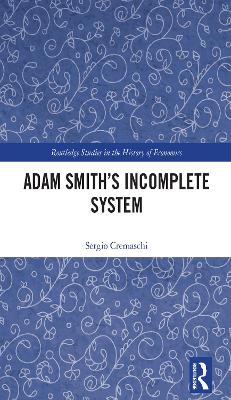
On his deathbed, Adam Smith ordered the burning of two unfinished works on epistemology and politics, fearing that his image as a philosopher would be tarnished and his ideas misinterpreted. This book argues that the inability to complete these two works is symptomatic of tensions for which Smith found no resolution.
On his deathbed, Adam Smith ordered the burning of two unfinished works on epistemology and politics, fearing that his image as a philosopher would be tarnished and his ideas misinterpreted. This book argues that the inability to complete these two works is symptomatic of tensions for which Smith found no resolution.
The loss of Smith’s final manuscripts led to a century and a half of deliberate neglect from philosophers and misinterpretation from economists. The book reconstructs the lost works from fragments, lecture notes, correspondence, and chapters from published works. It also examines the reasons for changes in various editions of the Theory of Moral Sentiments, and explores the hybrid argumentative strategy employed in the Wealth of Nations. The output serves as a map of a coherent system addressing the same questions as Kant and venturing onto the path later taken by the Pragmatists. This roadmap will guide twenty-first-century readers through Smith’s work.
The book is essential reading for Adam Smith specialists, historians of economic thought and philosophers of science.
1 The Enlightenment, post-scepticism, and an unfinished oeuvre 2
Language, theories, machines: the Philosophical History of the Arts and
Sciences 3 Looking-glasses: the Theory of Moral Sentiments as experimental
philosophy 4 Legislators without the impartial spectator: the Theory and
History of Law and Government 5 An immense machine: Wealth of Nations as
rhetorical discourse 6 The Enlightenment and proto-pragmatism Index
Sergio Cremaschi (Bergamo, 1949) was Professor of Philosophy at Ferrara University, Turin University and Amedeo Avogadro University until his retirement in 2014. He also held roles as a visiting fellow or lecturer at several universities, including the New School for Social Research in New York, the Hebrew University in Jerusalem, Aarhus University, and Nuffield College, Oxford. He has published extensively on ethical theory, the history of ethics, and the history and philosophy of economics. This book is part of a trilogy on philosophy and political economy, which also includes Utilitarianism and Malthuss Virtue Ethics (2014; ESHET Best Book award for 2015) and David Ricardo: An Intellectual Biography (2021).


 Lisainfo e-raamatute kohta