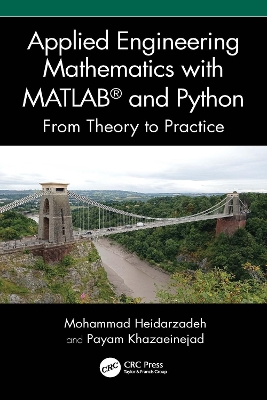
This textbook bridges the gap between mathematical theory and practical engineering applications. It introduces programming skills in MATLAB and Python alongside essential mathematical concepts, progressing from basic computation and linear algebra to more advanced topics like differential equations, Fourier series, and Laplace transforms.
This comprehensive new textbook bridges the gap between mathematical theory and practical engineering applications. Organized into eight chapters, it introduces programming skills in MATLAB and Python alongside essential mathematical concepts, progressing from basic computation and linear algebra to more advanced topics such as differential equations, Fourier series, and Laplace transforms.
The book develops both mathematical reasoning and computational proficiency, equipping students with essential tools for modern engineering practice. It includes numerous MATLAB and Python scripts, presented within the text and available through a dedicated GitHub repository for hands-on learning and reproducibility. Each chapter concludes with problems—many with solutions—that reinforce understanding and encourage practical application. By integrating theory with coding exercises, the book ensures that students not only grasp key concepts but also gain the skills to apply them in real-world contexts.
The book is intended for undergraduate engineering students in Civil, Mechanical, Electrical, and Chemical Engineering. It is particularly suited for modules in Engineering Mathematics, Programming, Computations, and Analytical Studies, and can also serve as a supplementary reference for postgraduate students seeking applied mathematical and computational skills. Instructors will find it a valuable teaching resource that integrates theory with practice, adaptable for both semester- and year-long courses.
The GitHub repository can be accesses at https://github.com/prog871/CRC-book2025.
1. Basics of MATLAB and Python for Engineers
2. Matrices, Vectors, and
Systems of Equations
3. Limits, Differentiation, and Integration
4.
Derivatives and Differential equations
5. Root Finding, Interpolation, and
Curve Fitting
6. Fourier Series and Transforms
7. Laplace Transforms and
Applications
8. Statistics and Probabilities
Mohammad Heidarzadeh is an Associate Professor of Civil Engineering at the University of Bath (UK). He is a Chartered Civil Engineer (CEng) with the Institution of Civil Engineers (ICE), UK, and a Chartered Water and Environmental Manager (C.WEM) with the Chartered Institution of Water and Environmental Management (CIWEM), UK. His expertise lies in coastal and hydraulic engineering, with research focused on improving coastal resilience to natural hazards, including storms, tsunamis, landslides, and earthquakes.
Payam Khazaeinejad is an Associate Professor of Solid Mechanics at Kingston University London (UK). He is a Chartered Engineer, a Chartered Scientist, a Senior Fellow of Advance HE (formerly the Higher Education Academy), and a Fellow of the Institution of Mechanical Engineers (IMechE). He received his PhD in Engineering from the University of Edinburgh (UK). His research focuses on computational design as a transformative approach to materials science and structural engineering, establishing principles for creating materials and systems with exceptional performance and adaptability, from microstructural architectures to full-scale applications.

 Lisainfo e-raamatute kohta