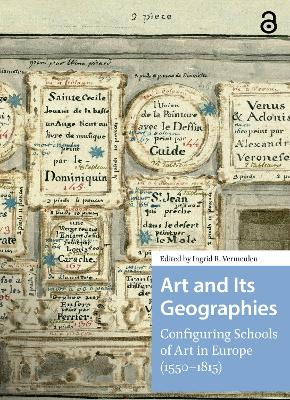
Schools of art represent one of the building blocks of art history. The notion of a school of art emerged in artistic discourse and disseminated across various countries in Europe during the early modern period. Whilst a school of art essentially denotes a group of artists or artworks, it came to be configured in multiple ways, encompassing different meanings of learning, origin, style, or nation, and mediated in various forms via academies, literature, collections, markets and galleries. Moreover, it contributed to competitive debate around the hierarchy of art and artists in Europe. The ensuing fundamental instability of the notion of a school of art helped to create a pluriform panorama of both distinct and interconnected artistic traditions within the European art world. This edited collection brings together 20 articles devoted to selected case studies from the Italian peninsula, the Low Countries, France, Spain, England, the German Empire, and Russia. This volume presents a comprehensive discussion of the various ways notions of school were developed, discussed and applied in pre-modern Europe. Contributions by specialists with different backgrounds, fields expertise and approaches guarantees a wide range of perspectives to the topic. The scope is distinctly trans-national and directed to the various artistic media: architecture, painting, drawings and prints.
INTRODUCTION, ACADEMIES OF ART, CHURCHES, AND COLLECTIVE ARTISTIC
IDENTITIES, ART LITERATURE, ARTISTS, AND TRANSNATIONAL IDENTITIES, DRAWINGS,
CONNOISSEURSHIP, AND GEOGRAPHY, TASTE AND GENIUS OF NATIONS, PRINTS,
COLLECTING, AND CLASSIFICATION, ART MARKETS: SELLING AND COLLECTING, ON
PUBLIC DISPLAY IN PICTURE GALLERIES, CONTRIBUTORS, ILLUSTRATION CREDITS, INDEX
INGRID R. VERMEULEN is Associate Professor of Early-Modern Art History at Vrije Universiteit Amsterdam. Her research focuses on the early-modern history of art history grounded in art literature, collections, and museums. It generated the book Picturing Art History (2010) and the project The Artistic Taste of Nations (2015) funded by the Dutch Research Council (NWO). .

 Lisainfo e-raamatute kohta