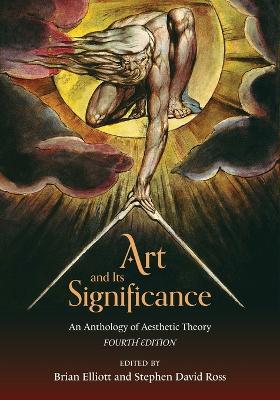
A topical, art-practice focused anthology that caters to diverse interests in aesthetics.
Art and Its Significance is a highly engaging and readable anthology, which ranges from ancient Greek writing on epic and theater to contemporary issues relating to how art is impacted by augmented reality technologies. This collection offers a firm foundation in classic and modern aesthetics by a diverse range of authors from Plato and Aristotle to Judith Butler, Jacques Rancičre, and Mary Devereaux. Its thematic organization allows readers to focus on particular topics and genres and make connections between different approaches to a wide range of artistic expression. Each article is introduced with details on the author and a summary of the main arguments offered in the text. Additional section introductions help the reader to understanding how the grouped texts relate to one another. This anthology does not assume prior knowledge of philosophy or aesthetics and is well suited to college course use.
Arvustused
"This is the best wide-ranging collection of philosophical writings on art that I've found, and I would highly recommend it to other professors teaching undergraduate or graduate classes in aesthetics or related courses." Andy Amato, University of Texas at Dallas
"Art and Its Significance is wide-ranging, covering texts from the history of Western philosophy from Plato through contemporary thinkers. I like that there are so many different options in the text. That variety and diversity frees professors to design courses in a variety of ways, using the 'same' textbook to support a number of different courses. I would recommend (and have recommended) the text to others for use in their classes." Anne J. Mamary, Monmouth College, Illinois
Muu info
A topical, art-practice focused anthology that caters to diverse interests in aesthetics.
Editor's Introduction, Fourth Edition
I. Reality, Experience, and Theater
Section Introduction
1. Republic III (Steph. 386402; c. 375 BCE)
Plato
2. Poetics 19 (Steph. 14471452; c. 350 BCE)
Aristotle
3. "Psychical Distance" as a Factor in Art and as an Aesthetic Principle
(1912)
Edward Bullough
4. Modern Theater Is Epic Theater (1930)
Bertolt Brecht
5. Art as Experience (1934)
John Dewey
6. The Artworld (1964)
Arthur Danto
7. Augmented Reality and Theatre (2024)
E. B. Hunter
II. Music, Emotion, and Dance
Section Introduction
8. The Birth of Tragedy (1872)
Friedrich Nietzsche
9. What Is Art? (1898)
Leo Tolstoy
10. Night Music (1929)
Theodor Adorno
11. Feeling and Form (1953)
Susanne Langer
12. Experimental Music (1958)
John Cage
13. Four Criteria of Electronic Music (1971)
Karlheinz Stockhausen
14. The Politics of the Body: Pina Bausch's Tanztheater (1990)
David W. Price
III. Taste, Imagination, and Literature
Section Introduction
15. Of the Standard of Taste (1757)
David Hume
16. Critique of Judgement (1790)
Immanuel Kant
17. The Writer and Fantasizing (1908)
Sigmund Freud
18. A Room of One's Own (1929)
Virginia Woolf
19. Psychology and Literature (1930)
Carl Jung
20. Narrative Emotions: Beckett's Genealogy of Love (1988)
Martha Nussbaum
IV. History, Interpretation, and Painting
Section Introduction
21. Philosophy of Fine Art (18181829)
G. W. F. Hegel
22. On the Spiritual in Art (1912)
Wassily Kandinsky
23. Suprematism (1927)
Kasimir Malevich
24. Plastic Art and Pure Plastic Art (1936)
Piet Mondrian
25. Cézanne's Doubt (1945)
Maurice Merleau-Ponty
26. Seven Seals of Affirmation (1973)
Michel Foucault
27. Answering the Question: What Is Postmodernism? (1983)
Jean-Franēois Lyotard
V. Politics, Power, and Film
Section Introduction
28. The Method of Making a Workers' Film (1925)
Sergei Eisenstein
29. Cult of Distraction: On Berlin Picture-Houses (1926)
Siegfried Kracauer
30. The Work of Art in the Age of Its Technological Reproducibility (1936)
Walter Benjamin
31. The Aesthetic Dimension (1977)
Herbert Marcuse
32. Beauty and Evil: The Case of Leni Riefenstahl's Triumph of the Will
(1998)
Mary Devereaux
33. The Pensive Image (2008)
Jacques Rancičre
VI. Gender, Difference, and Photography
Section Introduction
34. Brief Historical Sketch of the Invention of the Art (1844)
Henry Fox Talbot
35. The Future of Photographic Technique (1927)
Lįszló Moholy-Nagy
36. Any Theory of the "Subject" Has Always Been Appropriated by the
"Masculine" (1974)
Luce Irigaray
37. In Plato's Cave (1977)
Susan Sontag
38. Camera Lucida: Reflections on Photography (1980)
Roland Barthes
39. Torture and the Ethics of Photography (2007)
Judith Butler
40. The Coming of Age: Cindy Sherman, Feminism, and Art History (2014)
Abigail Solomon-Godeau
VII. Culture, Collecting, and Architecture
Section Introduction
41. The Lamp of Memory (1849)
John Ruskin
42. Towards a New Architecture (1923)
Le Corbusier
43. Learning from Las Vegas (1972)
Robert Venturi, Denise Scott Brown, and Steven Izenour
44. The Invention of Africa (1988)
V. Y. Mudimbe
45. On Collecting Art and Culture (1988)
James Clifford
46. Letter to Peter Eisenman (1990)
Jacques Derrida
47. Rethinking Historiography and Ethnography: Surrealism's Intellectual
Legacy (2017) Natalya Lusty
48. Embodied and Existential Wisdom in Architecture: The Thinking Hand (2017)
Juhani Pallasmaa
Credits
Brian Elliott is a faculty member in the Philosophy Department at Oregon State University. His publications include Benjamin for Architects; Natural Catastrophe: Climate Change and Neoliberal Governance; and A Childs Place in Nature: Towards a Pedagogy for the Anthropocene. Stephen David Ross is Professor Emeritus of Philosophy and Comparative Literature, SUNY Binghamton. He is the author of numerous works, including Un-Forgetting: Re-Calling Time Lost; The Gift of Self: Shattering Emptiness, Betrayal; and The Gift of Property: Having the Good / Betraying Genitivity, Economy and Ecology, an Ethic of the Earth, all published by SUNY Press.

 Lisainfo e-raamatute kohta