Muutke küpsiste eelistusi

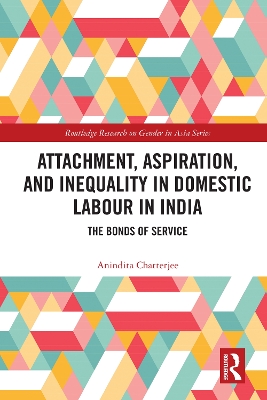
E-raamat: Attachment, Aspiration, and Inequality in Domestic Labour in India: The Bonds of Service

  • Formaat - EPUB+DRM
  • Hind: 59,79 €*
  • * hind on lõplik, st. muud allahindlused enam ei rakendu
  • Lisa ostukorvi
  • Lisa soovinimekirja
  • See e-raamat on mõeldud ainult isiklikuks kasutamiseks. E-raamatuid ei saa tagastada.

DRM piirangud

  • Kopeerimine (copy/paste):

    ei ole lubatud

  • Printimine:

    ei ole lubatud

  • Kasutamine:

    Digitaalõiguste kaitse (DRM)
    Kirjastus on väljastanud selle e-raamatu krüpteeritud kujul, mis tähendab, et selle lugemiseks peate installeerima spetsiaalse tarkvara. Samuti peate looma endale  Adobe ID Rohkem infot siin. E-raamatut saab lugeda 1 kasutaja ning alla laadida kuni 6'de seadmesse (kõik autoriseeritud sama Adobe ID-ga).

    Vajalik tarkvara
    Mobiilsetes seadmetes (telefon või tahvelarvuti) lugemiseks peate installeerima selle tasuta rakenduse: PocketBook Reader (iOS / Android)

    PC või Mac seadmes lugemiseks peate installima Adobe Digital Editionsi (Seeon tasuta rakendus spetsiaalselt e-raamatute lugemiseks. Seda ei tohi segamini ajada Adober Reader'iga, mis tõenäoliselt on juba teie arvutisse installeeritud )

    Seda e-raamatut ei saa lugeda Amazon Kindle's. 

This novel volume presents an ethnography of the gendered dynamics of informal labour relations in three cosmopolitan cities in India: Kolkata, Delhi and Noida in order to analyse women’s agency and identity formation in the domestic labour sphere in India.


This novel volume presents an ethnography of the gendered dynamics of informal labour relations in three cosmopolitan cities in India: Kolkata, Delhi and Noida in order to analyse women’s agency and identity formation in the domestic labour sphere in India.

Structured around an extensive set of in-depth narratives from female workers and employers, chapters reveal how employers and workers use language to express reciprocal support and care. Novel in its focus on affect – including the emotions, moods, and atmospheres that emerge from, and shape, the conditions of labour – chapters demonstrate the mutual, bi-directional "affective attachments” and dependencies that are formed between employers and workers through practices of mutual care. The book explores the construction of gender identities among workers, in part shaped by a variety of other intersecting relationships including caste, ethnicity and religion. As well as an exploration of worker-employer relations within the employers’ homes, the book also examines the squatter settlements of workers’, uncovering aspects of workers’ domestic lives, relationships with each other, and broader relationships between transregional and trans-border migrants.

Examining a space where gender, migration, language, and emotion intersect, this book will be of interest to researchers studying gender, South Asian Studies, anthropology, labour studies, migration studies and urban studies.

Arvustused

"Anindita Chatterjee has written an in-depth description of domestic workers lives in Kolkata, Noida and Delhi. There are ties that bind all of them, yet each woman has her singular relationship to aspirations, work, family and space. The chapters are well written, rich in terms of conversation between ethnographer and her interlocutors. Using in depth ethnographic research that spanned over four years, the author demonstrates her participation in women workers quotidian lives, meeting them in their homes, in tea shops, and in the households where they work. Overall, it is well-written and gives a window into the aspirations of these women. This will be an important book for college students learning about the aspirational lives of women in domestic work."

-- Lamia Karim , Professor of anthropology, University of Oregon, and author of 'Castoffs of Capital: Work and Love Among Garment Workers in Bangladesh.'

"Based on six years of ethnographic research, and grounded in the authors own early encounters with domestic workers, this illuminating book explores domestic labour as a deeply intimate yet unequal relationship in contemporary India. It shows how affection, kin-like attachment, and care coexist with structural inequality, compulsion, and exclusion. Attending to women workers and employers everyday emotional lives, the book reveals how class and respectability are reproduced through ordinary interactions. Attachment, Aspiration, and Inequality in Domestic Labour in India offers a compelling account of how love and labour intertwine."

-- Sarah Lamb, author of 'Being Single in India: Stories of Gender, Exclusion and Possibility and White Saris' and 'Sweet Mangoes: Aging, Gender, and Body in India', and Barbara Mandel Professor of Humanistic Social Sciences and Professor of Anthropology, Brandeis University.

This is a compelling book focusing on understanding the Domestic Attachments formed by domestic workers in various contexts in South Asia. The author has an impressive command of the literature in the field, and the ethnography truly engaging. [ ] This complex and interesting book offers lens to explore domestic work relation, framed around attachments, which become a prism to explore gender, class and ethnic inequalities in the home. The field material is greatly original and complex [ and the] scholarship is outstanding.

-- Alessandra Mezzadri, Professor, Department of Development Studies, SOAS, University of London,, UK.

1 Introduction

2 Affective Attachments and Embodied Labour: Kolkata and Delhi

3 English as an Aspirational Mechanism for Migrant Domestic Workers: Social
Mobility, Inequality, and Language

4 Construction, Negotiation, and Articulation on Class Among Domestic Workers
and Employers: Living Within Boundaries

5 Patterns of Exclusion Among Female Migrant Domestic Workers: Uneasy
Coexistence

6 Embodied Gender Inequality Among Migrant Domestic Workers: Exhausted Bodies
and Suppressed Desire

7 Narrative Accounts of Womens Working Conditions in Bangladesh:
Cross-Border Migration

8 Conclusion
Anindita Chatterjee is Visiting Professor at Ashoka University (Delhi, India) in the Department of Sociology and Anthropology. She is affiliated with BRAC University. Prior to joining Ashoka, Chatterjee has held academic appointments in Bangladesh, American University of Sharjah (UAE), and Symbiosis International University (India). She has held postdoctoral fellowship at Max Weber Stiftung IBO (New Delhi) and was a Postdoctoral Research Consultant with Sarah Lamb (Brandeis University) on Dr. Lambs Andrew Carnegie Fellowship project on Successful Agings Global Moment: Visions and Dilemmas of Aging Well. Her research and teaching engage with the fields of globalization, labour, migration, structural inequality, ethics and culture, gender and sexuality, reproductive health, ageing, and well-being. Chatterjee has presented her research findings at multiple international and national conferences over the past 16 years, and she also has a record of producing collaborative research with an international network of scholars.