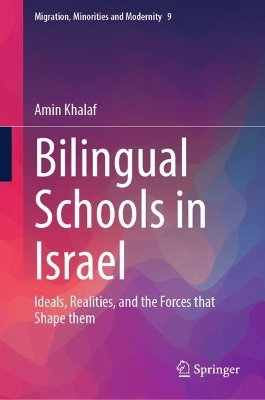
This book asks a central question: Does integrated education, aimed at peace and equality, influence life beyond school walls as its founders hoped? Or does the Israeli-Palestinian conflict turn the integrated school space into a battleground? The author, Dr. Amin Khalaf, concludes that the power imbalance between the Jewish majority and the Palestinian minority does not disappear within the framework of joint education, and the impact of these schools on Israeli society remains quite limited. Nevertheless, he demonstrates that integrated education has also borne fruit. The desire to maintain an equal partnership through educational frameworks holds the potential for positive environmental influence, even if it has not yet been fully realized.
Chapter
1. Theory and Reality.
Chapter
2. The Establishment and the
Institutions.
Chapter
3. Strategies of Equality.
Chapter
4. Inequality
Dimensions.
Chapter
5. Symbolic and Real Boundaries.
Chapter
6.
Achievements and Hopes.
Chapter
7. Lessons in Integration: Comparing
Educational Models in Conflict Zones - Northern Ireland and Cyprus as Case
Studies.
Dr. Amin Khalaf is an education lecturer at Ono Academic College and David Yellin Academic College of Education. Holds a bachelor's and a master's degree in Islamic and Middle Eastern Studies, a Business Administration master's degree from the Hebrew University of Jerusalem, and a Ph.D. from UBB University in Cluj, Romania. Alongside academic work, Dr. Khalaf co-founded the "Hand-in-Hand" Association, which, since 1998, has established seven bilingual Jewish-Arab schools. He also manages the "EAST & WEST" Language Learning Center in Sheikh Jarrah, Jerusalem.

 Lisainfo e-raamatute kohta