Muutke küpsiste eelistusi

E-raamat: Bio-Climatology for Built Environment

(Tokyo City University, Yokohama, Japan)
  • Formaat: EPUB+DRM
  • Ilmumisaeg: 18-Jan-2019
  • Kirjastus: CRC Press Inc
  • Keel: eng
  • ISBN-13: 9781351646673
  • Formaat - EPUB+DRM
  • Hind: 68,89 €*
  • * hind on lõplik, st. muud allahindlused enam ei rakendu
  • Lisa ostukorvi
  • Lisa soovinimekirja
  • See e-raamat on mõeldud ainult isiklikuks kasutamiseks. E-raamatuid ei saa tagastada.
  • Formaat: EPUB+DRM
  • Ilmumisaeg: 18-Jan-2019
  • Kirjastus: CRC Press Inc
  • Keel: eng
  • ISBN-13: 9781351646673

DRM piirangud

  • Kopeerimine (copy/paste):

    ei ole lubatud

  • Printimine:

    ei ole lubatud

  • Kasutamine:

    Digitaalõiguste kaitse (DRM)
    Kirjastus on väljastanud selle e-raamatu krüpteeritud kujul, mis tähendab, et selle lugemiseks peate installeerima spetsiaalse tarkvara. Samuti peate looma endale  Adobe ID Rohkem infot siin. E-raamatut saab lugeda 1 kasutaja ning alla laadida kuni 6'de seadmesse (kõik autoriseeritud sama Adobe ID-ga).

    Vajalik tarkvara
    Mobiilsetes seadmetes (telefon või tahvelarvuti) lugemiseks peate installeerima selle tasuta rakenduse: PocketBook Reader (iOS / Android)

    PC või Mac seadmes lugemiseks peate installima Adobe Digital Editionsi (Seeon tasuta rakendus spetsiaalselt e-raamatute lugemiseks. Seda ei tohi segamini ajada Adober Reader'iga, mis tõenäoliselt on juba teie arvutisse installeeritud )

    Seda e-raamatut ei saa lugeda Amazon Kindle's. 

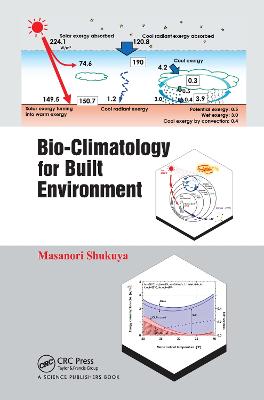
Indoor climate is determined by rational lighting, heating, cooling and ventilating systems. For occupants’ well-being it should be consistent with how regional outdoor climate works in the flow of radiation via four paths of heat transfer: radiation; convection; conduction; and evaporation. This book starts with the relationship between the human body and its immediate environmental space followed by a brief introduction of passive and active systems for indoor climate conditioning. The nature of light and heat is discussed with a focus on building envelope systems such as walls and windows, and then examined from the viewpoint of thermodynamics and human-biology. Some examples are given to enable a better understanding of luminous and thermal characteristics of our most immediate environment particularly for those professionally involved in environmental planning, designing, and engineering to know about bio-climatic design principle.
Preface v
1 Built Environment and Human Beings
1(12)
2 Passive and Active Systems for Conditioning the Built Environment
13(25)
3 Basics of Human Biology
38(20)
4 Solar and Lunar Effects on Built Environment
58(28)
5 Visible Light and Luminous Environment
86(31)
6 Heat and Thermal Environment
117(43)
7 Thermodynamics
160(33)
8 Air and Moisture
193(39)
9 Mathematical Modelling
232(39)
10 Human-Body Exergetic Behaviour
271(47)
11 Flow and Circulation of Matter
318(40)
12 Global Environmental System Enfolding Built-Environmental Systems
358(27)
Index 385
Masanori Shukuya, Ph.D., is a professor at the Department of Restoration Ecology and Built Environment and at the Graduate School of Environmental and Information Studies, Yokohama campus, Tokyo City University (YC-TCU). His major interests in research and education are 1) the development of exergy evaluation methods for various builtenvironmental systems for human thermal comfort with the rational use of various exergy resources; 2) the development of a method for the holistic approach to built-environmental education.
Ei ole sisse logitud.