Muutke küpsiste eelistusi

E-raamat: Buddhist Responses to Christianity in Postwar Taiwan: Awakening the World

  • Formaat: PDF+DRM
  • Sari: Religion and Society in Asia
  • Ilmumisaeg: 01-Oct-2025
  • Kirjastus: Amsterdam University Press
  • Keel: eng
  • ISBN-13: 9781040798102
  • Formaat - PDF+DRM
  • Hind: 59,79 €*
  • * hind on lõplik, st. muud allahindlused enam ei rakendu
  • Lisa ostukorvi
  • Lisa soovinimekirja
  • See e-raamat on mõeldud ainult isiklikuks kasutamiseks. E-raamatuid ei saa tagastada.
  • Formaat: PDF+DRM
  • Sari: Religion and Society in Asia
  • Ilmumisaeg: 01-Oct-2025
  • Kirjastus: Amsterdam University Press
  • Keel: eng
  • ISBN-13: 9781040798102

DRM piirangud

  • Kopeerimine (copy/paste):

    ei ole lubatud

  • Printimine:

    ei ole lubatud

  • Kasutamine:

    Digitaalõiguste kaitse (DRM)
    Kirjastus on väljastanud selle e-raamatu krüpteeritud kujul, mis tähendab, et selle lugemiseks peate installeerima spetsiaalse tarkvara. Samuti peate looma endale  Adobe ID Rohkem infot siin. E-raamatut saab lugeda 1 kasutaja ning alla laadida kuni 6'de seadmesse (kõik autoriseeritud sama Adobe ID-ga).

    Vajalik tarkvara
    Mobiilsetes seadmetes (telefon või tahvelarvuti) lugemiseks peate installeerima selle tasuta rakenduse: PocketBook Reader (iOS / Android)

    PC või Mac seadmes lugemiseks peate installima Adobe Digital Editionsi (Seeon tasuta rakendus spetsiaalselt e-raamatute lugemiseks. Seda ei tohi segamini ajada Adober Reader'iga, mis tõenäoliselt on juba teie arvutisse installeeritud )

    Seda e-raamatut ei saa lugeda Amazon Kindle's. 

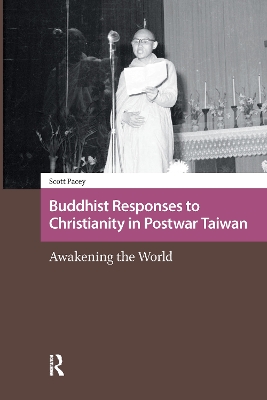
After the Communist victory in China's civil war, Taiwan-then governed by the KMT (or Nationalist Party)-became a focal point for both Buddhist and Christian activity in the Chinese world. Between the mid-1950s and 1970s, Buddhists responded to subsequent Christian growth on the island. This occurred against a backdrop of intense Christian proselytization, and Buddhist concern for the future viability of their tradition. Focusing on some of the most influential monastics of the time, this is the first study to provide in-depth coverage of Chinese Buddhist-Christian engagement after 1949. Drawing on Buddhist and Christian publications, it shows that interfaith competition, and political context, are important in shaping religious identity, and driving the religious engagement with modernity. This book will be of interest to historians of Buddhism, Chinese religion and Taiwanese society, and to those with an interest in interfaith dialogue more generally.

Arvustused

"Paceys study fulfills his commitment to shed light on areas such as the scope of Buddhist-Christian engagement in postwar Taiwan, its political relevance and impact on Buddhist identity formation, and the ways in which Buddhism adapted itself to the peculiar kind of modernity endorsed by the Guómínd.ng. [ ...] Both well researched and nicely edited, this book is warmly recommended to scholars and students of East Asian religions and modern Buddhism." - Ugo Dessì, Religious Studies Review, Vol. 48, No. 2, June 202

Acknowledgments 7(2)
A Note on Romanization and Translations 9(2)
Preface 11(6)
Introduction 17(40)
Chinese Buddhism and identity
19(8)
The three teachings
27(6)
Buddhism and Christianity in China
33(3)
New intellectual and political responses
36(4)
Enter the KMT
40(1)
Modernity, and "KMT modernity"
41(5)
Taixu
46(2)
Overview of the study
48(9)
1 Buddhism and Patriotism
57(32)
Taiwan's political context
60(3)
Buddhism and KMT values
63(14)
Awakening the world
77(10)
Conclusion
87(2)
2 Buddhism and Chinese Culture
89(32)
Cultural renaissance
93(1)
From Moses to Marx
94(7)
"Slave society"
101(5)
East of Eden
106(3)
The genesis of a new approach
109(4)
The study of Buddhism
113(6)
Conclusion
119(2)
3 Buddhism and Modernity
121(28)
Pointing at the moon
127(5)
Open letters to Du
132(4)
The science of Sakyamuni
136(4)
God and Gotama
140(2)
Yinshun's sources
142(3)
Conclusion
145(4)
4 Decline and Revitalization
149(28)
Perceiving the decline
154(5)
History as polemic
159(4)
From the temple to the ivory tower
163(12)
Conclusion
175(2)
5 Sermons Among Mountains
177(28)
Dharma Drum Mountain
183(5)
Tzu Chi
188(7)
Buddha-Light Mountain
195(3)
Lingjiu Shan and Zhongtai Chansi
198(4)
Conclusion
202(3)
Conclusion
205(12)
Religious inter-connectivity
206(1)
Interfaith competition in Taiwan after 1949
207(3)
KMT modernity
210(4)
Interfaith competition and identity
214(3)
List of Chinese Characters 217(8)
Bibliography 225(24)
Index 249
Dr Scott Pacey is an Assistant Professor in the School of Sociology and Social Policy at the University of Nottingham.