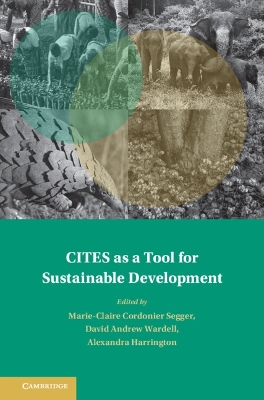
Saving endangered species presents a critical and increasingly pressing challenge for conservation and sustainability movements, and is also matter of survival and livelihoods for the world's poorest and vulnerable communities. In 1973, a global Convention on International Trade in Endangered Species (CITES) was adopted to stem the extinction of many species. In 2015, as part of the Sustainable Development Goals (SDG 15) the United Nations called for urgent action to protect endangered species and their natural habitats. This volume focuses on the legal implementation of CITES to achieve the global SDGs. Activating interdisciplinary analysis and case studies across jurisdictions, the contributors analyse the potential for CITES to promote more sustainable development, proposing international and national regulatory innovations for implementing CITES. They consider recent innovations and key intervention points along flora and fauna value chains, advancing coherent recommendations to strengthen CITES implementation, including through the regulation of trade in endangered species globally and locally.
The Convention on International Trade in Endangered Species (CITES) was adopted in 1973 to prevent flora and fauna species extinction; this book reviews how CITES implementation efforts promote sustainable development. It provides analysis of regulatory and policy innovations along value chains for international trade in endangered species.
Muu info
Reviews the key legal and policy innovations along endangered flora and fauna value chains for CITES to promote more sustainable development.
Part I. Endangered Species, Sustainable Development and the Law;
1.
Introduction;
2. Origins, Evolution and Contribution of CITES to Achieving
Sustainable Development;
3. Protected Species, Global Commodities and Law for
Sustainable Development; Part II. Sustainable Development in Law and Policy
on Endangered Species; 4 . Shifting the Burden of Wildlife Protection: The
Role of Extra-Territorial Jurisdiction in Implementing CITES;
5. Analysing
CITES Trade Measures;
6. CAFTA-DR Environmental Submission Process as a
Public Participation Alternative and a Way to Protect CITES-listed Species;
Part III. Global Implementation of CITES by Key Species / Commodity;
7.
Power, Profits and Policy: A Reality Check on CITES and the Prunus Africana
Bark Trade;
8. The Inclusion of the Scalloped Hammerhead Shark (Sphyrna
lewini) in Appendix II of CITES;
9. Understanding Markets to Conserve
CITES-listed Species;
10. Criminal Prosecution and Enforcement Challenges in
CITES; Part IV. Case Studies of National Implementation of CITES;
11.
Sustainable Enterprise Development: Protection of Endangered Species in Omo
and Other Potential Biosphere Reserves;
12. Biodiversity MEAs Matrix in
India: Synergies, Implementation Status and Future Challenges;
13. Tanzania's
Fight against Illegal Ivory Trade: Law-Enforcement Failures and
Non-Compliance with International Environmental Laws;
14. The Impact of CITES
COP 12 2002 Decision on Mahogany on Peru´s Timber Trade;
15. Strengthening
CITES Compliance: Improving the Management of Resources Preservation and
Cross-Border Wildlife Trade in China;
16. How to Reverse the Fallacy of
Command-and-Control in Combatting Illegal Trade of Exotic Pets in Brazil;
17.
Lessons on Sustainable Development and Challenges to Illegal Trade: The Case
of Chilean Larch;18. The Return of the Markhor: Why CITES Matters;
19. New
Technologies for Effective Biodiversity Governance: Lessons from Orangutans
in Indonesia;
20. Regulation of Import of Hunting Trophies of Exotic Species
Into India By Framing a Look-Alike Policy to Conserve Indigenous Wild Fauna;
21. Legislation for the Control of the Timber Trade in the Democratic
Republic of Congo and the Congo Basin;
22. Sustaining the Global Frankincense
Trade through CITES: Governance Challenges and Complexities; Part V. Emerging
Issues and Synergies for CITES in the Context of Sustainable Development:
23.
Sustaining Commercial Marine Fisheries for This Generation and Future
Generations Using CITES Appendix I and II for Trade Traceability;
24. CITES
as a Tool for Monitoring and Adaptive Management;
25. Linking Global
Processes: Institutional Interplay and the Global Sustainable Development
Agenda;
26. Trade and Zoonotic Diseases;
27. The Convention on Biological
Diversity (1992) and other Biodiversity Conservation Regimes: Looking through
the Lens of Synergy and an Ethical Shift; Part VI. Conclusions;
28. New
Directions for Law and Policy on Sustainable Development in the Context of
CITES and Endangered Species.
Marie-Claire Cordonier Segger is Leverhulme Trust Visiting Professor in the University of Cambridge, and Full Professor of Law at the University of Waterloo, Canada. She serves as Senior Director of the Centre for International Sustainable Development Law, also a founding Fellow of the Centre for Environment, Energy and Natural Resources Governance, Fellow of the Lauterpacht Centre for International Law, and Director of Studies and Law Fellow in Lucy Cavendish College, University of Cambridge. Author or editor of over twenty books and 120 papers, she edits the Treaty Implementation for Sustainable Development series and advises countries and international organizations on treaty commitments on climate change, biodiversity, trade and investment, and other Sustainable Development Goals. David Andrew Wardell has over forty years of experience working on natural resource governance, capacity development and finance issues in over twenty South-East Asia and Sub-Saharan Africa countries. He is a Principal Scientist at CIFOR-ICRAF with the Value Chains, Finance and Investment team based in Montpellier. He was formerly a Visiting Research Fellow at the Centre for World Environment History at the University of Sussex, and a Danish diplomat. He has published three books and edited collections, over fifty peer-reviewed articles and book chapters and seventy technical publications. Alexandra R. Harrington is Lecturer in Law (Environment) at Lancaster University Law School, Research Director for the Centre for International Sustainable Development Law and Fulbright Canada Special Foundation Fellow at the Balsillie School of International Affairs in Waterloo, Canada. She was the 20182019 Fulbright Canada Research Chair in Global Governance, based at the Balsillie School of International Affairs. Her other publications include International Organizations and the Law (2018) and International Law and Global Governance: Treaty Regimes and Sustainable Development Goals Interpretation (2021).

 Lisainfo e-raamatute kohta