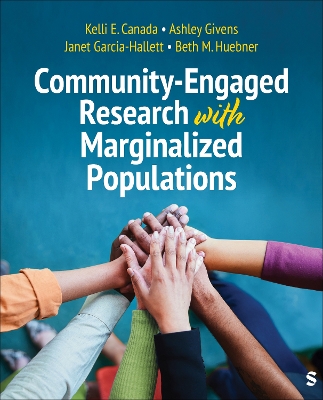
This text is a concise, accessible, and applied how-to guide for people interested in conducting community-engaged research. The authors define specific community-engaged research approaches, and then present a variety of strategies, resources, and tips throughout the book in the context of social justice and ethics. Written by authors who teach research methods and who conduct community-engaged research, the book benefits from a range of case studies and examples from areas as diverse as mental health, criminal-legal research, and urban planning. A short companion guide posted on the book’s website is designed for research teams to use collaboratively to build capacity in carrying out their research within communities.
Arvustused
This book will help students to expand their knowledge and understanding of community-based participatory research. It should be a primer for anyone interested in conducting research with communities. -- Jason Flatt This text is an essential addition to the community-engaged researchers library. Easy and interesting to read and packed with concrete examples and cases, the text concretizes the how and why of community-engaged research with marginalized populations. -- Lisa M. Vaughn
Preface
Acknowledgments
About the Authors
Part I: Community-Engaged Research History & Context
Chapter 1: History of Research With Marginalized and Oppressed Communities
Marginalized Populations
Historical Overview of Research Misuse/Abuse
Distrust and Mistrust in Research
Present-Day Research Neglect in Addressing Community Needs
Conclusion
Chapter 2: Philosophy and Principles of Community-Engaged Research
Defining Community & Academic
What is Community-Engaged Research?
History & Evolution of Community-Engaged Research
Philosophical Underpinnings & Core Principles of Community-Engaged
Research
Applying Community-Engaged Research
Preparing for the Research
Conclusion
Chapter 3: Continuum of Community-Engaged Approaches
Importance of Language
Overview of Community-Engaged Research Approaches
Why Do Community-Engaged Research?
Selecting the Right Approach
Challenges to Anticipate
Conclusion
Part II: Doing Community-Engaged Research: The Nuts and Bolts
Chapter 4: Partnering With Communities
Beginning a Research Partnership
Getting to Know One Another & Building Trust
Assessing and Identifying Needs
Defining Roles and Addressing Power Imbalances
Formal and Legal Agreements
When Conflict Arises
Sustaining Partnerships
Ethical Considerations
Documenting and Evaluating the Partnership
Conclusion
Chapter 5: Planning the Research
Planning Overview
Institutional Review Board (IRB)
Conclusion
Chapter 6: Building Capacity
Importance of Capacity Building
Approaches to Increase Capacity
Conclusion
Chapter 7: Collaborative Research Development and Data Sources
Ethical Considerations
Data Types
Data Collection
Conclusion
Chapter 8: Research Design: Collaboration From Design through Analysis
Group Designs
Sampling
Data Analysis
Interpreting Data
Conclusion and Call to Action
Chapter 9: Dissemination of Findings
Research Dissemination
The Importance of Translation
Dissemination Planning
Dissemination Approaches
Leveraging University Resources and Community Networks for Dissemination
Addressing Ethical Issues and Tensions
Conclusions
Part III: Ethical and Inclusive Practice
Chapter 10: Balancing Voice
Defining Power & the Role of Positionality
Addressing Power Imbalances
Disagreements & Conflicts
Conclusion
Appendix A
Appendix B
Glossary
References
Index
Kelli E. Canada, PhD, LCSW, is an Associate Professor at the University of Missouri, School of Social Work and the Marie M. and Harry L. Smith Endowed Professor. She received her PhD from the University of Chicago and worked more than 25 years in social work in direct services and administration. Dr. Canadas research focuses on interventions for people with mental illnesses who become involved in the criminal-legal system including community interventions, alternative sentencing, and programming within institutions using mixed methods and community-engaged approaches. She also examines the policies and practices impacting recidivism and quality of life of people formerly incarcerated. Dr. Canada is an alumnus of the Robert Wood Johnson Foundation Interdisciplinary Research Leader program and has active research projects funded through the National Institute of Mental Health, Arnold Ventures, and the Health Resources and Services Administration. She is an editor of the book Community-engaged research for resilience and health, Vol. 4. She currently serves on the board for the Society of Social Work and Research and is the co-Director of the Integrative Behavioral Health Clinic in Columbia, MO. Ashley Givens, PhD, LCSW, is a professor of social work at the University of Missouri. Her work centers around criminal legal involvement and its intersection with mental health and traumatic experiences. Dr. Givens also studies families, parent-child relationships, and social support. Dr. Givens has conducted research with individuals and staff associated with community supervision (i.e., probation and parole) as well as correctional institutions. Her work aims to provide meaningful interventions to reduce the amount of mental health needs, trauma symptoms, and social separation for individuals who interact with the criminal legal system. She teaches research methods, community and organizational health, social sciences measure development, and policy. Janet Garcia-Hallett, PhD, is an Associate Professor of Criminal Justice in the University of New Haven. Her research is focused on social justice issues for marginalized populations particularly, the impact of incarceration on communities of color and the obstacles women face before, during, and after incarceration. Her award-winning book, Invisible Mothers: Unseen Yet Hypervisible after Incarceration, explores how mothers of color navigate motherhood and life post-incarceration at the intersection of gender, motherhood, racial-ethnic background, and criminal record. It has received numerous recognitions, including the Academy of Criminal Justice Sciences (ACJS) 2024 Outstanding Book Award and the American Sociological Association (ASA) Section on Crime, Law, and Deviance 2023 Ida B. Wells-Barnett Distinguished Book Award. In collaboration with the authors of the current handbook, Dr. Garcia-Hallett has partaken in multi-year community-engaged research projects to improve prison conditions for those working and living in carceral spaces, and to promote the overall well-being of prison staff and residents. Beth M. Huebner, PhD, is the Director of the School of Criminology and Criminal Justice and Watts Endowed Professor of Public Safety at Arizona State University. Her principal research interests include punishment, the collateral consequences of contact with the criminal legal system, and public policy. She has spent most of her career partnering with local agencies and organizations on community-led reforms. Her research has been funded by the MacArthur Foundation, the National Institute of Justice, Pew Charitable Trusts, and Arnold Ventures, among others. She has served on many journal boards and has held leadership positions for Criminal Justice and Behavior and the Oxford Bibliographies in Criminology. She has served as the Vice President and Executive Counselor of the American Society of Criminology and the President of the Association of Doctoral Programs in Criminology and Criminal Justice.

 Lisainfo e-raamatute kohta