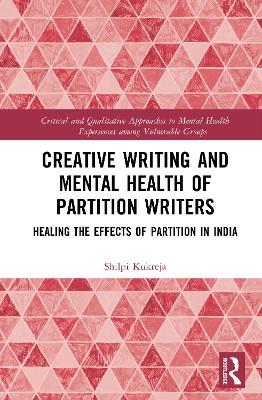
This book explores the life and works of two eminent writers of India – Bhishm Sahni and Joginder Paul, both of whom had to move to India following partition and wrote significant creative works on the theme of partition.
This book explores the life and works of two eminent writers of India – Bhishm Sahni and Joginder Paul, both of whom had to move to India following partition and wrote significant creative works on the theme of partition. Through the life story analysis of the writers’ life and works using constructivist grounded theory method, this book attempts a social constructionist understanding of the trauma of partition in the life of the writers. Based on the findings about creative writers’ experiences of suffering and healing, the book also contributes to theoretical and mental health rehabilitation-related concerns for creative persons as well as common human being who have survived historical trauma such as partition of India. It highlights the ways in which the drastically changed socio-political context, economic hardships, family roles and relationships besides personal and relational conflicts shaped their experiences of suffering. Another unique contribution of this study is the insights about creativity as reflexive experiential space for relating compassionately with suffering of common human beings, gathering moral courage to accept and reinterpret conflicts. The book marks a unique contribution to mental health in the context of socio-political disasters such as the 1947 partition of India. It is one of its kind in terms of explicating the relationship between mental health and process of creative writing by, a) providing a phenomenological understanding of the impact of partition on mental health, and b) by bringing out the potential within the creative space for restoration of mental health among creative writers. This book will be useful to students, researchers, and teachers from the fields of literature, creative writing, medical humanities, qualitative research, trauma studies, mental health, healing, psychology, sociology and anthropology.
Chapter 1 - Partition, Trauma, and Mental Health
Chapter 2 - Situating Creative Person in the Historical Context of Partition
Chapter 3 - Situating Suffering within Structural and Relational Context
Chapter 4 - Healing through Remoralisation and Transcendence
Chapter 5 - Weaving Links: Partition, Creativity, and the Stories of
Suffering and Healing
Shilpi Kukreja is a mother, independent researcher, and teacher with experience in higher education and secondary instruction. Her interests lie in the critical exploration of how historical and structural forces intersect with creativity, mental health, and education through qualitative methodology.

 Lisainfo e-raamatute kohta