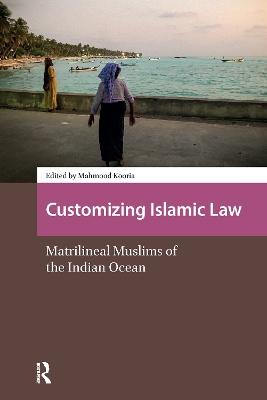
1. Takes the matrilineal Muslim communities from all over the Islamic world in a comparative and connected perspective 2. Compares the matrilineal Muslim communities among themselves as well as with the Jewish, Hindu and Christian communities as well. 3. Foregrounds the Indian Ocean world as an effective analytical frame to study the matrilineal communities. Millions of Muslims across the Indian Ocean littoral have historically followed a matrilineal system, where women had better economic and social stability and an upper hand in their personal choices. The system raised serious questions as the Islamic legal tradition evolved in the Middle East, especially when some inheritance customs gave men little to no share in the property. Bringing diverse matrilineal Muslim communities together for the first time, this volume studies their engagements against the patriarchal interpretations of Sharia in comparative and connected perspectives. The comparisons and connections go beyond the Indian Ocean and Islamic world, to the Mediterranean, Sub-Saharan and North African contexts as well as to the Christian, Jewish and Hindu traditions. The contributors explore how and why the followers of the matrilineal praxis defended the system within the legal epistemologies of their religion.
Bringing diverse matrilineal Muslim communities together, this volume studies their engagements against the patriarchal interpretations of Sharia in comparative and connected perspectives. The book explores how and why the followers of the matrilineal praxis defended the system within the legal epistemologies of their religion.
Millions of Muslims across the Indian Ocean littoral have historically followed a matrilineal system, where women had better economic and social stability and an upper hand in their personal choices. The system raised serious questions as the Islamic legal tradition evolved in the Middle East, especially when some inheritance customs gave men little to no share in the property. Bringing diverse matrilineal Muslim communities together for the first time, this volume studies their engagements against the patriarchal interpretations of Sharia in comparative and connected perspectives. The comparisons and connections go beyond the Indian Ocean and Islamic world, to the Mediterranean, Sub-Saharan and North African contexts as well as to the Christian, Jewish and Hindu traditions. The contributors explore how and why the followers of the matrilineal praxis defended the system within the legal epistemologies of their religion.
List of Figures and Tables, Acknowledgements,
1. Introduction: Can
Sharia be Customized? Entanglements between Matrilineal and Islamic
Traditions, PART I: SOCIAL CROSSROADS,
2. Engaging with Islamic Inheritance :
Matrilocal Marriage and Womens Dowry Houses in Sri Lanka and the Coromandel
Coast of Tamil Nadu,
3. Matriliny, Islam, and Womens Cultures on the Swahili
Coast,
4. For a Social History of Matriliny in Between Christianity and Islam
in Northern Mozambique: Notes on Cabo Delgado,
5. Matrilineal Jews or Slave
Descendants? Halakhic Laws and Trade Alliances in Medieval Malabar, PART II:
PATTERNS IN DISCOURSES,
6. The Adat Perpatih is Sharia Compliant : Practices,
Challenges, and Prospects in a Matrilineal Society in Negeri Sembilan, West
Malaysia,
7. Legal Debates on the Matrilineal System in Minangkabau,
Indonesia,
8. Matrilineal Reform in the Lakshadweep Archipelago : Debating
the Custom Through Islam,
9. Resilience of Matriliny Among Muslims of
Malabar,
10. Matrifocality, Islamic Law, and Modernity in Aceh, Indonesia,
PART III: RESILIENT PRACTICES,
11. Performative Spaces, Time Schemes, and
Gender Relations in Mappila Matriliny,
12. Spirit Possession, Islam, and
Matriliny in Northern Mozambique,
13. Poison in the Will: Transformation of
Muslim Matriliny in Colonial, Notes on the Editor and Contributors, Index
Mahmood Kooria is a historian based at University of Edinburgh, Scotland. He has authored Islamic Law in Circulation: Shafi'i. Texts across Mediterranean and Indian Ocean (Cambridge University Press, 2022), co-edited Islamic Law in the Indian Ocean: Texts, Ideas and Practices (Routledge, 2022) and Malabar in the Indian Ocean World: Cosmopolitanism in a Maritime Historical Region (Oxford University Press, 2018).

 Lisainfo e-raamatute kohta