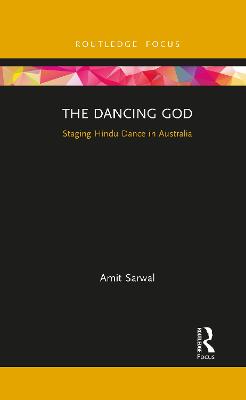
The Dancing God: Staging Hindu Dance in Australia charts the sensational and historic journey of de-provincialising and popularising Hindu dance in Australia.
In the late nineteenth and early twentieth centuries, colonialism, orientalism and nationalism came together in various combinations to make traditional Hindu temple dance into a global art form. The intricately symbolic Hindu dance in its vital form was virtually unseen and unknown in Australia until an Australian impresario, Louise Lightfoot, brought it onto the stage. Her experimental changes, which modernised Kathakali dance through her pioneering collaboration with Indian dancer Ananda Shivaram, moved the Hindu dance from the sphere of ritualistic practice to formalised stage art. Amit Sarwal argues that this movement enabled both the authentic Hindu dance and dancer to gain recognition worldwide and created in his persona a cultural guru and ambassador on the global stage.
Ideal for anyone with an interest in global dance, The Dancing God is an in-depth study of how a unique dance form evolved in the meeting of travellers and cultures.
List of figures; Glossary; Acknowledgements; Introduction: the
beginnings;
1. Hindu, Hinduism and Hindutva;
2. The Hindu dance;
3. The
Australian mother of Kathakali;
4. The dancing God; Conclusion: temple
dreaming; Bibliography; Index
Dr. Amit Sarwal is a senior lecturer in literature at the University of the South Pacific, an affiliate member of the Contemporary Histories Research Group at Deakin University and the founding convenor of Australia-India Interdisciplinary Research Network. His areas of interest include the South Asian diaspora, cultural diplomacy, Australia-India relations, and Bollywood. His research papers on these topics have appeared in high-ranking journals such as Asian Ethnicity, Dance Chronicle, Dance Research, Antipodes, South Asian Popular Culture, South Asian Diaspora, Journalism Studies, Politics & Policy and Culture, Society and Masculinities. He has many books to his credit, prominent being Wanderings in India (2012), Bollywood and Its Other(s) (2014), Labels and Locations (2015), Salaam Bollywood (2016), South Asian Diaspora Narratives (2016/2017), Louise Lightfoot in Search of India (2017) and Vyakul Rashtra (2017).

 Lisainfo e-raamatute kohta