Muutke küpsiste eelistusi

E-raamat: Democratic Wealth Stewardship: Governing Concentrated Wealth for the Public Good

(Illinios State University, USA)
  • Formaat: EPUB+DRM
  • Sari: Emerald Points
  • Ilmumisaeg: 05-May-2026
  • Kirjastus: Emerald Publishing Limited
  • Keel: eng
  • ISBN-13: 9781837422562
  • Formaat - EPUB+DRM
  • Hind: 52,65 €*
  • * hind on lõplik, st. muud allahindlused enam ei rakendu
  • Lisa ostukorvi
  • Lisa soovinimekirja
  • See e-raamat on mõeldud ainult isiklikuks kasutamiseks. E-raamatuid ei saa tagastada.
  • Formaat: EPUB+DRM
  • Sari: Emerald Points
  • Ilmumisaeg: 05-May-2026
  • Kirjastus: Emerald Publishing Limited
  • Keel: eng
  • ISBN-13: 9781837422562

DRM piirangud

  • Kopeerimine (copy/paste):

    ei ole lubatud

  • Printimine:

    ei ole lubatud

  • Kasutamine:

    Digitaalõiguste kaitse (DRM)
    Kirjastus on väljastanud selle e-raamatu krüpteeritud kujul, mis tähendab, et selle lugemiseks peate installeerima spetsiaalse tarkvara. Samuti peate looma endale  Adobe ID Rohkem infot siin. E-raamatut saab lugeda 1 kasutaja ning alla laadida kuni 6'de seadmesse (kõik autoriseeritud sama Adobe ID-ga).

    Vajalik tarkvara
    Mobiilsetes seadmetes (telefon või tahvelarvuti) lugemiseks peate installeerima selle tasuta rakenduse: PocketBook Reader (iOS / Android)

    PC või Mac seadmes lugemiseks peate installima Adobe Digital Editionsi (Seeon tasuta rakendus spetsiaalselt e-raamatute lugemiseks. Seda ei tohi segamini ajada Adober Reader'iga, mis tõenäoliselt on juba teie arvutisse installeeritud )

    Seda e-raamatut ei saa lugeda Amazon Kindle's. 
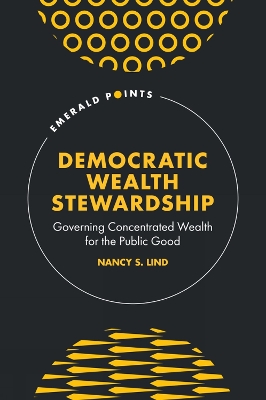
Over the past four decades, extreme wealth concentration has reshaped democratic societies, amplifying private power even as democratic institutions struggle to respond. This book offers a bold new framework for governing concentrated wealth - not as untouchable private property, but as a form of power that must be held accountable in the public interest.


In Democratic Wealth Stewardship, Nancy S. Lind brings together insights from political theory, economics, law, and comparative case studies to examine how wealth accumulation, philanthropy, and corporate power affect democratic governance. Through empirical analysis and global examples of participatory innovation, the book shows how democratic institutions can steward wealth to support equity, innovation, and longterm public goods while resisting authoritarian capture.


Written for scholars, policymakers, advocates, and engaged citizens, this book bridges normative theory and institutional design, offering concrete governance mechanisms for democracies confronting inequality, democratic erosion, and civilizationscale challenges. It argues that the future of democracy depends not on eliminating wealth, but on governing it democratically.
Introduction: Democracy Under Siege and the Case for Wealth Stewardship


Part I. The Crisis

Chapter
1. Wealth Concentration and the Authoritarian Threat

Chapter
2. The Innovation-Democracy Tension

Part II. The Framework

Chapter
3. Five Principles of Democratic Wealth Stewardship

Chapter
4. Historical Lessons

Part III. The Dual Nature

Chapter
5. When Private Wealth Serves Public Good

Chapter
6. The Democracy Deficit

Chapter
7. The Racial and Class Dimensions

Part IV. Solutions

Chapter
8. Pre-Distribution: Preventing Extreme Concentration

Chapter
9. Post-Distribution: Governing Deployment

Chapter
10. Participatory Innovations

Chapter
11. Implementation Strategies

Conclusion: Choosing Democracy
Nancy S. Lind is Professor Emerita of Political Science and Government at Illinois State University, USA, where she taught for more than three decades. Her work focuses on democratic governance, public law, public administration, and the ways concentrated economic power shapes political institutions and policy outcomes. An awardwinning teacher and widely published scholar, Linds research bridges democratic theory and applied policy analysis, with a sustained commitment to accountability, citizen participation, and institutional design in contemporary democracies.