Muutke küpsiste eelistusi

E-raamat: Development Trajectory of Communism in Poland: The Life of Wladyslaw Bienkowski, Communist Leader and Socialist Thinker

  • Formaat - EPUB+DRM
  • Hind: 59,79 €*
  • * hind on lõplik, st. muud allahindlused enam ei rakendu
  • Lisa ostukorvi
  • Lisa soovinimekirja
  • See e-raamat on mõeldud ainult isiklikuks kasutamiseks. E-raamatuid ei saa tagastada.
  • Raamatukogudele

DRM piirangud

  • Kopeerimine (copy/paste):

    ei ole lubatud

  • Printimine:

    ei ole lubatud

  • Kasutamine:

    Digitaalõiguste kaitse (DRM)
    Kirjastus on väljastanud selle e-raamatu krüpteeritud kujul, mis tähendab, et selle lugemiseks peate installeerima spetsiaalse tarkvara. Samuti peate looma endale  Adobe ID Rohkem infot siin. E-raamatut saab lugeda 1 kasutaja ning alla laadida kuni 6'de seadmesse (kõik autoriseeritud sama Adobe ID-ga).

    Vajalik tarkvara
    Mobiilsetes seadmetes (telefon või tahvelarvuti) lugemiseks peate installeerima selle tasuta rakenduse: PocketBook Reader (iOS / Android)

    PC või Mac seadmes lugemiseks peate installima Adobe Digital Editionsi (Seeon tasuta rakendus spetsiaalselt e-raamatute lugemiseks. Seda ei tohi segamini ajada Adober Reader'iga, mis tõenäoliselt on juba teie arvutisse installeeritud )

    Seda e-raamatut ei saa lugeda Amazon Kindle's. 

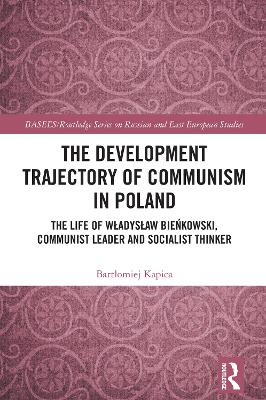
Charting the life and writings of Wladyslaw Bienkowski, a leading politician and writer in communist Poland and sometime right hand man and ideologue of the Polish leader Wladyslaw Gomulka, this book outlines the shifts in the nature of communism in Poland throughout the period of communist rule.


Charting the life and writings of Wladyslaw Bienkowski, a leading politician and writer in communist Poland and sometime right hand man and ideologue of the Polish leader Wladyslaw Gomulka, this book outlines the shifts in the nature of communism in Poland throughout the period of communist rule.

It considers the shaping of Bienkowski’s ideas in eastern Poland, later occupied by the Soviet Union, during the economic depression, the development of his great hopes for socialist socio-economic transformation as the right way forward, and his and Gomulka’s attempts to enact “people’s democracy” and “socialist humanism” in the period 1945 to 1948, attempts which failed, Stalinist repression coming to the fore instead. The book further discusses Bienkowski’s role as a minister in the period following Stalin’s death, when Bienkowski was a leading “revisionist”, warning of the dangers of the “petrification of the system”, and to explain how with a sense of shattered hopes he resigned from power and became a dissident, publicly critical of the regime. The book concludes by examining Bienkowski’s writings in post-communist times when, now just an observer, he continued to reflect on and write about the future of socialism. Overall, the book demonstrates that communism in Eastern Europe was flexible and adaptable, and not rigidly monolithic as it is often portrayed.

The book will be of interest to academics and scholars interested in the history of communism and Europe.

Introduction

1. A dreamer: Wadysaws formative days (1906-1939)

2. How the steel was tempered: A communist in the East and in the
underground (19391945)

3. Dr. Jekyll and Mr. Hyde: A demiurge of the gentle revolution
(19451948).

4. The neck that turned Gomukas head: The Stalinist purgatory
(19481953)

5. A revolutionary (19531959)

6. Contesting the drab real socialism (19591968)

7. A dissident (1968-1980)

8. Faust in an ivory tower. What has remained of socialism? (1980-1991)

Concluding remarks

Index
Bartomiej Kapica is an assistant professor at the Research Centre for Totalitarianism at the Pilecki Institute in Warsaw. He earned his Ph.D. in history from the Faculty of History, Adam Mickiewicz University of Pozna, in 2015. He was an assistant professor at the Institute of History of the Polish Academy of Sciences in Warsaw (from 2016 to 2018 under the NCN FUGA Fellowship) and a scholar at the Universita di Roma, La Sapienza, in Rome (2013). His research interests include Biographical studies, history of the communist movement in Poland, Polish political history and intellectual history.