Muutke küpsiste eelistusi

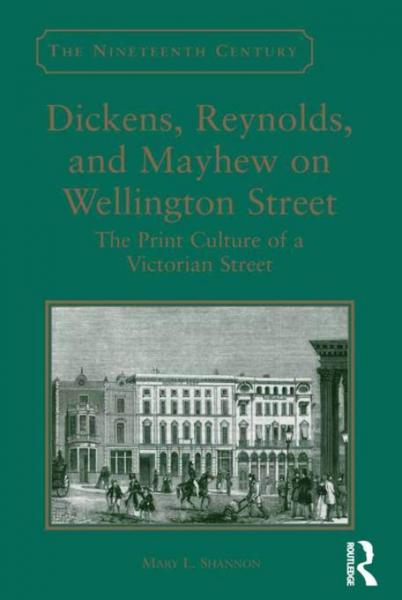
E-raamat: Dickens, Reynolds, and Mayhew on Wellington Street: The Print Culture of a Victorian Street

  • Formaat - EPUB+DRM
  • Hind: 59,79 €*
  • * hind on lõplik, st. muud allahindlused enam ei rakendu
  • Lisa ostukorvi
  • Lisa soovinimekirja
  • See e-raamat on mõeldud ainult isiklikuks kasutamiseks. E-raamatuid ei saa tagastada.

DRM piirangud

  • Kopeerimine (copy/paste):

    ei ole lubatud

  • Printimine:

    ei ole lubatud

  • Kasutamine:

    Digitaalõiguste kaitse (DRM)
    Kirjastus on väljastanud selle e-raamatu krüpteeritud kujul, mis tähendab, et selle lugemiseks peate installeerima spetsiaalse tarkvara. Samuti peate looma endale  Adobe ID Rohkem infot siin. E-raamatut saab lugeda 1 kasutaja ning alla laadida kuni 6'de seadmesse (kõik autoriseeritud sama Adobe ID-ga).

    Vajalik tarkvara
    Mobiilsetes seadmetes (telefon või tahvelarvuti) lugemiseks peate installeerima selle tasuta rakenduse: PocketBook Reader (iOS / Android)

    PC või Mac seadmes lugemiseks peate installima Adobe Digital Editionsi (Seeon tasuta rakendus spetsiaalselt e-raamatute lugemiseks. Seda ei tohi segamini ajada Adober Reader'iga, mis tõenäoliselt on juba teie arvutisse installeeritud )

    Seda e-raamatut ei saa lugeda Amazon Kindle's. 

A glance over the back pages of mid-nineteenth-century newspapers and periodicals published in London reveals that Wellington Street stands out among imprint addresses. Between 1843 and 1853, Household Words, Reynolds’s Weekly Newspaper, the Examiner, Punch, the Athenaeum, the Spectator, the Morning Post, and the serial edition of London Labour and the London Poor, to name a few, were all published from this short street off the Strand. Mary L. Shannon identifies, for the first time, the close proximity of the offices of Charles Dickens, G.W.M. Reynolds, and Henry Mayhew, examining the ramifications for the individual authors and for nineteenth-century publishing. What are the implications of Charles Dickens, his arch-competitor the radical publisher G.W.M. Reynolds, and Henry Mayhew being such close neighbours? Given that London was capital of more than Britain alone, what connections does Wellington Street reveal between London print networks and the print culture and networks of the wider empire? How might the editors’ experiences make us rethink the ways in which they and others addressed their anonymous readers as ’friends’, as if they were part of their immediate social network? As Shannon shows, readers in the London of the 1840s and '50s, despite advances in literacy, print technology, and communications, were not simply an ’imagined community’ of individuals who read in silent privacy, but active members of an imagined network that punctured the anonymity of the teeming city and even the empire.

Arvustused

2016 winner of The Robert and Vineta Colby Scholarly Book Prize

From the Committee: Mary L. Shannons book is an innovate expansion of the current interest in tracing networks into a consideration of the more concrete juxtaposition of bodies and buildings in space. Structured creatively around a day in the life of the street, the book entices us into seeing what would have been obvious to the Victorian eye and ear, but which our standard narratives have occluded. Shannon connects some of the more ephemeral products of the press and the situation of their production with canonical works, such as Bleak House, produced in the same milieu.Its a book that models new ways to do our business.

Awarded the Colby Book Prize

'Mary L. Shannons informative book offers an entirely new way to think about print culture. In focusing on Wellington Street off the Strand, where important Victorian writers such as Dickens, Mayhew, and Reynolds maintained their offices, she demonstrates the significance of geography for understanding the print networks that developed in midcentury London.' - Anne Humpherys, City University of New York, USA, author of Travels into the Poor Mans Country: The Work of Henry Mayhew

Shannons exemplary research takes her on a series of errands in order to reconstruct the working practices of Wellington Street in the period under scrutiny: examining metropolitan and borough archives, city guide books, directories, advertisements, maps and playbills, as well as an admirable range of types and genres of literary production. - John Drew, University of Buckingham, Dickens Quarterly

This is such a good book. Much of its immediate impact lies in its striking originality, of structure and of method, even if sometimes not all of it comes off. And while the book is risktaking, exploratory, and conspicuous for the breadth of its data, its discourse is largely traditional and verbal, its readings are close and wide but not distant. - Laurel Brake, The London Journal

Certainly this is a book which deserves a wide readership of its own. Like Wellington Street itself, Shannons monograph and the new model of the literary network that she proposes has the potential for impact far beyond its apparent compass. - Jessica Hindes, University of London

The primary research here on Melbourne Punch, Orion Horne and the influence of Dickens and Sala upon Marcus Clarkes night-walking sketches addresses an important gap in the study of nineteenth-century Anglo-Australian transnational exchanges to date. It also extends the range of scholars and readers for whom this rich and extraordinarily detailed book is likely to be of interest: not only Dickensians, but those working on Victorian literary and visual cultures, nineteenth-century periodicals and newspapers, Melbournes Bohemia and anyone interested in the historical geography of urban space. - Catherine Waters, University of Kent

This, as I hope this review has made clear, is a work of impressive research in which intensive and meticulous historical, biographical and topographical research come together. The result is to provide us with a valuable addition to our knowledge and understanding of the way in which certain notable print networks, both in London and in Melbourne, were operating in the mid-nineteenth century. - Michael Slater, Birkbeck, University of London, UK

List of Figures
ix
Acknowledgements xiii
List of Abbreviations
xv
Introduction 1(20)
Arrival on Wellington Street
1(8)
Urban Print Networks and the Everyday
9(5)
Gender, Place, and Modernity
14(3)
Outline of
Chapters
17(4)
1 Morning: `The Smallness of the World'
21(48)
Editors on Wellington Street
24(13)
Rival Networks
37(10)
Street Life
47(17)
`Tillers of the Field' and Household Words
64(5)
2 Afternoon: `Dissolute and Idle Persons'
69(44)
Delinquency on the Streets and on the Page: G.W.M Reynolds and the Trafalgar Square Demonstration
72(11)
The Radical Press around Wellington Street
83(17)
`Spoilt by Improvement': The Mysteries of London
100(13)
3 Evening: `The Showman Introduces Himself'
113(52)
The Local and the Outsider
117(13)
The Writer-as-Showman, Adaptation, and the `Real' Public
130(20)
Anonymity, Mayhew, and the Drama of the Streets
150(15)
4 Night: `The Compass of the World and They That Dwell Therein'
165(54)
The Emigrant's Body: R.H. Horne and Melbourne Punch
171(8)
Horne and the Print Networks of London and Melbourne
179(21)
`Borrowed Metaphors and Stolen Thoughts': Marcus Clarke's Night-time
200(13)
Conclusion: `Very Curiously Brought Together' by Bleak House
213(6)
Appendix 219(2)
Bibliography 221(32)
Index 253
Mary L. Shannon received her BA from the University of Cambridge and her PhD from Kings College London. She is a postdoctoral research fellow in the Department of English and Creative Writing, University of Roehampton, London. She works on early nineteenth-century print culture and visual culture, with particular interests in literary networks, cultural geography, periodicals, and literature about London.