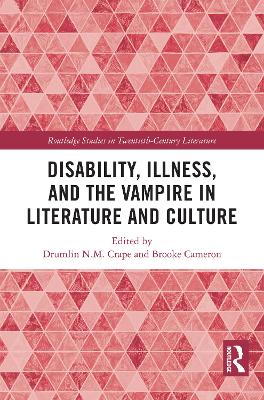
Drumlin N.M. Crape and Brooke Cameron’s Disability and the Vampire is an edited collection of essays addressing a wide range of literary depictions of vampirism and disability.
Drumlin N.M. Crape and Brooke Cameron’s Disability and the Vampire is an edited collection of essays addressing a wide range of literary depictions of vampirism and disability, from early and formative Victorian vampire stories like Eric Stenbock’s ‘The True Story of a Vampire’ (1894) and Dion Boucicault’s The Vampire (1852) to contemporary depictions across media forms, including the novels that comprise Anne Rice’s The Vampire Chronicles (1976-2018), television shows like The Vampire Diaries (2009-2017) and Midnight Mass (2021), and recent video games like V Rising (2022).
In addition to this breadth of vampires and vampire stories included, this collection emphasizes a broad and multifaceted understanding of disability that is critical of the historical and ongoing ways that ableism and rigid ideas about normalcy have linked monsters like vampires to disabled people.
By critically examining the way disability is presented in vampire stories, the work of this collection’s contributors speaks to evolving ideas of who counts as human–and of what, exactly, the figure of the vampire has to teach us about our own humanity.
Foreword Introduction: The Vampire and Disability Section 1: Disabled
vampire embodiment
Chapter
1. Anne Rices Liminal Women Vampires Impairment
and Power
Chapter
2. The Duality of the Deaf Vampire in Peter Wolfs Deafula
(1975)
Chapter
3. Violet Hunt's Vampire, Reversed
Chapter
4. Render her a
tempting morsel: Unholy Appetites and Disordered Bodies in Florence
Marryats The Blood of the Vampire
Chapter
5. Queer Teen/Vamp Love in an
Ableist World Section 2: Narrating the disabled vampire
Chapter
6. Nervous
Vampirism and Narrative Disability in The True Story of a Vampire by Eric
Stenbock
Chapter
7. Russian Literary Vampire: a Lonely Demon or a Disabled
Man?
Chapter
8. The Mechanics of Marginality: Making Vampires from Video Game
Players in V Rising
Chapter
9. Narrating Disability in Arthur Conan Doyles
The Adventure of the Sussex Vampire Section 3: Invisible disability, mental
health, and the vampire
Chapter
10. My Own Mind is a Demon that Haunts Me:
The Dawn of the Bipolar Vampire
Chapter
11. Vampirism and/as Mental Illness:
Martin and The Transfiguration
Chapter
12. The Autistic Vampire
Chapter
13.
Memories that Haunt: Traumatic Histories in Dion Boucicaults The Vampire
(1852)
Chapter
14. Caregiving and the Disabled Female Body in Mary Wilkins
Freemans Luella Miller" Section 4: Reimagining vampirism
Chapter
15. Bloody
Bitch: The Deviant Biofictions of Countess Elizabeth Bįthory
Chapter
16. 'The
Vampyre of Time and Memory: Vampirism and Trauma in Tana Frenchs In the
Woods
Chapter
17. 'You stole from me! Not just who I was, but who I couldve
been.: Intersections of Disability, Time, and Child Vampirism in Midnight
Mass (2021) and Interview with a Vampire (1994) and (2022)
Chapter
18. 'Its
like being stuck indoors with the flu watching daytime television, forever
and ever: Chronic Illness and Crip Time in Catherine Jinks The Reformed
Vampire Support Group
Drumlin N.M. Crape is a PhD candidate in the Department of English & Creative Writing at Queens University, Canada.
Brooke Cameron is Associate Professor of English at Queens University, Canada.


 Lisainfo e-raamatute kohta