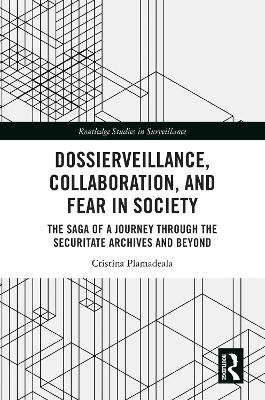
Exploring the cultural history of surveillance practices of the Securitate, Romania’s secret police during its communist period, the book blends biographical details in a historical inquiry to establish the concepts of psuchegraphy, dossierveillance, and banalization of evil in the study of Securitate Archives.
In the context of communist Romania under the reign of Nicolae Ceausescu (1965-89), dossierveillance was a type of surveillance that stresses the miasmic effect of Securitate dossiers in the daily life of Romanians. Centered around the analysis of this concept, the book presents a unique account of the surveillance practices of totalitarian and authoritarian regimes, expanding its relevance to fear in the current neo-liberal societies. This book will appeal to students of Eastern European history and politics, criminology, sociology, anthropology, and surveillance studies.
Exploring the cultural history of surveillance practices of the Securitate, Romania’s secret police during its communist period, the book blends biographical details in a historical inquiry to establish the concepts of psuchegraphy, dossierveillance, and banalization of evil in the study of Securitate Archives.
Part 1: An Itinerant in the Securitate Archives
1. Three Questions
2. Doing Research in the Securitate Archives
3. Brief Historical Overview: Romania and the Other Satellite States during
the Cold War
Part 2: The Reluctant Betrayal: Collaboration During Nicolae Ceauescu Regime
(1965-89)
4. Defining Psuchegraphy: Antonie Plmdeals Novel Trei Ceasuri īn Iad
5. The Four Stages of Psuchegraphic Work in Securitate Manuals
6. On Dossierveillance in Communist Romania under Ceauescu: its tangible
dimension
7. On Dossierveillance in Communist Romania under Ceauescu: its
non-tangible dimension
8. Post-recruitment: Between Banalization of Evil and Perpetration
Part 3: Dossierveillance Then and Now
9. On Centralized Deliberate Dossierveillance
10. Centralized Deliberate Dossierveillance and Lustration
11. A Few More Thoughts on Dossierveillance
Cristina Plamadeala is a researcher. She writes about surveillance practices in totalitarian and neo-liberal societies. She has published works on the subject of religion, culture and politics, Romanian history, and the history of communism. A philosopher and historian of Eastern European history by training, with a background in theology, her work attempts to ask historical questions through philosophical and theological lenses. In her spare time, she writes novels and divides her time between Quebec, Canada, and France.


 Lisainfo e-raamatute kohta