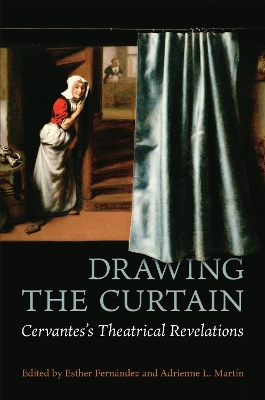
Miguel de Cervantes’s experimentation with theatricality is frequently tied to the notion of revelation and disclosure of hidden truths. Drawing the Curtain showcases the elements of theatricality that characterize Cervantes’s prose and analyses the ways in which he uses theatricality in his own literary production.
Bringing together the works of well-known scholars, who draw from a variety of disciplines and theoretical approaches, this collection demonstrates how Cervantes exploits revelation and disclosure to create dynamic dramatic moments that surprise and engage observers and readers. Hewing closely to Peter Brook’s notion of the bare or empty stage, Esther Fern ndez and Adrienne L. Mart n argue that Cervantes’s omnipresent concern with theatricality manifests not only in his drama but also in the myriad metatheatrical instances dispersed throughout his prose works. In doing so, Drawing the Curtain sheds light on the ways in which Cervantes forces his readers to engage with themes that are central to his life and works, including love, freedom, truth, confinement, and otherness.
Drawing the Curtain examines the ways in which Miguel de Cervantes experiments with theatre and exploits theatricality in his diverse literary creations.
Arvustused
"This collection of essays stands as a fantastic example of how differing cultural studies approaches can be used to examine a single thematic, in this case Cervantine theatricality. Individually, each chapter represents a well-researched and incredibly insightful investigation into studies on theater and Cervantes on whole. In short, it is a collection of essays that presents value for graduate students and well-established scholars alike." - Brian M. Phillips, Jackson State University (Hispanofila)
Introduction: The Poetics of the Imagined Stage
Esther Fernįndez and Adrienne L. Martķn
Part One: Alternate Theatricalities in Cervantess Drama
1. Cervantes and the Simple Stage
Bruce R. Burningham
2. Queer Cambalaches in El rufiįn dichoso
John Slater
3. Of Players and Wagers: The Theatricality of Gambling for Salvation in El
rufiįn dichoso
Sonia Velįzquez
4. Writing to Rescue from Oblivion: The Phantasms of Captivity in El trato
de Argel
Julia Domķnguez
5. Captivating Music, Memory, and Emotions in Los bańos de Argel
Sherry Velasco
6. In the Name of Love: Cervantess Play on Captivity in La gran sultana
Ana Laguna
7. Revolving Sets: Spatial Revelations in the Entremeses
Esther Fernįndez and Adrienne L. Martķn
Part Two: Acts of Disclosure in Cervantess Prose
8. Coups de théātre in the Novelas ejemplares
B.W. Ife
9. Captive Audiences: Performing Captivity in Cervantess Prose Narrative
Catherine Infante
10. Painting into Theatre: "The Suicide of Lucretia" as a Tableau Vivant in
El curioso impertinente
Mercedes Alcalį-Galįn
11. "Muchas y muy verdaderas seńales": The Theatrics of Truth and Sincerity
of Fiction in La Galatea
Paul Michael Johnson
12. Eavesdropping or Spying? Secret Places and Spaces in Don Quixote
Eduardo Olid Guerrero
13. Don Quixote and the Performance of Aging Masculinities in Early Modern
Spain
José R. Cartagena Calderón
Esther Fernįndez is an associate professor in the Department of Modern and Classical Literatures and Cultures at Rice University.
Adrienne L. Martķn is a professor emerita of early modern Spanish literature and culture and former Vice Provost-Global Affairs at the University of California, Davis.

 Lisainfo e-raamatute kohta