Muutke küpsiste eelistusi

E-raamat: Earthquake Statistical Analysis through Multi-state Modeling

(Le Mans University, France), (Aristotle University of Thessaloniki, Greece), (Aristotle University of Thessaloniki, Greece), (University of Technology of Compiègne, France)
  • Formaat: PDF+DRM
  • Ilmumisaeg: 03-Jan-2019
  • Kirjastus: ISTE Ltd and John Wiley & Sons Inc
  • Keel: eng
  • ISBN-13: 9781119579069
  • Formaat - PDF+DRM
  • Hind: 171,60 €*
  • * hind on lõplik, st. muud allahindlused enam ei rakendu
  • Lisa ostukorvi
  • Lisa soovinimekirja
  • See e-raamat on mõeldud ainult isiklikuks kasutamiseks. E-raamatuid ei saa tagastada.
  • Raamatukogudele
  • Formaat: PDF+DRM
  • Ilmumisaeg: 03-Jan-2019
  • Kirjastus: ISTE Ltd and John Wiley & Sons Inc
  • Keel: eng
  • ISBN-13: 9781119579069

DRM piirangud

  • Kopeerimine (copy/paste):

    ei ole lubatud

  • Printimine:

    ei ole lubatud

  • Kasutamine:

    Digitaalõiguste kaitse (DRM)
    Kirjastus on väljastanud selle e-raamatu krüpteeritud kujul, mis tähendab, et selle lugemiseks peate installeerima spetsiaalse tarkvara. Samuti peate looma endale  Adobe ID Rohkem infot siin. E-raamatut saab lugeda 1 kasutaja ning alla laadida kuni 6'de seadmesse (kõik autoriseeritud sama Adobe ID-ga).

    Vajalik tarkvara
    Mobiilsetes seadmetes (telefon või tahvelarvuti) lugemiseks peate installeerima selle tasuta rakenduse: PocketBook Reader (iOS / Android)

    PC või Mac seadmes lugemiseks peate installima Adobe Digital Editionsi (Seeon tasuta rakendus spetsiaalselt e-raamatute lugemiseks. Seda ei tohi segamini ajada Adober Reader'iga, mis tõenäoliselt on juba teie arvutisse installeeritud )

    Seda e-raamatut ei saa lugeda Amazon Kindle's. 

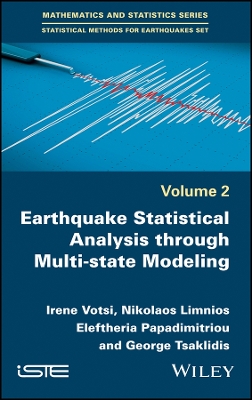
This book is concerned with a number of central themes in a rapidly developing area, earthquake occurrence modelling. The book starts with an introductory chapter that sketches out the state-of-the-art earthquake modelling approaches based on Markov and semi–Markov models. In Chapter 2 the long–term seismogenesis is presented in association with the evolving stress field. The occurrence times of the earthquakes are considered to have been advanced, i.e. triggered by accumulated stress changes from past nearby earthquakes and tectonic loading on the major regional faults. Chapters 3 and 4 cover the application of discrete-time hidden Markov models (HMMs) and hidden semi–Markov models (HSMMs) to earthquake occurrence data from Greece and surrounding lands. A nonparametric estimation method is used by means of which, insights into features of the earthquake process are provided which are hard to detect otherwise. Important indicators concerning the levels of the stress field are estimated by means of the suggested HMM and HSMM. Chapter 5 discusses the evaluation of the discrete-time intensity of the hitting time (DTIHT) with regard to semi–Markov chains (SMCs) and hidden Markov renewal chains (HMRCs). In addition to providing results on the evaluation of the DTIHT, it also contains formulas for DTIHT statistical estimation for both SMCs and HMRCs. This Chapter also discusses the asymptotic properties of the estimators, including strong consistency and asymptotic normality. It also contains detailed examples illustrating the theoretical results. Chapter 6 focuses on the comparison between HMMs and HSMMs in a Markov and a semi–Markov framework in order to highlight possible differences in their stochastic behavior partially governed by their transition probability matrices. Results are given in the general case where specific distributions are assumed for sojourn times as well as in the special case concerning the models applied in the previous chapters, where the sojourn time distributions are estimated non-parametrically. The impact of the differences is observed through the calculation of the mean value and the variance of the number of steps that the Markov chain (HMM case) and the EMC (HSMM case) need to make for visiting for the first time a particular state. Finally, Chapter 7 summarizes some of the most important results, provides concluding remarks and perspectives.
List of Abbreviations
ix
List of Symbols
xi
Preface xv
Introduction xix
Chapter 1 Fundamentals on Stress Changes
1(34)
1.1 Introduction
1(3)
1.2 Stress interaction
4(8)
1.3 Stress changes calculation
12(3)
1.4 Modeling of Coulomb stress changes for different faulting types
15(6)
1.4.1 ΔCS for strike-slip faulting
15(1)
1.4.2 ΔCS for dip-slip faulting
16(5)
1.5 Seismicity triggered by stress transfer
21(10)
1.5.1 Triggering of strong earthquakes
21(2)
1.5.2 Aftershock triggering
23(5)
1.5.3 Triggering of mining seismicity
28(3)
1.6 Discussion on stress interaction
31(4)
Chapter 2 Hidden Markov Models
35(22)
2.1 Introduction
35(2)
2.2 Hidden Markov framework
37(5)
2.3 Seismotectonic regime and seismicity data
42(2)
2.4 Application to earthquake occurrences
44(10)
2.4.1 Two hidden states and three observation types
45(3)
2.4.2 Three hidden states and three observation types
48(2)
2.4.3 Model selection and simulation
50(3)
2.4.4 Steps number for the first earthquake occurrence
53(1)
2.5 Conclusion
54(3)
Chapter 3 Hidden Markov Renewal Models
57(18)
3.1 Introduction
57(1)
3.2 Semi-Markov framework
58(7)
3.3 Hidden Markov renewal framework
65(1)
3.4 Modeling earthquakes in Greece
66(7)
3.4.1 Hitting times and earthquake occurrence numbers
69(4)
3.5 Conclusion
73(2)
Chapter 4 Hitting Time Intensity
75(14)
4.1 Introduction
75(1)
4.2 DTIHT for semi-Markov chains
76(7)
4.2.1 Statistical estimation of the DTIHT
78(5)
4.3 DTIHT for hidden Markov renewal chains
83(4)
4.3.1 Statistical estimation of the DTIHT
85(2)
4.4 Conclusion
87(2)
Chapter 5 Models Comparison
89(10)
5.1 Introduction
89(1)
5.2 Markov framework
90(3)
5.2.1 HMM case
92(1)
5.2.2 HMRM case
92(1)
5.3 Markov renewal framework
93(4)
5.3.1 HMM case
95(1)
5.3.2 HMRM case
96(1)
5.4 Conclusion
97(2)
Discussion & Concluding Remarks 99(6)
Appendices 105(2)
Appendix 1 107(6)
Appendix 2 113(4)
Appendix 3 117(2)
References 119(18)
Index 137
Irene Votsi is Assistant Professor of Statistics at the Manceau Laboratory of Mathematics, Le Mans University, France.

Nikolaos Limnios is Professor of Applied Mathematics at the University of Technology of Compiègne, Sorbonne University, France.

Eleftheria Papadimitriou is Professor of Seismology at the Aristotle University of Thessaloniki, Greece.

George Tsaklidis is Professor of Probability and Statistics at the Aristotle University of Thessaloniki, Greece.