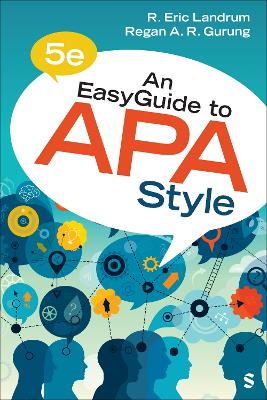
Your Clear Path to Mastering APA Style
This accessible and student-focused guide demystifies APA Style and formatting, making it easier than ever to write with confidence. Fully aligned with the Publication Manual of the American Psychological Association, Seventh Edition, this updated guide is designed to help students avoid common mistakes and apply APA rules accurately and efficiently.
Written in a conversational tone, the guide includes real-world examples, an annotated sample student paper, and practical tips that simplify even the most complex APA guidelines. Whether used alongside the Publication Manual or on its own, An EasyGuide to APA Style, Fifth Edition helps students quickly become proficient in APA Style.
Arvustused
A highly engaging, carefully presented overview of APA. Applicable to experts as much as beginners. -- Will Miller * Pre-Revision Review * Overall, I LOVE this book. Its a little easier to navigate than OWL and is very concise in presentation. -- Stephani Cuddie * Pre-Revision Review * This is a book that helps students become acquainted with APA style in a brief, easy-to-use format. -- Timothy Gunnells * Pre-Revision Review *
Preface
About the Authors
Section I Overview
Chapter 1 APA Style Versus Format: Why It Matters to Your Audience and Why
It Should Matter to You
What Is the Difference Between APA Style and APA Format?
Why APA Style Anyway? Wasnt MLA Good Enough?
In the Long Run, Attention to Detail Matters (Including APA Style and
Format)
Write for Your Specific Audience: Term Papers Versus Formal Research
Papers
Chapter 2 Your Visual Table of Contents QuickFinder
The Sample Paper With Content and
Chapter Numbers
Section II Writing With (APA) Style: BIG-PICTURE ITEMS
Chapter 3 General Writing Tips Specific to APA Style: General Bare-Bones
Fundamentals
Clear and Succinct Writing: Using Your Scholarly Voice
Commonly Confused Words in Psychology and Beyond
SubjectVerb Agreement
Active Voice Versus Passive Voice in APA style
Some (But Not Too Much) First-Person Usage
Avoiding Anthropomorphism/the Pathetic Fallacy Error
Chapter 4 A Quick Grammar Summary for APA-Style Writing
Parts of a Sentence
Parts of Speech
Common Grammar Mistakes to Avoid
Chapter 5 Plagiarism and How to Avoid It: Thou Shalt Not Steal (or Be
Lazy)
But I Didnt Know.?.?.?.
It Sounds Like a Bad Word
Quoting: More Than Just a Copy and Paste
Paraphrasing: In Your Own Words
Thats Really Sic [ and Not a Typo]
An Authors License (Yours): Modifying Source Material
But I Can Freely Use My Own Work, Right?
How About This for a Plagiarism Awareness Exercise?
Chapter 6 Avoiding Biased Language
Section III Writing With (APA) Style: GETTING DOWN TO BUSINESS
The Fundamental Lesson: View People as Individuals First
Specific Recommendations for Reducing Bias: Nonsexist Language and Other
Areas
Sexual Orientation
Racial and Ethnic Identity
Disabilities
Occupations
Gender and Pronouns: With an Indefinite Recommendation
Chapter 7 Writing Your Introduction: Tying the Story All Together
What to Include in Your Introduction
Formatting Your Introduction
Getting Your Introduction Started
Using an Outline: Organizing Your Literature Review
Common Mistakes to Avoid in Your Introduction
Chapter 8 Citing Sources in Text: Whodunit (or Said It)?
A Good Rule of Thumb
Ready, Cite, GO
In-Text Citation Basics
Some Exceptions
Chapter 9 A Step-by-Step Playbook of Your Method: How, What, When, Who, and
Where?
Where in the Flow of Pages Do You Place the Method Section?
Where in the Method Section Does This Information Go?
Subjects/Participants
Materials and Apparatus
Procedure
Formatting Your Method Section
Chapter 10 Writing About Statistics and Associated Fun: How Did It All Turn
Out?
Let Us Talk Statistics
Basics and Beyond
Formatting Your Results Paragraph
Including Effect Size and Power
Chapter 11 Writing Your Discussion: Its a Wrap
Formatting Your Discussion Section
What to Include in Your Discussion Section
Getting Your Discussion Section Started
Organizing Your Discussion Section
Common Mistakes to Avoid in Your Discussion Section
Sample Paper
Chapter 12 Everybody Needs References
A Helpful Note
Creating Your References Section
Using Abbreviations
The Basics
Basic References Section Formatting Rules
Some Not-So-Basic Rules You Might Need
Section IV Presenting Your Work in APA Format
Chapter 13 The Numbers Game: How to Write Numbers (and When the Rules
Change)
When You Use Numerals
When You Use Words
Using Both Numerals and Words
How to Use Decimal Points
Additional Rules for Including Numbers in Your Paper
Metrication
When Do You Use Abbreviations?
Chapter 14 Formatting: Organizing, Headings, and Making Your Work Look Good
to Print
What Goes Where?
What Your Paper Should Look Like
Headings
Spelling Matters: Spelling and Capitalization Rules
Final Touches
Chapter 15 Table That Motion: The Special Challenges of Tables and Figures
What Is What
Getting the Details Just Right
A Note on Notes
Figuring It Out
Get Legendary (and Use Captions)
Where to Place Tables and Figures
But I Am Doing a Literature Review: Could I Use a Table or Figure?
Do Not Forget
Chapter 16 Make Microsoft Word Work for You: APA Formatting
Word Tabs and Drop-Down Menus
Setting the Margins
Line Spacing and Spacing Between Paragraphs
Page Numbering
Tabs, Centering, and the Ruler
References and the Hanging Indent
Preparing a Table (Rows, Columns, Lines, Centering)
Fonts and Font Variations (Italics, Bold, Superscript)
Page Breaks, Orphans, and Widows
Spellchecker and Grammar Checker
Developing Good Habits: Autosaving, File Naming, File Storage, Frequent
Backups
Section V Some Nitty-Gritty Details
Chapter 17 Making a List, No Apps Required: Enumeration and Seriation
Why Bother?
Keeping Order at the Section Level
Order Within Paragraphs or Sentences
On a Related Note
Chapter 18 Abbreviations, Signs, Symbols, and Punctuation: The Details Can
Matter: Emoji This!
OMG: To Abbreviate or Not?
Blinding You With Science and Latin
Punctuation
Section VI In Closing: IMPORTANT CONSIDERATIONS
Chapter 19 Using Rubrics: Knowing What It Means to Write a Good Paper
Follow Rubrics When Provided
Example Rubrics
Chapter 20 Proofreading the Entire Paper: Get It Right!
Sample Pages of APA Text for Practicing Proofreading
Chapter 21 How to Avoid the Most Common Mistakes: All Together Now
APA Style and Format Quiz
APA Style and Format Quiz: Answers
Be Aware of Professors Pet Peeves
Appendix A: APA Style and Format Checklist
References
Index
R. Eric Landrum is a professor and chair in the Department of Psychological Science at Boise State University. He received his PhD in cognitive psychology from Southern Illinois UniversityCarbondale. He is a research generalist, broadly addressing the improvement of teaching and learning, including the long-term retention of introductory psychology content, skills assessment, improvement of help-seeking behavior, innovations in advising, understanding of student career paths, the psychology workforce, successful graduate school applications, and more. Eric has made more than 425 presentations, written 23 books, and published 85 peer-reviewed journal articles. He has collaborated with more than 300 research assistants and taught more than 18,000 students in 28 years at Boise State. During summer 2008, he led an American Psychological Association (APA) working group at the National Conference for Undergraduate Education in Psychology studying the desired results of an undergraduate psychology education. At the 2014 APA Educational Leadership Conference, Eric was presented with a presidential citation for outstanding contributions to the teaching of psychology. With the 2015 launch of the Scholarship of Teaching and Learning in Psychology journal, he served as inaugural coeditor. He is a member of APA, a fellow of Division 2 (Society for the Teaching of Psychology), and a fellow of Division 1 (General Psychology), and he served as STP president (2014). He served as the 20152016 president of the Rocky Mountain Psychological Association. He is a charter member of the Association for Psychological Science (named fellow in 2018). During 20162017, Eric was president of the Rocky Mountain Psychological Association, and he was president of Psi Chi, the international honor society in psychology, in 20172018. In August 2019, he received the American Psychological Foundations Charles L. Brewer Distinguished Teaching of Psychology Award, the highest award given to teachers of psychology in America. In April 2024, Eric was named a Distinguished Professor at Boise State, the highest award for tenured faculty at the university. In January 2025, he was named a Psi Chi Distinguished Member, the highest honor bestowed by the international honor society in psychology.
Regan A. R. Gurung is professor of psychological sciences at Oregon State University. He was on the faculty at the University of WisconsinGreen Bay (UWGB) for 20 years, where he was the Ben J. and Joyce Rosenberg Professor of Human Development and Psychology. He received a BA at Carleton College (Minnesota) and a PhD at the University of Washington. He then spent three years at the University of California, Los Angeles. He has published articles in a variety of scholarly journals, including Psychological Review and Teaching of Psychology. His textbook, Health Psychology: A Cultural Approach (SAGE, 2023) is in its fifth edition, and he has coauthored/edited 15 other books, including Study Like a Champ (APA, 2023) and Transforming Introductory Psychology (APA, 2023). He is a fellow of the American Psychological Association, the American Psychological Society, and the Midwestern Psychological Association. He has won the Founders Award for Excellence in Teaching as well as of the Founders Award for Scholarship at UWGB, and he was also the Carnegie Foundation for the Advancement of Teachings Wisconsin Professor of the Year (2009) and the UW System Regents Teaching Excellence Award winner. In August 2017, he received the American Psychological Foundations Charles L. Brewer Distinguished Teaching of Psychology Award, the highest award given to teachers of psychology in America, and he is the 2024 Oregon State University Margaret and Thomas Meehan Honors College Eminent Mentor. He is past president of the Society for the Teaching of Psychology and past president of Psi Chi, the international honor society in psychology. He is founding coeditor of the APA journal, Scholarship of Teaching and Learning in Psychology. In January 2025, he was named a Psi Chi Distinguished Member, the highest honor bestowed by the international honor society in psychology.

 Lisainfo e-raamatute kohta