Muutke küpsiste eelistusi
  • Formaat - PDF+DRM
  • Hind: 59,79 €*
  • * hind on lõplik, st. muud allahindlused enam ei rakendu
  • Lisa ostukorvi
  • Lisa soovinimekirja
  • See e-raamat on mõeldud ainult isiklikuks kasutamiseks. E-raamatuid ei saa tagastada.

DRM piirangud

  • Kopeerimine (copy/paste):

    ei ole lubatud

  • Printimine:

    ei ole lubatud

  • Kasutamine:

    Digitaalõiguste kaitse (DRM)
    Kirjastus on väljastanud selle e-raamatu krüpteeritud kujul, mis tähendab, et selle lugemiseks peate installeerima spetsiaalse tarkvara. Samuti peate looma endale  Adobe ID Rohkem infot siin. E-raamatut saab lugeda 1 kasutaja ning alla laadida kuni 6'de seadmesse (kõik autoriseeritud sama Adobe ID-ga).

    Vajalik tarkvara
    Mobiilsetes seadmetes (telefon või tahvelarvuti) lugemiseks peate installeerima selle tasuta rakenduse: PocketBook Reader (iOS / Android)

    PC või Mac seadmes lugemiseks peate installima Adobe Digital Editionsi (Seeon tasuta rakendus spetsiaalselt e-raamatute lugemiseks. Seda ei tohi segamini ajada Adober Reader'iga, mis tõenäoliselt on juba teie arvutisse installeeritud )

    Seda e-raamatut ei saa lugeda Amazon Kindle's. 

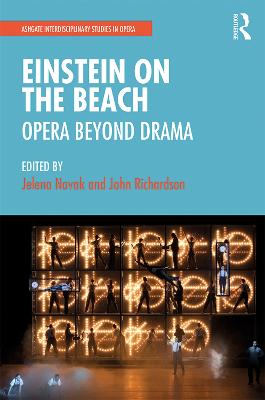
Philip Glass and Robert Wilson’s most celebrated collaboration, the landmark opera Einstein on the Beach, had its premiere at the Avignon Festival in 1976. During its initial European tour, Metropolitan Opera premiere, and revivals in 1984 and 1992, Einstein provoked opposed reactions from both audiences and critics. Today, Einstein is well on the way itself to becoming a canonized avant-garde work, and it is widely acknowledged as a profoundly significant moment in the history of opera or musical theater. Einstein created waves that for many years crashed against the shores of traditional thinking concerning the nature and creative potential of audiovisual expression. Reaching beyond opera, its influence was felt in audiovisual culture in general: in contemporary avant-garde music, performance art, avant-garde cinema, popular film, popular music, advertising, dance, theater, and many other expressive, commercial, and cultural spheres. Inspired by the 2012–2015 series of performances that re-contextualized this unique work as part of the present-day nexus of theoretical, political, and social concerns, the editors and contributors of this book take these new performances as a pretext for far-reaching interdisciplinary reflection and dialogue. Essays range from those that focus on the human scale and agencies involved in productions to the mechanical and post-human character of the opera’s expressive substance. A further valuable dimension is the inclusion of material taken from several recent interviews with creative collaborators Philip Glass, Robert Wilson, and Lucinda Childs, each of these sections comprising knee plays, or short intermezzo sections resembling those found in the opera Einstein on the Beach itself. The book additionally features a foreword written by the influential musicologist and cultural theorist Susan McClary and an interview with film and theater luminary Peter Greenaway, as well as a short chapter of reminiscences written by the singer-songwriter Suzanne Vega.

List of figures
vii
List of music examples
x
Series editor preface xi
Foreword xiii
Susan McClary
Contributors xvii
Acknowledgements xxiii
Introduction xxv
John Richardson
Jelena Novak
Knee chapter 1 Paying attention to Einstein: Philip Glass interview
1(12)
John Richardson
PART 1 Einstein on the shores of culture
13(74)
1 Einstein on the radio
15(34)
Robert Fink
2 Sous les paves, la plage
49(38)
Johannes Birringer Misko Suvakovic
Knee chapter 2 Einstein on the Beach is not radical, it is classic: Robert Wilson interviewed by Bojan Djordjev
79(8)
PART 2 From repetition to representation
87(62)
4 Intuition and algorithm in Einstein on the Beach
89(17)
Kyle Gann
5 "Only pictures to hear": reading Einstein on the Beach through experimental theatre
106(19)
Pwyll Ap Sion
6 Creating beauty in chaos: Robert Wilson's visual authorship in Einstein on the Beach
125(24)
Avra Sidiropoulou
Knee chapter 3 Stay out of the way of Bob Wilson when he dances: Lucinda Childs interviewed by Jelena Novak
141(8)
PART 3 Beyond drama: surfaces and agencies of performance
149(62)
7 Heavenly bodies: the integral role of dance in Einstein on the Beach
151(23)
Leah G. Weinberg
8 Anonymous voice, sound, indifference
174(37)
Zeynep Bulut
Knee chapter 4 Artists recall and respond
195(1)
Suzanne Vega, Under the influence -- Philip Glass
195(3)
Two Finnish composers reminisce: Juhani Nuorvala, Petri Kuljuntausta
198(5)
Tom Johnson, Rehearsing Einstein on the Beach
203(3)
Two steps forwards but three steps back, and then one step forwards again - Peter Greenway interviewed
206(5)
John Richardson
PART 4 Operatic machines and their ghosts
211(60)
9 Leaving and re-entering: punctuating Einstein on the Beach
213(18)
Sander Van Maas
10 Historia Einsteinalium: from the beach to the church, via theatre and "state bank"
231(40)
Jelena Novak
Knee chapter 5 Critical excavations
253(18)
Pieter T'Jonck, How democratic baroque came about in dance and Einstein on the Beach
253(8)
Frits van der Waa, Einstein in the press
261(10)
Appendix 1 Robert Wilson, Einstein on the Beach, storyboard drawings 271(5)
Appendix 2 Einstein on the Beach, spoken texts 276(11)
Bibliography 287(14)
Index 301
Jelena Novak is Researcher at the Centre for the Study of the Sociology and Aesthetics of Music at NOVA University of Lisbon. Her publications include Opera u doba medija (Opera in the Age of Media), Postopera: Reinventing the Voice-Body, and Operofilia.

John Richardson is Professor of Musicology at the University of Turku in Finland. His publications include An Eye for Music: Popular Music and the Audiovisual Surreal, Singing Archaeology: Philip Glasss Akhnaten, and The Oxford Handbook of New Audiovisual Aesthetics (eds. Richardson, Gorbman, and Vernallis).