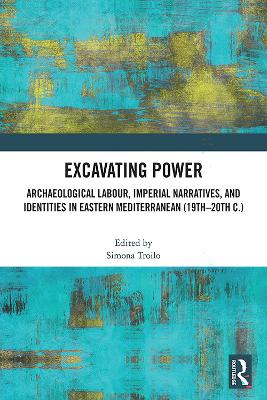
This book analyses archaeological excavations and the use of antiquities in the eastern Mediterranean from a unique and original perspective, that of power relations built on the vestiges of the past. Starting with Egypt, Crete, Palestine, Greece and Ottoman Empire.
This book analyses archaeological excavations and the use of antiquities in the eastern Mediterranean from a unique and original perspective, that of power relations built on the vestiges of the past. Starting with Egypt, Crete, Palestine, Greece and Ottoman Empire, the authors of the essays reconstruct the history of some European excavations in Ottoman and post-Ottoman times, bringing to light the marginalised actors and the different narratives shaped on antiquities. Men, women and children recruited locally to dig, guides and interpreters in the service of archaeologists are some of the protagonists of these stories, which allow us to go beyond European stereotypes and shed light on how local communities perceived and experienced the excavations. The narratives and interpretations applied to unearthed or restored antiquities also help us understand how traces of the past were used to legitimise imperialism and reinforce identities based on ideas of cultural superiority and inferiority.
This interdisciplinary volume spans archaeology, colonial studies, Ottoman history, Mediterranean studies, and cultural anthropology, making it essential reading for students and researchers in Middle Eastern studies, museum studies, and heritage management and scholars examining the intersection of power, identity, and heritage.
The chapters in this book were originally published as a special issue of European Review of History.
Introduction: Digging in the Eastern Mediterranean: antiquities,
workforce and identities in Ottoman and post-Ottoman times
1. Condemned to
the Past: peasants, Orientalists, anthropologists and Egyptologists in late
nineteenth and early twentieth-century Egypt
2. Land, indigeneity and
archaeological ruins in Ottoman Palestine: the people of Beit Jibrin and the
Palestine Exploration Fund
3. Ghosts between the lines: local workers in
Italian archaeological excavations in Crete (18991910)
4. A tale of two
cities: Athens, Thessaloniki and the incorporation of Byzantium in the Greek
national imagination
5. Historia (non?) grata: Byzantine archaeology of
Istanbul during the First World War and the Allied occupation
Simona Troilo is Associate Professor of Contemporary History at the University of LAquila. She holds a PhD from the European University Institute (Florence) and is the author of numerous articles on archaeology and imperialism; the construction of "Otherness" through the remains of the past; the relationship between materiality, narrativity and visuality; the ideological use of colonial antiquities by Italian fascism; the restitution of archaeological finds to former colonies by the Italian Republic. Her last book is Pietre doltremare. Scavare, conservare, immaginare lImpero (18991940), Rome-Bari, Laterza, 2021.

 Lisainfo e-raamatute kohta