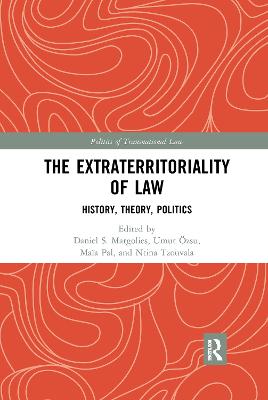
Questions of legal extraterritoriality figure prominently in scholarship on legal pluralism, transnational legal studies, international investment law, international human rights law, state responsibility under international law, and a large number of other areas. Yet many accounts of extraterritoriality make little effort to grapple with its thorny conceptual history, shifting theoretical valence, and complex political roots and ramifications.
This book brings together thirteen scholars of law, history, and politics in order to reconsider the history, theory, and contemporary relevance of legal extraterritoriality. Situating questions of extraterritoriality in a set of broader investigations into state-building, imperialist rivalry, capitalist expansion, and human rights protection, it tracks the multiple meanings and functions of a distinct and far-reaching mode of legal authority. The fundamental aim of the volume is to examine the different geographical contexts in which extraterritorial regimes have developed, the political and economic pressures in response to which such regimes have grown, the highly uneven distributions of extraterritorial privilege that have resulted from these processes, and the complex theoretical quandaries to which this type of privilege has given rise.
The book will be of considerable interest to scholars in law, history, political science, socio-legal studies, international relations, and legal geography.
Questions of legal extraterritoriality figure prominently in scholarship on legal pluralism, transnational legal studies, international investment law, international human rights law, state responsibility under international law, and a large number of other areas.
Arvustused
"This important collection is indispensable reading for any serious scholar investigating the extraterritorial application of law. Its multidisciplinary roster of authors embodies a wide range of fresh theoretical and political perspectives that bear on both historical issues and contemporary policy."
-- Teemu Ruskola, Jonas Robitscher Professor of Law, Emory University
"This rich and wide-ranging collection of essays invites us to think in new and radical ways about the relations between territory, sovereignty, jurisdiction, and power in law and history."
-- Anne Orford, Redmond Barry Distinguished Professor and Michael D. Kirby Chair of International Law, University of Melbourne
"This is a truly remarkable and wide-ranging collection that explores historical and contemporary extraterritorial legality. The chapters examine the complex nature of the relationship between territorial authority and extraterritorial applications of law, both analytically and theoretically. The analyses provide rich accounts of the projection of state sovereignty abroad, as a modality of state-building, imperialist rivalry, human rights promotion, and the global expansion of capitalism, and are of great interest to scholars of law, politics, and history."
-- A. Claire Cutler, Professor of Political Science, University of Victoria
Introduction
Daniel S. Margolies, Umut Özsu, Maļa Pal, Ntina Tzouvala
Part I
What Is Extraterritoriality?
1. Ways of Doing Extraterritoriality in Scholarship
John D. Haskell
2. In the Middle of Nowhere: The Futile Quest to Distinguish Territoriality
from Extraterritoriality
Péter D. Szigeti
3. Moving Beyond the E-word in the Anthropocene
Sara L. Seck
Part II
Constituting and Contesting Extraterritoriality
4. Early Modern Extraterritoriality, Diplomacy, and the Transition to
Capitalism
Maļa Pal
5. 'Uneven Empires': Extraterritoriality and the Early Trading Companies
Kate Miles
6. Protégé Problems: Qing Officials, Extraterritoriality, and Global
Integration in Nineteenth-Century China
Richard S. Horowitz
7. Drinking Water by the Sea: Real and Unreal Property in the Mixed Courts of
Egypt
Mai Taha
8. "And the laws are rude, crude and uncertain": Extraterritoriality and
the Emergence of Territorialised Statehood in Siam
Ntina Tzouvala
9. Imperial Reorderings in US Zones and Regulatory Regimes, 193450
Daniel S. Margolies
Part III
Extraterritoriality in the Contemporary World-System
10. The Interplay between Extraterritoriality, Sovereignty, and the
Foundations of International Law
Austen L. Parrish
11. Extraterritoriality as an Analytic Lens: Examining the Global Governance
of Transnational Bribery and Corruption
Ellen Gutterman
12. From Extraterritorial Jurisdiction to Sovereignty: The Annexation of
Palestine
Alice M. Panepinto
13. Extraterritoriality Reconsidered: Functional Boundaries as Repositories
of Jurisdiction
Ezgi Yildiz
Daniel S. Margolies is Professor and Chair of the History Department at Virginia Wesleyan University, US.
Umut Özsu is Assistant Professor of Law and Legal Studies at Carleton University, Canada.
Maļa Pal is Senior Lecturer in International Relations at Oxford Brookes University, UK.
Ntina Tzouvala is Laureate Postdoctoral Fellow in International Law at Melbourne Law School, Australia.

 Lisainfo e-raamatute kohta