“Could anyone possibly believe that writing doesn’t exist? It would be like denying the existence of rain.”
"Sergio Chejfec is an admirable writer." —Patti Smith
“Could anyone possibly believe that writing doesn’t exist? It would be like denying the existence of rain.”
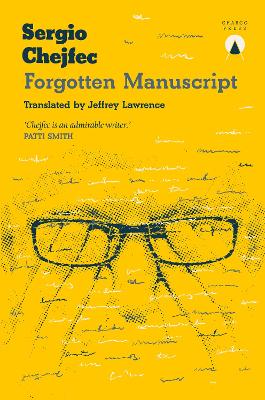
The perfect green notebook forms the basis for Sergio Chejfec’s work, collecting writing, and allowing it to exist in a state of permanent possibility, or, as he says, “The written word is also capable of waiting for the next opportunity to appear and to continue to reveal itself by and for itself.”
This same notebook is also the jumping off point for this essay, which considers the dimensions of the act of writing (legibility, annotation, facsimile, inscription, typewriter versus word processor versus pen) as a way of thinking, as a record of relative degrees of permanence, and as a performance. From Kafka through Borges, Nabokov, Levrero, Walser, the implications of how we write take on meaning as well worth considering as what we write. This is a love letter to the act of writing as practice, bearing down on all the ways it happens (cleaning typewriter keys, the inevitable drying out of the bottle of wite-out, the difference between Word Perfect and Word) to open up all the ways in which “when we express our thought, it changes.”
Arvustused
************ Praise for Sergio Chejfec "Sergio Chejfec is an admirable writer." Patti Smith
Chejfec's latest work should be treated as a significant event." Publisher's Weekly
"It is hard to think of another contemporary writer who, marrying true intellect with simple description of a space, simultaneously covers so little and so much ground. Times Literary Supplement
"I'd locate My Two Worlds among the rarae aves of recent fiction, among those books still capable of blazing new paths on the perilous trajectory of the modern novel." Enrique Vila-Matas
"This first novel by New York-based Argentine native Chejfec to be translated into English is a slim, gracefully discursive work....[ My Two Worlds] allows us to enter the thoughts of a restless intellectual whose streams of thought involve the reader in his quest to find meaning in everything he sees and does." Kirkus Reviews
"If genius can be defined by the measure of depth of an artists perception into human experience, then Chejfec is a genius." Coffin Factory
Sergio Chejfecs The Incompletes is a masterfully nested narrative where writingits presence on the page, its course through time, its prismatic dispersion of meaningis the true protagonist. Heather Clearys flawless translation adds yet another layer to this extraordinary palimpsest of a novel. Hernan Diaz
"This was one of Sergios great gifts as a writer: his ability to take the small, the fragmentary, and to reveal the worlds contained within." Heather Cleary, Lit Hub
"A beautifully baffling book about the peripatetic wanderings of your own mind through the hotels, hallways, and postcards of the protagonists, or about the instability hiding in every apparently solid building, or maybe even how you dont know an event is significant until some disconnected and celestial phenomenon illuminates it." Josh Cook , Porter Square Books
Sergio Chejfec was a fiction writer and essayist born in Argentina. Between 1990 and 2005 he lived in Caracas. He was writer in Residence in the M.F.A. Creative Writing program in Spanish at New York at the time of his death. His books include: Modo linterna (short fiction, 2013), La experiencia dramįtica (novel, 2012), Sobre Giannuzzi (essay, 2010), Mis dos mundos (novel, 2008), Baroni, un viaje (novel, 2007). He writes about memory, the idea of experience and urban perambulation. He has published various essays and short stories in diverse anthologies and collections. He has been translated into English, French, German, Turkish and Hebrew. He was a recipient of a Guggenheim Fellowship and a Resident of the Civitella Ranieri Foundation.
Jeffrey Lawrence is Associate Professor of English and Comparative Literature at Rutgers University, where he teaches modern U.S. and Latin American literature and culture. He is the author of Anxieties of Experience: The Literatures of the Americas from Whitman to Bolańo (Oxford, 2018) and the translator of Andrés Neumans How to Travel Without Seeing: Dispatches from the New Latin America (Restless Books, 2016). His work has appeared in the Los Angeles Review of Books , Public Books , Words Without Borders ,BOMB Magazine and The Puerto Rico Review as well as in numerous academic journals.

 Lisainfo e-raamatute kohta