Muutke küpsiste eelistusi

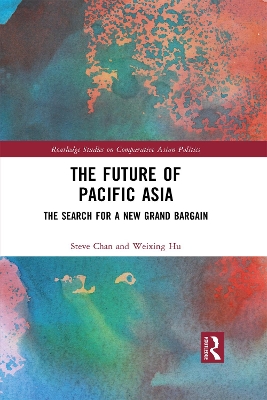
E-raamat: Future of Pacific Asia: The Search for a New Grand Bargain

  • Formaat - PDF+DRM
  • Hind: 59,79 €*
  • * hind on lõplik, st. muud allahindlused enam ei rakendu
  • See e-raamat ei ole veel ilmunud. Saate seda tellida alles alates: 17-Jun-2026
  • Lisa soovinimekirja
  • See e-raamat on mõeldud ainult isiklikuks kasutamiseks. E-raamatuid ei saa tagastada.

DRM piirangud

  • Kopeerimine (copy/paste):

    ei ole lubatud

  • Printimine:

    ei ole lubatud

  • Kasutamine:

    Digitaalõiguste kaitse (DRM)
    Kirjastus on väljastanud selle e-raamatu krüpteeritud kujul, mis tähendab, et selle lugemiseks peate installeerima spetsiaalse tarkvara. Samuti peate looma endale  Adobe ID Rohkem infot siin. E-raamatut saab lugeda 1 kasutaja ning alla laadida kuni 6'de seadmesse (kõik autoriseeritud sama Adobe ID-ga).

    Vajalik tarkvara
    Mobiilsetes seadmetes (telefon või tahvelarvuti) lugemiseks peate installeerima selle tasuta rakenduse: PocketBook Reader (iOS / Android)

    PC või Mac seadmes lugemiseks peate installima Adobe Digital Editionsi (Seeon tasuta rakendus spetsiaalselt e-raamatute lugemiseks. Seda ei tohi segamini ajada Adober Reader'iga, mis tõenäoliselt on juba teie arvutisse installeeritud )

    Seda e-raamatut ei saa lugeda Amazon Kindle's. 

This book examines the future of the Asia Pacific’s political economy and its security challenges for the next quarter century.

Featuring pertinent discussions on topics such as the ongoing Sino-American power transition and hedging behavior by various states in this vital region, it explains that while some important legacies will endure (such as China’s centrality in the region and continuing U.S. military dominance), other ongoing changes (such as the obsolescence of the Yoshida Doctrine and China’s displacement of the U.S. as the main economic partner for practically all countries in this region) suggest a more turbulent and unpredictable future. The book also explores the profound changes occurring in Chinese, Japanese, and U.S. domestic politics and their cascading effects on the rest of the region.

Highlighting how existing Western analytic categories are unable to fully capture the nuances of the Asia Pacific, this book will be a valuable resource to students and scholars of international relations and comparative politics interested in this region.


This book examines the future of the Asia Pacific’s political economy and its security challenges for the next quarter century.

Arvustused

Pacific Asia is a paradoxical region, simultaneously the world's most vibrant economic powerhouse and home to some of its most acute security flashpoints. Steven Chan and Weixing Hu's book arrives at a propitious moment, adeptly capturing this intricate dichotomy. It ventures boldly into the future, attempting to foresee the trends and events that will shape Pacific Asia over the next quarter-century. The authors' long-standing and in-depth engagement with the region's convoluted developments endows them with a unique vantage point. Their expertise makes them eminently qualified to undertake this challenging prediction. Despite the veil of uncertainty that shrouds Pacific Asia's future, the book brims with incisive insights. These demand a thorough, attentive read, as they offer invaluable perspectives on this pivotal part of the world.

Qingguo Jia, Professor and former Dean of School of International Studies, Peking University

The Future of Pacific Asia is an innovative and important book. The regions future stability and prosperity face challenges from Sino-American power shift, Sino-Japanese animosity, and the transformation of regional order. In this book, Chan and Hu offer a sophisticated account of structural and ideational variables shaping the future of Pacific Asia circa 2050. It is timely and a must-read for understanding the regions future.

Cheng Li, Professor and Founding Director of Centre on Contemporary China and the World, University of Hong Kong

The old order for Pacific Asia is unravelling. The transformation of the worlds center of economic, political, and military gravity and rising geopolitical rivalry are converging to augur a more uncertain and perhaps tumultuous Pacific Asia. Chan and Hus book provides a thought-provoking and nuanced understanding of future trends of regional international relations. It is a welcome and significant contribution to the study of Pacific Asia.

Mingjiang Li, Associate Dean (Academic Affairs) and Provost's Chair in International Relations, S. Rajaratnam School of International Studies, Nanyang Technological University

The future of Pacific Asia is central to global peace and prosperity in the twenty-first century. In this timely and perceptive book, two leading scholars illuminate how the regions great and middle powers are likely to interact, as old norms erode and new rivalries intensify. The authors analysis leads to sobering warnings about the strategic uncertainties ahead. The book is a timely wake-up call for scholars and policymakers alike.

Quan Li, Visiting Fellow, the Niehaus Center for Globalization and Governance, Princeton University, and Sara H. Lindsey Chair in the George Bush School of Government and Public Service, Texas A&M University

As Pacific Asia becomes the worlds strategic center, Chan and Hu challenge alarmist narratives, showing why peace has endured, why uncertainty is rising, and why a new grand bargain is essential a sharp and powerful read.

Xiaoyu Pu, Associate Professor, Department of Political Science, University of Nevada, Reno

1. Introduction: Our Concepts, Arguments, and Rationale for Studying
Pacific Asias Future
2. Differentiating Peace and Debunking Popular
Narratives on Deteriorating Sino-American Relations
3. Chinas Operational
Code and Its Policy Adaptations in Coping with the Incomparable United States
4. Other Pacific Asian Countries Conduct and Strategy
5. Conclusion:
Catching a Glimpse of Pacific Asias Future and Our Quarrels with the
Prevailing Discourse
Steve Chan is College Professor of Distinction (Emeritus) at the University of Colorado, Boulder. He has published twenty-eight books and over two hundred journal articles and book chapters.

Weixing Hu is UM Development Foundation Distinguished Professor and Dean of Faculty of Social Sciences at the University of Macau. Before joining UM in 2019, he was Professor and Head of Department of Politics and Public Administration at the University of Hong Kong.