Muutke küpsiste eelistusi

E-raamat: Gender, Climate Change and Disaster Resilience: An Asia-Pacific Perspective

Edited by , Edited by
  • Formaat: PDF+DRM
  • Sari: Disaster Risk Reduction
  • Ilmumisaeg: 22-Apr-2026
  • Kirjastus: Springer Verlag, Singapore
  • Keel: eng
  • ISBN-13: 9789819561889
  • Formaat - PDF+DRM
  • Hind: 147,58 €*
  • * hind on lõplik, st. muud allahindlused enam ei rakendu
  • Lisa ostukorvi
  • Lisa soovinimekirja
  • See e-raamat on mõeldud ainult isiklikuks kasutamiseks. E-raamatuid ei saa tagastada.
  • Formaat: PDF+DRM
  • Sari: Disaster Risk Reduction
  • Ilmumisaeg: 22-Apr-2026
  • Kirjastus: Springer Verlag, Singapore
  • Keel: eng
  • ISBN-13: 9789819561889

DRM piirangud

  • Kopeerimine (copy/paste):

    ei ole lubatud

  • Printimine:

    ei ole lubatud

  • Kasutamine:

    Digitaalõiguste kaitse (DRM)
    Kirjastus on väljastanud selle e-raamatu krüpteeritud kujul, mis tähendab, et selle lugemiseks peate installeerima spetsiaalse tarkvara. Samuti peate looma endale  Adobe ID Rohkem infot siin. E-raamatut saab lugeda 1 kasutaja ning alla laadida kuni 6'de seadmesse (kõik autoriseeritud sama Adobe ID-ga).

    Vajalik tarkvara
    Mobiilsetes seadmetes (telefon või tahvelarvuti) lugemiseks peate installeerima selle tasuta rakenduse: PocketBook Reader (iOS / Android)

    PC või Mac seadmes lugemiseks peate installima Adobe Digital Editionsi (Seeon tasuta rakendus spetsiaalselt e-raamatute lugemiseks. Seda ei tohi segamini ajada Adober Reader'iga, mis tõenäoliselt on juba teie arvutisse installeeritud )

    Seda e-raamatut ei saa lugeda Amazon Kindle's. 

Gender plays a crucial role in shaping the vulnerabilities and resilience of communities in the face of disaster risk and climate change. Women, men, and gender minorities often experience the impacts of climate change and disasters differently due to existing social, economic, and cultural inequalities. For instance, women, especially in the Global South, often bear the brunt of climate-related disasters due to limited access to resources, decision-making power, and mobility. They are more likely to be affected by food insecurity, displacement, and health challenges following a disaster. Moreover, traditional gender roles can limit women's participation in disaster preparedness and response, further exacerbating their vulnerability. Despite these challenges, women also play a key role in building community resilience. They often lead in managing natural resources, advocating for sustainable practices, and organizing community-based disaster risk reduction (DRR) initiatives.


Integrating gender perspectives into climate change and DRR policies is essential for effective and equitable outcomes. This includes promoting women's leadership in disaster management, ensuring their access to resources and information, and addressing the specific needs of gender minorities. By recognizing and addressing these gendered dimensions, we can enhance the resilience of all community members and build more just and effective responses to climate change and disaster risk.


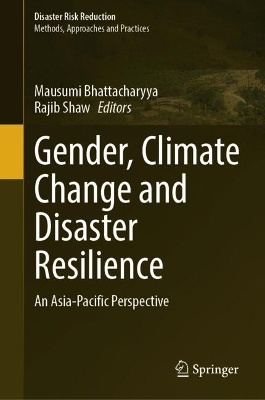
Based on the above, this book provides an in-depth analysis of the current practices, challenges and future potentials of gender integration in disaster resilience and climate change adaptation. Drawing lessons from Asia Pacific regions, the book covers best practices, challenges and potentials. Overall, this book is a valuable resource for students, researchers, academia, policymakers and development practitioners.
Gender, Climate Change and Disaster Resilience: An Asia Pacific
Overview.- Gender-Sensitive Communication Strategies for Climate Change.-
Revolutionising Climate Resilience: Gender-Responsive Solutions in
Asia-Pacifics Environmental Emergency.- Gender Transformative Strategies for
Socio-Ecological Transformation in Urban India.- Disasters as Structural
Violence: Integrating Indigenous Resistance and Knowledge in Flood Management
(Majuli and Bihar).
Dr. Mausumi Bhattacharyya is an associate professor and currently in charge of the Centre for Journalism and Mass Communication in India. She has 24 years of teaching and research experience. She holds a masters degree and Ph.D. in journalism and mass communication from the University of Calcutta. She has been awarded prestigious fellowships, including the ICSSR Post-Doctoral Fellowship at Jamia Millia Islamia and a research grant from IAWRT-FOKUS, Norway. Her expertise spans new media, gender and communication, and public relations. She contributed to national initiatives including the MHRD's 'National Mission on Education through ICT.' She is also a recipient of the SUSI fellowship, a prestigious program by the U.S. Government, and was nominated to represent India at the 'International Learning Project for Shaping Globalization' held in Bonn, Germany, in 2010.


Rajib Shaw is a professor in the Graduate School of Media and Governance in Keio University, Japan. His expertise includes disaster governance, community-based disaster risk management, climate change adaptation, urban risk management, and disaster and environmental education. Professor Shaw was the chair of the United Nations Science Technology Advisory Group (STAG) for disaster risk reduction and currently is the co-chair of the Asia Pacific Science Technology Academic Advisory Group (AP-STAG). He is also the coordinating lead author (CLA) for the Asia chapters 6th Assessment Report of the Intergovernmental Panel on Climate Change (IPCC). He is the editor-in-chief of the journal Progress in Disaster Science and series editor of a Springer book series on disaster risk reduction. Prof. Shaw has published 89 books and over 450 academic papers and book chapters. He is the recipient of prestigious Pravasi Bharatiya Samman Award (PBSA) in 2021 for his contribution in education sector. He also received United Nations Sasakawa Award in 2022 for his lifetime contributions in the field of disaster risk reduction.