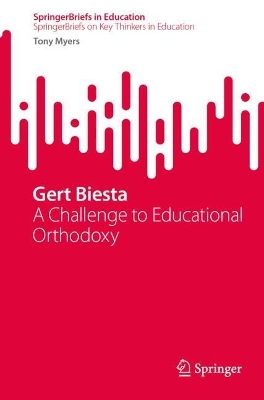
This book focuses on the work of Dutch educational philosopher Gert Biesta. It offers a comprehensive exploration of his revolutionary ideas, guiding readers through his critique of contemporary educational thought and his alternative vision for education. By engaging with Biesta's work, we are invited to grapple with fundamental questions about the nature and purpose of education in the twenty-first century. What does it mean to be educated? What is the role of the teacher? How can education contribute to a more democratic society?
The book illuminates a different approach to the key question underpinning all of Biestas work: what is the purpose of education? It pays particular attention to unpicking the more abstruse areas of his work, in order to make it more accessible to practitioners who are attracted to the general tenor of Biestas work but find some of the philosophical discussions hard to digest.
This book will be beneficial to researchers, educators, policymakers, or readers interested in the future of education. At the end of it, readers will have been introduced to the key ideas of one of the most original and challenging voices in contemporary educational philosophy, as well as being able to identify exactly what it is that bothers them about modern schools and universities, and how those issues might be addressed.
Introduction.- 1 What is Education for?.- 2 Beyond 'What Works'?
Challenging the Effectiveness Agenda.- 3 The Weakness of Education: Embracing
Risk in a Culture of Control.- 4 The Return of Teaching as an Interruptive
Event.- 5 Rethinking Emancipation: From 'Learning From' to 'Being Taught
by'.- 6 World-Centred Education: Beyond the Limits of Constructivism.- 7 The
Future of Education: Towards a Democratic and Public Conception.
Tony Myers is Assistant Professor at Zayed University with over 20 years of experience in the education sector, teaching across Europe, Asia, and the Gulf. He has published on a number of topics, including philosophy, education, and literature, including writing books on Slavoj Zizek, and genres in IT. His interest in the work of Gert Biesta stems from his own experience as a practitioner in the classroom and a wish to foster a better educational climate for those he teaches.

 Lisainfo e-raamatute kohta