Muutke küpsiste eelistusi

E-raamat: Globalising Everyday Consumption in India: History and Ethnography

Teised raamatud teemal:
  • Formaat - PDF+DRM
  • Hind: 54,59 €*
  • * hind on lõplik, st. muud allahindlused enam ei rakendu
  • Lisa ostukorvi
  • Lisa soovinimekirja
  • See e-raamat on mõeldud ainult isiklikuks kasutamiseks. E-raamatuid ei saa tagastada.
Teised raamatud teemal:

DRM piirangud

  • Kopeerimine (copy/paste):

    ei ole lubatud

  • Printimine:

    ei ole lubatud

  • Kasutamine:

    Digitaalõiguste kaitse (DRM)
    Kirjastus on väljastanud selle e-raamatu krüpteeritud kujul, mis tähendab, et selle lugemiseks peate installeerima spetsiaalse tarkvara. Samuti peate looma endale  Adobe ID Rohkem infot siin. E-raamatut saab lugeda 1 kasutaja ning alla laadida kuni 6'de seadmesse (kõik autoriseeritud sama Adobe ID-ga).

    Vajalik tarkvara
    Mobiilsetes seadmetes (telefon või tahvelarvuti) lugemiseks peate installeerima selle tasuta rakenduse: PocketBook Reader (iOS / Android)

    PC või Mac seadmes lugemiseks peate installima Adobe Digital Editionsi (Seeon tasuta rakendus spetsiaalselt e-raamatute lugemiseks. Seda ei tohi segamini ajada Adober Reader'iga, mis tõenäoliselt on juba teie arvutisse installeeritud )

    Seda e-raamatut ei saa lugeda Amazon Kindle's. 
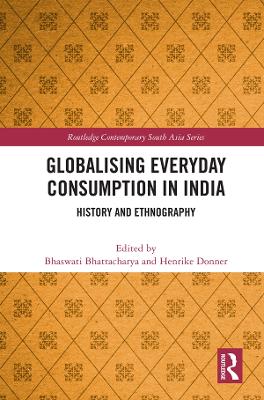
This book brings together historical and ethnographic perspectives on Indian consumer identities.

Through an in-depth analysis of local, regional, and national histories of marketing, regulatory bodies, public and domestic practices, this interdisciplinary volume charts the emergence of Indian consumer society and discusses commodity consumption as a main feature of Indian modernity.

Nationalist discourse was shaped by moral struggles over consumption patterns that became a hallmark of middle-class identity. But a number of chapters demonstrate how a wide range of social strata were targeted as markets for everyday commodities associated with global lifestyles early on. A section of the book illustrates how a new group of professionals engaged in advertising trying to create a market shaped tastes and discourses and how campaigns provided a range of consumers with guidance on ‘modern lifestyles’. Chapters discussing advertisements for consumables like coffee and cooking oil, show these to be part of new public cultures. The ethnographic chapters focus on contemporary practices and consumption as a main marker of class, caste and community. Throughout the book consumption is shown to determine communal identities, but some chapters also highlight how it reshapes intimate relationships. The chapters explore the middle-class family, microcredit schemes, and metropolitan youth cultures as sites in which consumer citizenship is realised.

The book will be of interest to readers from a range of disciplines, including anthropology, history, geography, sociology, South Asian studies, and visual cultures.


This book brings together historical and ethnographic perspectives on Indian consumer identities.

Arvustused

"This fascinating and important collection of essays provides a timely corrective to social sciences approaches to the study of Indian culture and society. Any contemporary understanding of Indian modernity caste, class, gender, intimacies, religiosity, citizenship, etc. is incomplete without an understanding of how consumer cultures shape everyday lives. Focussing on both the colonial and post-colonial periods, the books contributors lucidly outline the multiple publics imagined by advertising as well as how people construct identities through varied acts of consumption."

Sanjay Srivastava, British Academy Global Professor, University College London

"This collection of articles, with a well written introduction, is an important contribution to the analysis of the process of growth and working of consumer capitalism in contemporary India. The major strength of this collection is its focus on a deep, as well as immediate, historical perspective behind complex intertwining social fields: production practices, market cultures and consumer choices. Well-informed by western sociological theories, the contributors have underlined the making and transformation of consumer culture from the restricted horizon of colonial environment to the glittering world of mass consumption and mass culture with its necessary predicaments."

Gautam Bhadra, Honorary Professor at the Centre For Studies in Social Sciences, India

Introduction
1. Notes on the advertisement and the advertising agency in
Indias twentieth century
2. A magic system? Print publics, consumption, and
advertising in modern Tamil Nadu
3. Making the ideal home? Advertising of
electrical appliances and the education of the middle-class consumer in
Bombay, 1925-40
4. Wooing Indians with new smokes: cigarette and bidi
advertising in British India
5. Creating desire in the name of the nation,
1947-65
6. Consuming the home: creating consumers for the middleclass house
in India, 1920-60
7. Drink it the damn way we want: some reflections on the
promotion and consumption of coffee in India in the twentieth century.
8. The
Housewife goes to Market: Food, Work, and Neoliberal Selves in Kolkata
Middle-class Families
9. Consumer citizenship and Indian Muslim youth
10.
Consuming credit: microfinance and making credit markets at the bottom of the
pyramid
Bhaswati Bhattacharya is a Senior Fellow at the Centre for Modern Indian Studies at Georg August University, Göttingen, Germany. She is the author of Much Ado over Coffee (Social Science Press and Routledge 2017).

Henrike Donner is Reader in Social Anthropology at Goldsmiths, University of London, UK. She is the author of Domestic Goddesses (Routledge 2008) and has edited The Meaning of the Local (with Geert De Neve, Routledge 2006) and Being Middle-class in India (Routledge 2011).