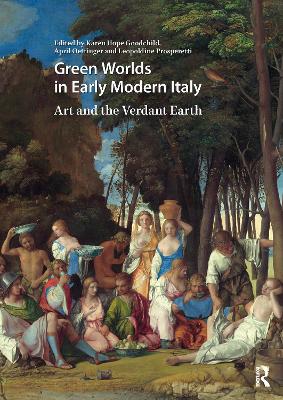
The green mantle of the earth! This metaphor is a poetic image that borrows from the vocabulary of weaving and epitomizes the Renaissance interest in "fashioning green worlds" in art and poetry. Here it serves as a motto for a cultural poetics that made representing living nature increasingly popular across Italy in the Early Modern period. The explosion of landscape art in this era is often associated with the rise of interest in the literary pastoral, narrowly defined, but this volume expands that understanding to show Greens broad appeal as it intrigued audiences ranging from the ecclesiastic to the medical and scientific to the humanistic and courtly. The essays gathered here explore the expanding technologies and varied cultural dimensions of verzure and verdancy in the Italian Renaissance, and thus the role of visual art in shaping the poetics and expression of greenery in the arts of the 16th-century and beyond.
|
List of Plates and Figures |
|
|
7 | (10) |
| Introduction: A Fresh Vision of the Natural World in Renaissance Italy |
|
17 | (14) |
|
|
|
|
|
|
|
Part I Devotional Viridescence |
|
|
|
1 The Green Places of Fra Filippo Lippi and Sandro Botticelli |
|
|
31 | (18) |
|
|
|
2 Anthropomorphic Trees and Animated Nature in Lorenzo Lotto's 1509 St. Jerome |
|
|
49 | (20) |
|
|
|
3 `Honesta voluptas': The Renaissance Justification for Enjoyment of the Natural World |
|
|
69 | (20) |
|
|
|
|
|
|
4 "The Sata delle Asse as Locus Amoenus: Revisiting Leonardo da Vinci's Arboreal Imagery in Milan's Castello Sforzesco" |
|
|
89 | (20) |
|
|
|
5 Naturalism and Antiquity, Redefined, in Vasari's Verzure |
|
|
109 | (22) |
|
|
|
6 Verdant Architecture and Tripartite Chorography: Toeput and the Italian Villa Tradition |
|
|
131 | (24) |
|
|
|
Part III The Sylvan Exchange |
|
|
|
|
|
155 | (20) |
|
|
|
8 From Venice to Tivoli: Girolamo Muziano and the `Invention' of the Tiburtine Landscape |
|
|
175 | (22) |
|
|
|
9 Of Oak and Elder, Cloud-like Angels, and a Bird's Nest: The Graphic Interpretations of Titian's The Death of St. Peter Martyr by Martino Rota, Giovanni Battista Fontana, Valentin Lefebre, John Baptist Jackson, and their Successors |
|
|
197 | (20) |
|
|
|
10 The Verdant as Violence: The Storm Landscapes of Herman van Swanevelt and Gaspard Dughet |
|
|
217 | (24) |
|
|
| Afterword: A Brief Journey Through the Green World of Renaissance Venice |
|
241 | (14) |
|
|
| Works Cited |
|
255 | (22) |
| Index |
|
277 | |
Karen Hope Goodchild is Chapman Professor and Chair of Art History at Wofford College in Spartanburg, South Carolina. She has recently published articles on landscape theory, Giorgio Vasari, Piero di Cosimo, and Agnolo Bronzino, and her research has appeared in scholarly journals including Artibus et Historiae and Source, as well as in the Ashgate Research Companion to Giorgio Vasari (2016). Her current work intersects with landscape and art theory, artist biography, literature, and gender. April Oettinger is Professor of Art History and Visual Culture at Goucher College in Baltimore, Maryland. Her recent publications, which have appeared in scholarly journals including Artibus et Historiae, The Journal of Word and Image, and Source, treat topics including the art of 16th-century Venetian painter Lorenzo Lotto and the 1499 edition of the Hypnerotomachia Poliphili. She is the recipient of grants from the National Endowment for the Humanities and the Center for Advanced Studies in the Visual Arts, National Gallery of Art, Washington, DC. Her current book project is titled, Animating Nature. Lorenzo Lotto and the Sublime Turn in 16th-Century Venetian Landscape Art, 1500-1550. Leopoldine Prosperetti is the author of Landscape and Philosophy in the Art of Jan Brueghel (Ashgate, 2009) as well as a number of scholarly articles. In 2002-03 she was a Fellow at the Center for Advanced Study in the Visual Arts, National Gallery of Art in Washington, DC, and has since taught at Goucher College and Towson University in Maryland. In fall 2016 she took up a position as Instructional Professor in the History of Art at the School of Art at the University of Houston. She is in the final stages of a book entitled Sylvan Moments: Woodland Imagery in European Art, a collection of essays on the poetics of woodlands in European art.

 Lisainfo e-raamatute kohta