Rooted in ancient traditions, spiritual journeys have long served as powerful catalysts for self-reflection, cultural understanding, and personal growth. With an emphasis on the cognitive transformation that often accompanies such travels, this contributed volume provides both historical context and practical advice to navigate the complex landscape of contemporary spiritual tourism.
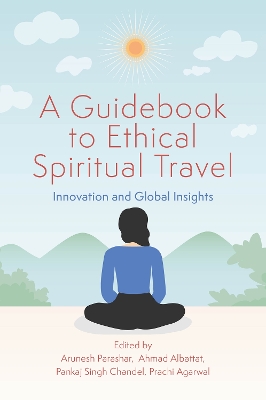
A Guidebook to Ethical Spiritual Travel: Innovation and Global Insights synthesises age-old teachings with modern perspectives, offering readers a comprehensive framework for travellers on meaningful spiritual journeys. By presenting case studies and practical guidance, it encourages mindfulness and intentionality in travel, while addressing critical challenges like cultural appropriation, sustainability, and the commercialisation of sacred sites. Aimed at both academics and industry professionals, the international team of authors emphasises the importance of respect, responsibility, and cultural sensitivity, fostering global empathy and personal transformation through well-guided spiritual exploration.
Introduction; Arunesh Parashar, Ahmad Albattat, Pankaj Singh Chandel,
and Prachi Agarwal
Chapter
1. Digital Media and Ethical Storytelling in Spiritual Travel:
Navigating Authenticity in a Globalized World; Rakesh Kumar, Rohit Jaiswal,
Pankaj Singh Chandel, Arunesh Parashar, Prachi Agarwal, and Amita
Chapter
2. Assessing the Economic and Cultural Significance of Religious
Tourism in Ayodhya; Animesh Kumar Sharma and Rahul Sharma
Chapter
3. Relevance and Ethical Guidance for Sun-Related Daily Practices as
an Indigenous Spiritual Technique In the Context of Nature-Based Health
Tourism; Bandana Kumari, Santosh Vishvakarma, Arunesh Parashar, and Prachi
Agarwal
Chapter
4. Spiritual Tourism in Haridwar: A Global Aspect; Ashish Dhyani,
Vinay Rana, Garima Dimri, Rajat Praveen Dimri, Archana Dhyani, and Sunil
Kumar Lal
Chapter
5. Faith vs. Trend: Understanding Tourist Motivations for Maha Kumbh
Mela; Ananya Mitra
Chapter
6. Harmonizing with Nature: Carving a Spiritual Relationship with the
Ecosystem through Laozis Principle of Wu Wei; Ridwan Ishola Mogaji, Adewale
Oluwaseun Motadegbe, and Abdullahi Adeyemi Adegoke
Chapter
7. Religion as Destination Attractiveness: A Study on Jammu & Kashmir
Tourism; Mariya Mushtaq, Anil Kumar Goyal, Tahir Sufi, and Hare Krishna
Chaudhary
Chapter
8. Digital Detox: The Pathway to Spiritual Travel; Amit Kumar
Chapter
9. The Future of Spiritual Tourism: Emerging Trends, Ethical
Innovations, and Global Perspectives; S.R. Ramesh K Kumar, Nammi Lalitha,
Santosh Kumar, Vijay Prakash Gupta, and Punjika Rathi
Chapter
10. Ethical and Voluntary Contributions in a Spiritual Context:
Insights from Shri Ram Janmabhoomi Teerth Kshetra, Ayodhya, India; Thangjam
Ravichandra, Nikita S Nille, Kalpana K Deshmukh, Deepali Singh, Punjika
Rathi, and Vijay Prakash Gupta
Chapter
11. Digital Disconnection in Travel: How Health Perceptions,
Technology Fatigue and Social Influence Shape Detox Behaviours; Abhay Chamoli
and Shashi Kant
Chapter
12. Ethical Souvenir Purchasing for Transforming Local Economy and
Preserving Tradition in Uttarakhand; Tanushree Lohani and Chhaya Shukla
Arunesh Parashar is an Associate Professor and Head of Department of Tourism and Travel Management at Dev Sanskriti Vishwavidyalaya, India.
Ahmad Albattat is an Associate Professor and Program Leader in School of Global Hospitality and Tourism, Asia Pacific University of Technology and Innovation, Malaysia.
Pankaj Singh Chandel is an Assistant Professor in the School of Hospitality and Tourism Management, AAFT University of Media and Arts, India.
Prachi Agarwal is an Assistant Professor in the Department of Tourism and Travel Management at Dev Sanskriti Vishwavidyalaya, India.

 Lisainfo e-raamatute kohta