Muutke küpsiste eelistusi

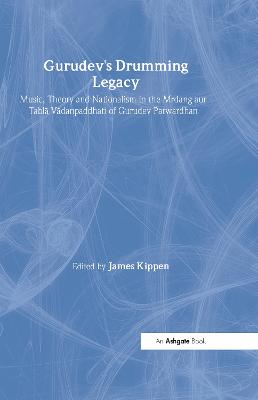
E-raamat: Gurudev's Drumming Legacy: Music, Theory and Nationalism in the Mrdang aur Tabla Vadanpaddhati of Gurudev Patwardhan

  • Formaat: EPUB+DRM
  • Sari: SOAS Studies in Music
  • Ilmumisaeg: 30-Mar-2022
  • Kirjastus: Routledge
  • Keel: eng
  • ISBN-13: 9781351564724
  • Formaat - EPUB+DRM
  • Hind: 55,89 €*
  • * hind on lõplik, st. muud allahindlused enam ei rakendu
  • Lisa ostukorvi
  • Lisa soovinimekirja
  • See e-raamat on mõeldud ainult isiklikuks kasutamiseks. E-raamatuid ei saa tagastada.
  • Raamatukogudele
  • Formaat: EPUB+DRM
  • Sari: SOAS Studies in Music
  • Ilmumisaeg: 30-Mar-2022
  • Kirjastus: Routledge
  • Keel: eng
  • ISBN-13: 9781351564724

DRM piirangud

  • Kopeerimine (copy/paste):

    ei ole lubatud

  • Printimine:

    ei ole lubatud

  • Kasutamine:

    Digitaalõiguste kaitse (DRM)
    Kirjastus on väljastanud selle e-raamatu krüpteeritud kujul, mis tähendab, et selle lugemiseks peate installeerima spetsiaalse tarkvara. Samuti peate looma endale  Adobe ID Rohkem infot siin. E-raamatut saab lugeda 1 kasutaja ning alla laadida kuni 6'de seadmesse (kõik autoriseeritud sama Adobe ID-ga).

    Vajalik tarkvara
    Mobiilsetes seadmetes (telefon või tahvelarvuti) lugemiseks peate installeerima selle tasuta rakenduse: PocketBook Reader (iOS / Android)

    PC või Mac seadmes lugemiseks peate installima Adobe Digital Editionsi (Seeon tasuta rakendus spetsiaalselt e-raamatute lugemiseks. Seda ei tohi segamini ajada Adober Reader'iga, mis tõenäoliselt on juba teie arvutisse installeeritud )

    Seda e-raamatut ei saa lugeda Amazon Kindle's. 

Kippen (music, U. of Toronto, Canada) provides a translation of the Mrdang aur Tabla Vadanpaddhati, a manual of drum playing in North Indian music from 1903, and also considers its ideas (and the later edition's) and its differences from traditional Hindustani rhythmic theory. In addition to the history and context of the text, he also discusses changes in the 1938 edition made by Gurudev's nephew, Vinayakrao Patwardhan, and includes translations of those changes. Further discussed are the notation system and repertoire in the manual. An index of compositions is included. Annotation ©2007 Book News, Inc., Portland, OR (booknews.com)

The 1903 Mrdang aur Tabla Vadanpaddhati is a revelatory text that has never been translated or analysed. It is a manual for playing the two most important drums of North Indian (Hindustani) music, the pakhavaj (mrdang) and the tabla. Owing to its relative obscurity, it is a source that has never been discussed in the literature on Hindustani music. Its author, Gurudev Patwardhan, was Vice Principal of V.D. Paluskar's first music school in Lahore from its inception in 1901 to 1908. Professor James Kippen provides the first translation of this immensely important text and examines its startling implications for rhythmic and metric theory. It is the earliest work on Indian drumming to contain a notation sufficiently precise to allow definitive reconstruction. The compositions are of considerable musical interest, for they can be readily realized on the tabla or pakhavaj. Kippen sets the work and objectives of the original author in the context of a rich historical, social and political background. By also discussing radical differences in the second edition of 1938, published by Gurudev's nephew, the vocalist Vinayakrao Patwardhan, Kippen illuminates the process by which 'tabla theory' was being created in the early 20th century. Both Patwardhans were enthusiastic supporters of Paluskar's nationalist imperatives, and active participants in his drive to institutionalize music, codify and publish notations of it, and promote a modern, Hindu vision of India wherein its identity could once again be linked to a glorious golden age in distant antiquity.

Arvustused

'As a whole, this book will be of use to historians searching for a musically grounded view on the transformations taking place in the theory, practice, and representation of Hindustani music in the twentieth century. It will enrich the understanding of south Asian music scholars in the emergence of today's common practice on the tabla. It is also a model of modern ethnomusicological scholarship in south Asia, combining careful archival research, close readings of texts, versatility in the language and terminology of relevant treatises, and a toolbox of musical expertise built from practical performance experience and some thirty years engagement with India as a field researcher.' Asian Ethnology

List of Figures
viii
List of Tables and Maps
ix
Preface x
Acknowledgments xii
Notes on Orthography and Translation xiii
Part 1 Music, Theory and Nationalism in the Mrdang aur Tabla Vadanpaddhati
1(184)
Introduction
3(10)
The Mrdang aur Tabla Vadanpaddhati
3(4)
A brief historical note on pakhavaj and tabla
7(6)
Gurudev, Paluskar and the History and Context of the Mrdang aur Tabla Vadanpaddhati
13(24)
Gurudev Patwardhan
13(6)
Paluskar's quest
19(6)
Lahore, and the establishment of the Gandharva Mahavidyalaya
25(2)
Gurudev's and Paluskar's work in Lahore
27(8)
Gurudev's return to Bombay and Miraj
35(2)
Vinayakrao and the Mrdang-Tabla Vadanpaddhati
37(8)
Vinayakrao's formative years
37(3)
Vinayakrao's career
40(5)
The Structure, Contents and Language of the Editions
45(6)
Notation
51(24)
The origins of Gurudev's notation
51(1)
Paluskar's search for a notation system
51(2)
The development of notation in Calcutta and Baroda
53(10)
Paluskar's notation system
63(3)
Gurudev's notation system
66(3)
The notation system used for the transcriptions in this study
69(5)
Vinayakrao's notation system
74(1)
Hindustani Rhythmic Theory
75(24)
Tal and theka
75(9)
Towards an explanation of tal's incongruities
84(6)
The folk roots of tabla thekas
90(4)
Lay
94(3)
Conclusion
97(2)
Gurudev's Rhythmic Theory
99(14)
Lay, tal and theka
100(8)
Formal theory
108(4)
Conclusion
112(1)
Vinayakrao's Rhythmic Theory
113(18)
Vinayakrao and the das mukhya ang of tal (tala dasa prana)
114(4)
Vinayakrao on tal and theka
118(9)
Vinayakrao on lay
127(2)
Vinayakrao on instruments and strokes
129(1)
Conclusion
130(1)
The Repertoire
131(48)
Tabla repertoire
132(32)
Theka and badla hua theka
133(4)
Gat
137(13)
Rela
150(5)
Gatparan
155(5)
Mohra
160(4)
Pakhavaj repertoire
164(11)
Theka and badla hua theka
164(2)
Sath
166(5)
Gatparan
171(3)
Rela
174(1)
Vinayakrao's repertoire
175(2)
Conclusion
177(2)
Conclusion
179(6)
Part 2 Translation of the Mrdang aur Tabla Vadanpaddhati (1903) by Gurudev Patwardhan
185(94)
Part 3 Translation of New Material from the Mrdang-Tabla Vadanpaddhati (1938/1982) as edited by Vinayakrao Patwardhan
279(34)
Appendix 1: Translation of the Preface to Sangit Balbodh (vol. 1, 1901) by Vishnu Digambar Paluskar 313(2)
Appendix 2: List of Compositions 315(8)
Bibliography 323(8)
Index 331


James Kippen is Professor at the Faculty of Music, University of Toronto, Canada.