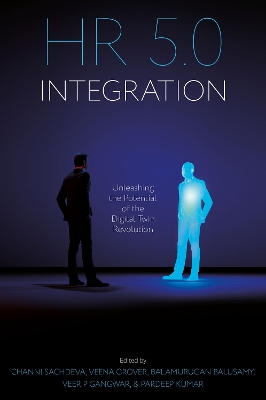
HR 5.0 Integration: Unleashing the Potential of the Digital Twin Revolution encapsulates the transformation of Human Resources (HR) through Digital Twin technology. The book provides numerous practical strategies and case studies for implementing Digital Twin technology to revolutionize organizational efficiency, agility, and competitiveness in the digital age.
Digital Twins, or virtual replicas of physical assets or processes, is a technology which could revolutionize HR practices through real-time monitoring, analysis, and simulation of workforce dynamics, to model employees and their interactions within the organisation. By leveraging data analytics and machine learning, HR 5.0 optimizes talent acquisition, enhances employee engagement, predicts future trends, fosters personalised employee experiences, facilitates skill development, and creates a culture of continuous improvement.
Covering the vast array of technological advancements, from ethical concerns such as data privacy, to case studies of organisational success, the book bridges theory and practice to drive HR innovation into the age of 5.0. Various HR functions such as recruitment, onboarding, learning and development, performance management, and workforce planning can all be rationalised by the creation and implementation of Digital Twins in HR, including AI, Internet of Things, data analytics, and privacy considerations.
Chapter
1. Digital twin technologies contributing towards the
advancement of HR 5.0: A bibliometric analysis; Namita Rath, Vishal Sood,
Alok Kumar Sahai, Swati Sood, Rushil Varma,an Christopher J. Rees
Chapter
2. The evolution of human resource management: From traditional
practices to digital twin-driven approaches; Ruchi Verma, Rashmi Mathur,
Saloni Pahuja, Pawan Kumar, and Sumesh Dadwal
Chapter
3. Digital twins in industry 5.0: A comprehensive review; Avtar
Singh, Mandeep Bhardwaj, and Dalwinder Kaur Dhillon
Chapter
4. Ethical implications of AI-driven digital twin in human resources
management; Rajat Bhattacharjee, Santujit Chanda, and Zareen Mazumder
Chapter
5. Designing a digital twin strategy for HR transformation; Babita
Bhati, Prachi Agarwal, and Hermine V. Poghosyan
Chapter
6. Enhancing employee onboarding through digital twin technology;
Priya Makhija, Elizabeth Chacko, Richa Tiwari, Ananda. S., and R Thanga Kumar
Chapter
7. Performance management transformation: Unleashing the potential of
digital twin technologies; Smita Singh, Garima Singhal, and Deepika Sharma
Chapter
8. Digital twin for employee engagement and satisfaction; Seema
Ghanghas, Ritu Garg, Poonam, and Shakeb Akhtar
Chapter
9. Improving workplace health and safety through digital twins; Seema
Ghanghas, Neha Arora, and Shakeb Akhtar
Chapter
10. Workforce planning and optimization with digital twin: Insights
from social media campaigns for sustainable development goals; Jahangeer
Ahmad Ganie, Damanpreet Singh, Yogesh Kumar, Christo Ananth, Mohammad
Shahparan, and Rakhmanov Buribay
Chapter
11. Challenges and ethical considerations in digital twin HR systems;
Manju Nandal, Navneesh Tyagi, Purnima Pal, and Channi Sachdeva
Chapter
12. Case studies: Real-world examples of digital twin integration in
HR; Kalyan Duvva, Hardeep Kaur, and Radhika Kiran Kumar
Chapter
13. Future trends and opportunities in HR 5.0: The road ahead; Shanul
Gawshinde, Kashish Ohri, Suruchi Pandey, Hemlata Vivek Gaikwad, and Sneha
Racheal Samuel Kutty
Channi Sachdeva is currently pursuing a PhD in Human Resource Management from Lovely Professional University, India.
Veena Grover is a Professor of Economics at Noida Institute of Engineering & Technology, India.
Balamurugan Balusamy is an Associate Dean of Students at Shiv Nadar University, Delhi-NCR, India.
Veer P. Gangwar is a Professor of Marketing at Lovely Professional University, India.
Pardeep Kumar is Pro-Vice Chancellor at Manav Rachna International Institute of Research and Studies, India.

 Lisainfo e-raamatute kohta